Why you need an automated blueprint takeoff software
How automated blueprint takeoff software like Kamai pulls quantities straight from your drawings, with fewer errors and faster turnaround on bids.

A 300-sheet commercial set lands in your inbox on a Tuesday, and the bid is due Friday. Somewhere in those sheets are the wall lengths, door counts, slab areas, and duct runs you need to price, scattered across architectural, structural, and MEP drawings at three different scales. Pulling all of that by hand is the job most estimators dread, and it is the job that automated blueprint takeoff software exists to absorb.
This post walks through what that software actually does, where manual takeoff breaks down, and how Kamai handles the extraction.
What is blueprint takeoff software?
Blueprint takeoff software pulls material quantities directly from architectural and engineering drawings. Instead of measuring and counting on paper or on screen, you feed it the drawing files, usually PDFs, and it returns structured quantity data: lengths, areas, volumes, and counts of the components on each sheet.
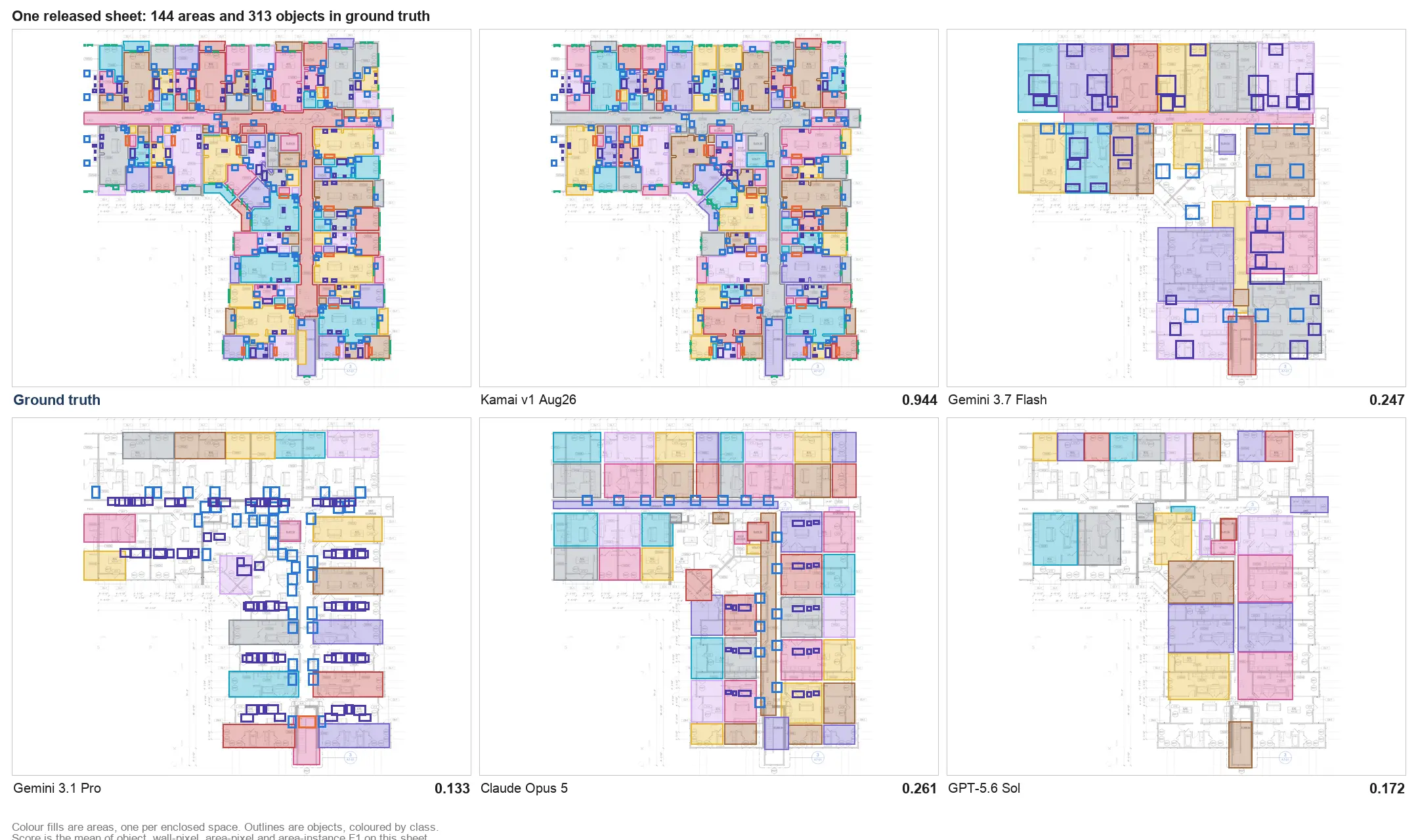
Automated takeoff goes further. Rather than waiting for you to trace every wall and click every fixture, Kamai's models read the drawing, recognize building elements, and produce the quantities for you. That turns a stack of raw sheets into data you can price, often in the time it used to take to set the scale and warm up.
Where manual takeoff breaks down
Anyone who has done takeoff by hand knows the failure modes. You set the wrong scale on a detail sheet and every dimension downstream is off. An addendum reissues the second-floor plan and the revised partition layout never makes it into your count. Two units share a demising wall and you bill it twice. None of these are exotic mistakes. They are the ordinary cost of tracing hundreds of sheets late at night against a deadline.
The deeper problem is time. On a large set, a careful estimator spends most of a bid window zooming, tracing, and tallying instead of pricing the work or sharpening the number. Add more projects to the queue and the math gets worse, because the only way to scale a manual process is to add people and hope accuracy holds. It rarely does at the same rate.
How automated takeoff works
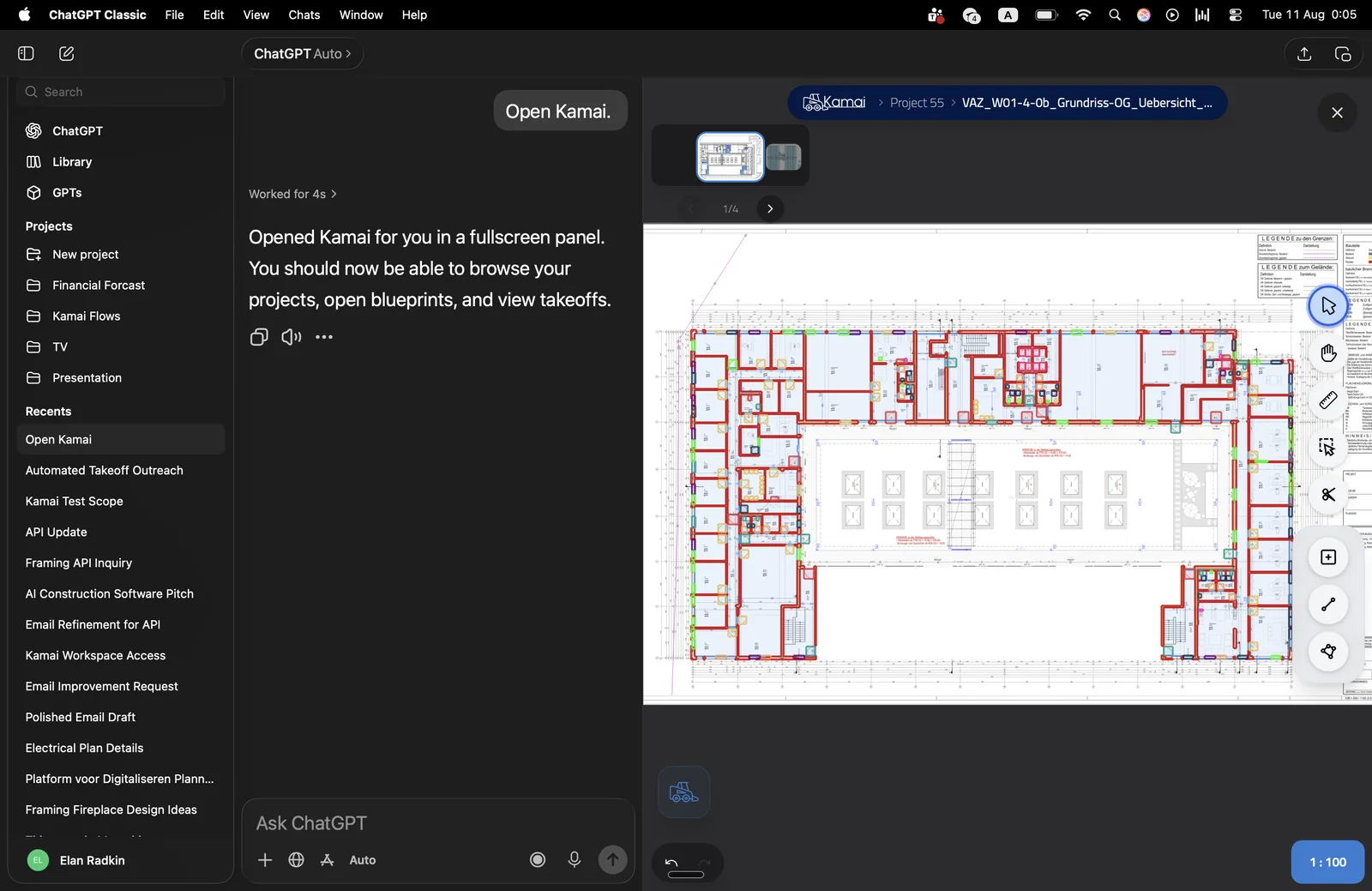
The workflow is short. You upload the drawing set, Kamai reads the sheets, and you get structured quantity data back. Behind that, computer vision and Kamai's trained models do the recognition: identifying walls, openings, fixtures, and the rest, then measuring them against the drawing scale.
The output is the part that matters. Quantities come back as structured data you can export to Excel or PDF, or pull programmatically as JSON through the API. It feeds an estimate, a report, or a project plan without anyone retyping a single number.
Kamai handles drawings across the trades that show up on a real set, structural, mechanical, electrical, and the finishing scopes, so a multi-discipline package does not turn into a multi-week project.
Accuracy you can defend
Consistency is where software has a real edge over a tired person with a mouse. Kamai applies the same measurement rules across every sheet, so a wall on sheet A-201 is counted the way a wall on A-208 is counted. That removes the drift that creeps into manual takeoff over a long set, and it cuts the missed elements and miskeyed dimensions that turn a winning bid into a money-loser during construction.
There is a business case underneath the technical one. A contractor who hands over a clean, well-structured quantity breakdown looks like a contractor who knows the job. That is the reputation that gets you invited back to bid.
Large sets and mixed trades
Complexity is exactly where manual methods stall. A high-rise core-and-shell package or an infrastructure job can run to hundreds of sheets with overlapping disciplines, and tracing that by hand is where weekends disappear.
Kamai is built for that volume. It processes large plan sets and organizes the quantities by trade, so structural steel, HVAC layouts, plumbing risers, and interior finishes come back sorted rather than piled together. When the set is big, that organization is half the value.
Working as a team, not a relay
Estimating is rarely a solo act. Estimators, project managers, engineers, and field staff all touch the same numbers. Kamai runs in the cloud, so the team views, updates, and shares takeoff data from one place instead of emailing spreadsheet versions back and forth. When an addendum drops, everyone is looking at the same current set, which is the difference between catching a change and pricing the old design.
For the estimator working through a tricky sheet, the in-app AI assistant is there to query the drawing and the extracted quantities directly, so a question about what is on a plan does not mean reopening the PDF and hunting.
From data entry to actual analysis
The point of automating takeoff is not just speed. It is moving your hours from collecting numbers to using them. Once the quantities are structured and trustworthy, you can run cost scenarios, test alternates, and find where a substitution or a resequencing actually saves money. That is the work that wins bids and protects margin, and it is the work that gets crowded out when takeoff eats the schedule.
It is also how a small estimating shop takes on more bids without hiring in lockstep. Kamai lets a team push more drawing sets through the same week, so growth stops being capped by how fast people can trace.
Why Kamai
Kamai converts a blueprint set into accurate, structured quantities and hands the estimator back the part of the job that requires judgment. The models do the extraction; you do the pricing, the strategy, and the call on what to bid.
It fits the tools you already use. Quantities export to Excel and PDF for the formats your team and clients expect, and the API lets you wire takeoff data straight into an existing estimating stack. The goal is not to replace your workflow but to take the slowest part of it off your plate.
The bottom line
Manual takeoff still works, the way a hand drafting board still works. But on the sets contractors are bidding now, the wrong scale, the missed addendum, and the double-counted wall cost real money, and the hours spent tracing are hours not spent on the estimate. Automated blueprint takeoff software fixes the slow, error-prone part and leaves the judgment with the estimator. For a shop bidding against the clock, that is the difference worth paying for.
Get the next post in your inbox.
Low frequency. High signal.