What is Takeoff API and How Has it Changed Construction Estimating?
What a takeoff API is, how it pulls quantities straight from your PDFs, and how Kamai folds takeoff into the tools estimators already use.

Most estimators have done a takeoff the old way at least once: a roll of drawings on the table, a scale rule, a highlighter, and a calculator running totals for slab area, linear feet of wall, and fixture counts off the plumbing sheets. It works, but it is slow, and it falls apart the moment an addendum lands or a sheet gets reissued at a different scale.
A takeoff API is what happens when you move that work behind software. Instead of a person clicking around a drawing, an application sends a set of plans to a service, gets back quantities, and keeps going. This post covers what that actually means, where it changes the day-to-day, and how Kamai's takeoff API fits in.
What a takeoff is, in plain terms
A construction takeoff is the count: how much of each material a project needs, measured straight off the drawings. Square footage of slab and roofing, linear footage of wall and trim, counts of doors, windows, fixtures, and devices. Those numbers feed the estimate, the procurement list, and the schedule. Get them wrong and the bid is wrong before anyone has priced a single line.
For decades the work was manual. You measured distances by hand, calculated areas, and counted elements off printed sheets, then logged it all in a spreadsheet. Accurate enough with a careful estimator, but it does not scale, and a single missed sheet or a wall counted on two adjacent plans can blow a number.
What a takeoff API is
A takeoff API is a software interface that lets another application request a takeoff and get structured data back. Rather than opening a standalone program and working a drawing by hand, a team builds the capability into the system they already run, whether that is estimating software, a project management platform, or an internal tool.
With Kamai's API, an application can:
- Upload digital drawings, typically PDFs
- Get back quantities - areas, lengths, and counts - pulled from the sheets
- Receive that data as structured JSON, not a flat image or a screenshot
- Push the results straight into estimating, reporting, or project management systems
The point is that the takeoff stops being a detour. The quantities show up where the next person needs them, in a format software can read.
From hand measurement to digital, then to integrated
Digital takeoff software was the first real shift away from paper. Working on-screen, an estimator could measure, calculate areas, and count with more precision than a scale rule allowed, and handle bigger sets without re-rolling drawings across a table.
The catch was that most of those tools were islands. You did the takeoff in one program, then exported and retyped or re-imported the numbers into wherever the estimate actually lived. Every handoff was a chance to transpose a figure or drop a quantity.
An API closes that gap. The takeoff happens inside the workflow instead of beside it, so the data does not get walked from one system to another by hand.
Where an API actually changes the work
Speed during bid season. When three bids are due the same week, the takeoff is the bottleneck. An API returns quantities in minutes, which is the difference between bidding a job and passing on it because there was no time to count it.
Consistency across a portfolio. Two estimators measuring the same garden-apartment plan by hand will disagree on the totals. Pulling the quantities the same way every time removes that drift, which matters most when you are bidding repeat building types.
Fewer transcription errors. Most takeoff mistakes are not measurement errors, they are handoff errors: a number typed wrong, a sheet skipped, a shared wall counted twice across two plans. Structured output that flows straight into the estimate cuts the steps where those creep in.
A single set of numbers. When estimators, project managers, and field teams pull from the same takeoff data rather than three private spreadsheets, there is one version to argue with instead of three.
How Kamai's takeoff API works
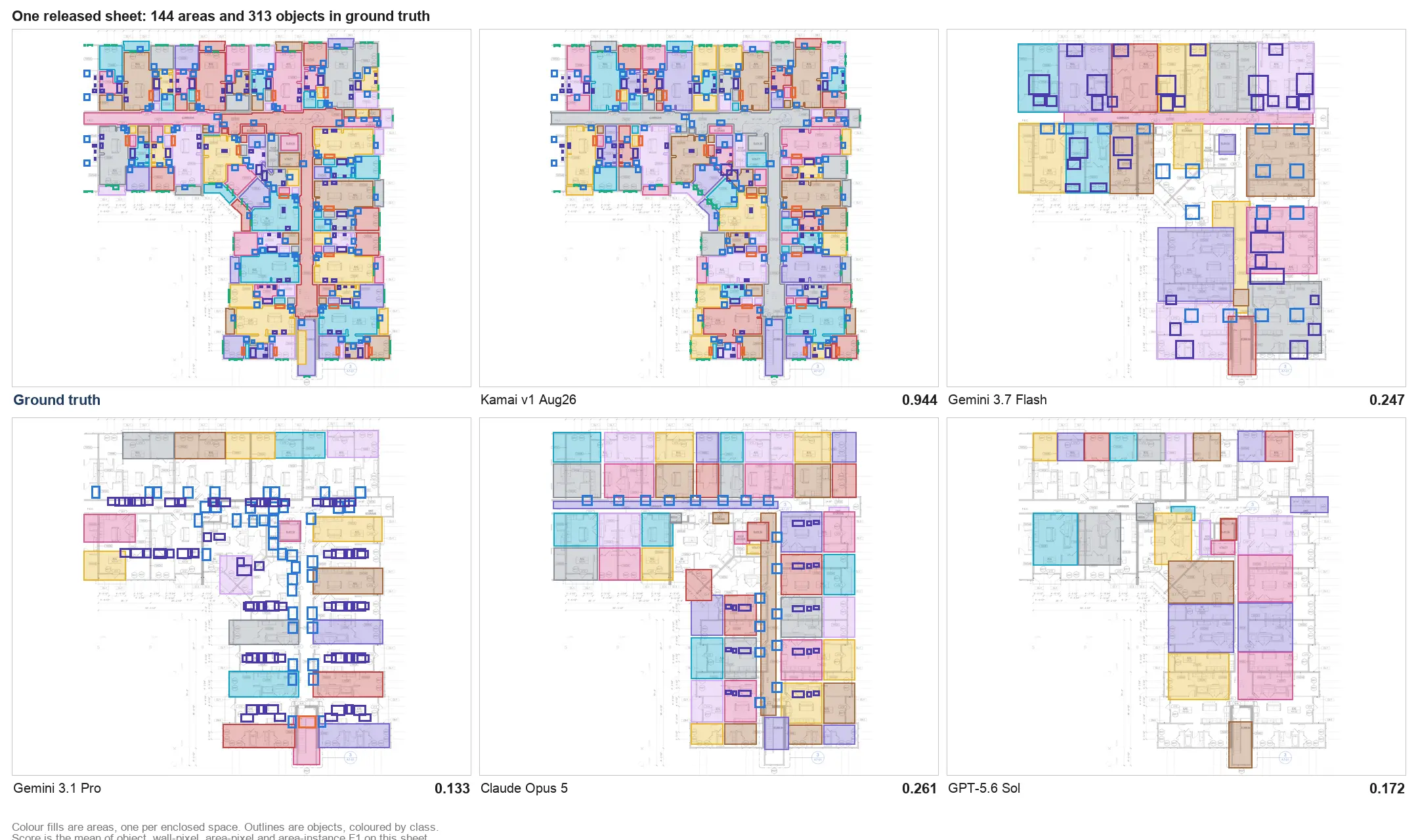
You send drawing files, usually PDFs. Kamai's models read the sheets - architectural, structural, MEP - and identify what is on them: walls, rooms, fixtures, devices, and the materials tied to them. From there it produces quantities and organizes them into structured datasets keyed to the elements they came from.
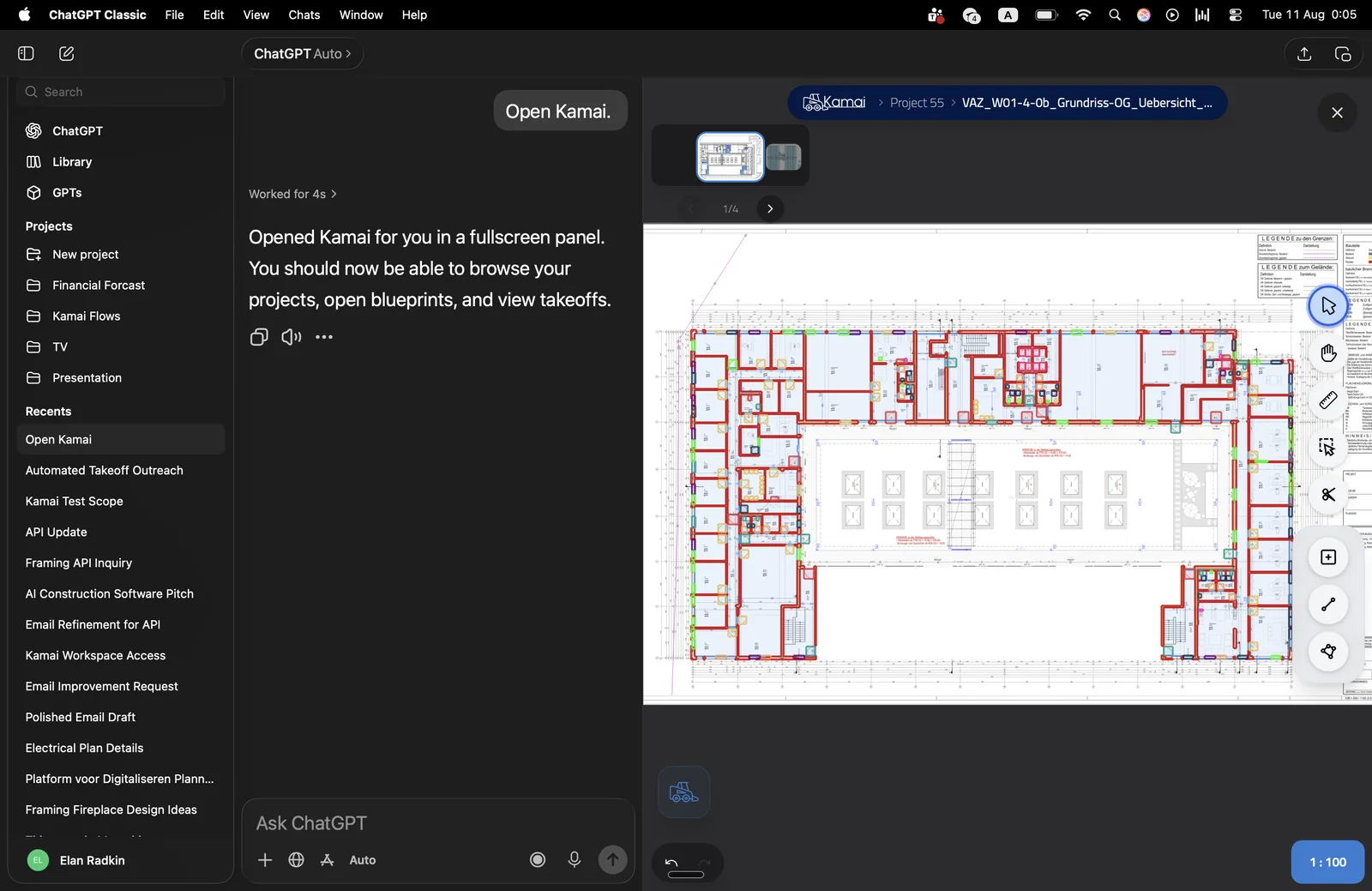
That output is the part that matters for an API. Because it comes back as structured JSON rather than an image, it drops directly into estimating systems, or you can export it to Excel or PDF when a person needs to read it. The same data is available in the app, where the Co-Pilot assistant lets an estimator ask questions about a takeoff and adjust it without re-measuring by hand.
Across the trades, Kamai handles the divisions estimators bid most: concrete and masonry, framing and finishes, doors and windows, and the MEP scopes. The goal is to take the rote counting off the estimator's plate so the time goes to scope, pricing, and the judgment calls software cannot make.
What it means for a construction business
The business case is not complicated. A faster takeoff means you can bid more work with the same staff. More consistent quantities mean budgets you can defend and fewer surprises when the actuals come in. And because the data is structured, it moves into the rest of your stack instead of dead-ending in a tool nobody else opens.
There is a longer arc here too. Once quantities are reliable, structured data, the next steps - historical cost comparison, flagging scope that changed between drawing revisions, sanity-checking a number against past jobs - become things software can help with instead of work an estimator does from memory. Kamai is built around that data, not around replacing the estimator.
So, what changed?
A takeoff API turns counting off a drawing from a standalone chore into something an application does and hands off in a usable format. For an estimator, that is fewer hours with a scale rule and fewer numbers retyped between systems. For a construction business, it is more bids out the door and quantities everyone can trust. That is the change, and it is why takeoff is moving from a manual step into part of the workflow rather than a stop along the way.
Get the next post in your inbox.
Low frequency. High signal.