What is a Construction Takeoff?
A construction takeoff is the count of every material a project needs, pulled from the drawings. Here is how it works and how Kamai automates it.

Before anyone prices a wall, someone has to know how many linear feet of it there are, how many doors swing into it, and how much drywall covers both faces. Counting and measuring all of that off the drawings is the takeoff, sometimes called a quantity or material takeoff, and it sits underneath every estimate, every bid, and every purchase order that follows.
Get it wrong and the rest of the job inherits the error. A missed sheet of structural steel or a wall counted twice because it's shared between two units doesn't show up until the numbers are already committed. That is why the takeoff is the part of preconstruction estimators sweat over most, and it's the part Kamai's models automate by reading the drawings and returning structured quantities.
What a takeoff actually does
A takeoff turns a set of plans into a list of quantities: square feet of slab, count of fixtures, cubic yards of concrete, linear feet of partition. Those numbers drive three decisions.
Pricing a bid. A bid is only as good as the quantities behind it. Guess high and the proposal loses to a sharper competitor; guess low and you win the job and eat the difference. Pulling counts directly off the sheets, rather than eyeballing them, is what keeps a bid both competitive and survivable. Kamai extracts those quantities from the blueprints so the number you submit is grounded in what's actually drawn.
Building the estimate. Quantities are the raw input; the estimate is what you do with them. Once you know there are 2,400 linear feet of metal stud partition, you layer on labor rates, material pricing, waste factors, and tax to reach a cost. The measuring is the tedious part, and it's the part Kamai handles, which frees the estimator to spend time on pricing and judgment calls instead of running a scale across a PDF.
Buying material. Takeoffs outlive the bid. When it's time to order, the same counts tell the super how much to buy. Order short and the crew stands around waiting on a delivery; order long and the surplus comes out of margin. Accurate quantities up front are what keep procurement off of guesswork.
Manual takeoffs versus digital
For decades the takeoff was a printed roll of drawings, a scale ruler, a highlighter, and a calculator. The estimator worked sheet by sheet, measuring walls, counting doors and windows, computing areas and volumes, and keying every result into a spreadsheet by hand.
The method works, but it's slow and it leaks. A full set can take hours or days, and the failure modes are well known to anyone who's done it: the wrong scale set at the start throws off every measurement after it, an addendum revision gets missed because it landed after the takeoff was "done," and shared walls between adjacent spaces get counted on both sides. Even a seasoned estimator drops items on a deadline.
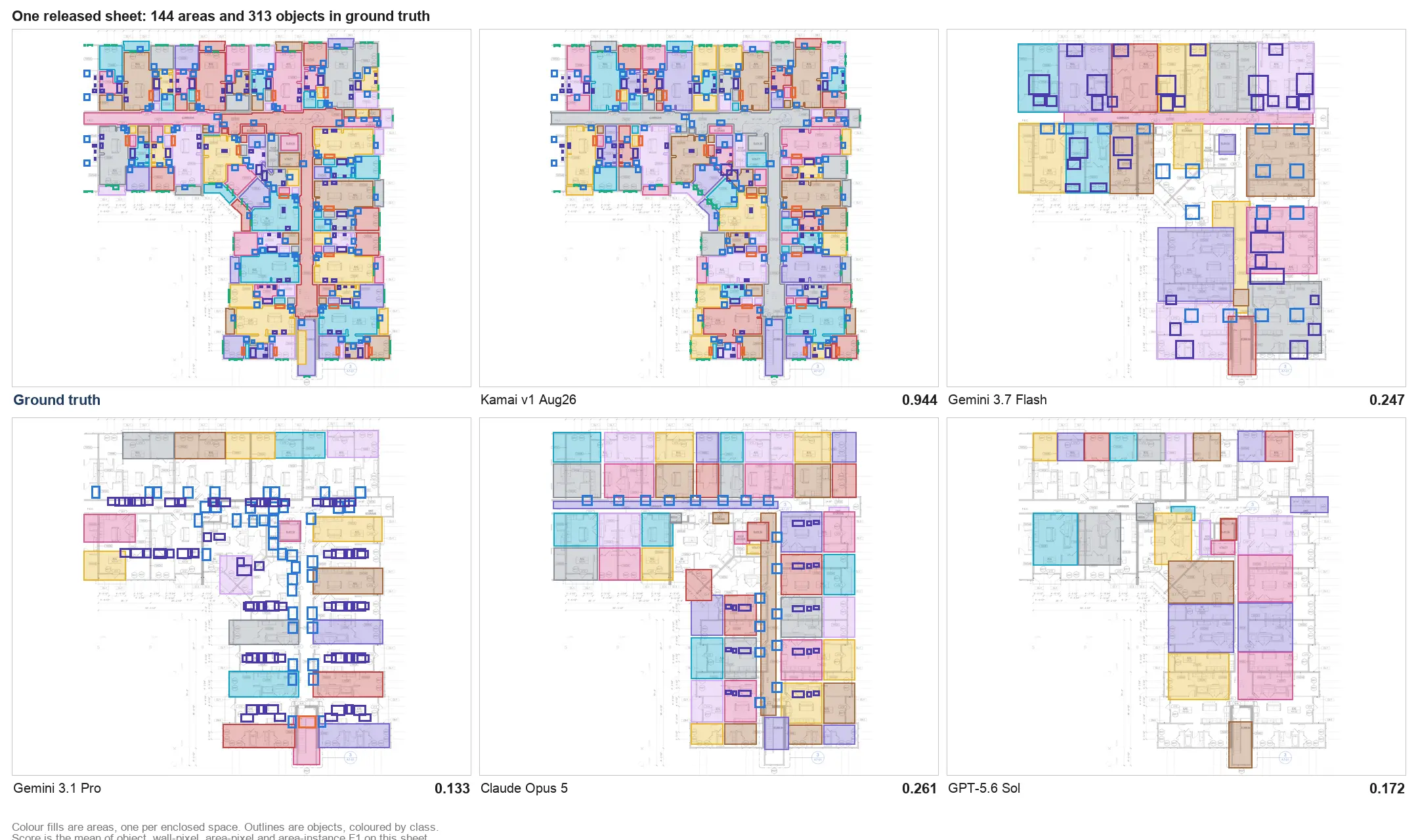
Digital takeoff removes the ruler from the loop. With Kamai, the estimator uploads the plan set and Kamai's models read the drawings and return quantities directly. The same project that took a day of measuring comes back in minutes, and because the extraction is consistent, the same set of drawings produces the same counts every time rather than varying by who happened to run it.
How the process works in Kamai
The workflow follows the same logic an estimator would, with the measuring automated.
Upload the drawings. Drop in the plan set as standard construction PDFs - architectural floor plans, elevations, sections, and the structural and MEP sheets that come with them.
Read the sheets. Kamai's models analyze the drawings and identify the elements that carry quantities: walls, floors, doors, windows, and the materials called out on them.
Calculate quantities. From those elements Kamai computes the numbers that feed an estimate - surface areas, volumes, counts, and material requirements.
Return structured data. The results come back as structured data rather than marks on a page. Export to Excel or PDF, or pull the underlying JSON through the API or MCP to move it into whatever estimating workflow you already run.
Estimate and buy. From there the quantities feed bids, estimates, and procurement the same way a manual takeoff would, minus the hours spent producing them.
If something looks off, the in-app AI assistant lets you interrogate the takeoff in plain language - ask why a count came out the way it did, or which sheet a quantity came from - instead of re-measuring to check the work.
Who does takeoffs
On most teams the estimator owns the takeoff: they produce the quantities and turn them into a cost estimate. But the work doesn't stay in one seat. Contractors run takeoffs to plan a job and order material, project managers lean on the same numbers to hold a budget and a schedule, and at a company level the whole bidding operation depends on getting these counts fast and right. Kamai shortens that cycle for all of them by handing back a structured takeoff instead of a stack of marked-up sheets.
What you get from automating it
The case for takeoff software is concrete, not abstract.
- Time back. A takeoff that ran hours or days by hand comes back in minutes, so estimators can chase more bids instead of fewer.
- Fewer dropped items. The mistakes that hurt most - a missed run, a double-counted shared wall, a math slip on a deadline - are exactly what gets removed when the measuring is automated.
- Consistency. The same drawings yield the same quantities regardless of who runs them, so a takeoff is repeatable rather than a function of one person's morning.
- One source of data. Because results are structured, a team works off the same quantities instead of reconciling three private spreadsheets, which cuts the back-and-forth before a bid goes out.
The problems it solves
Manual takeoffs fail in a few predictable ways, and each maps to something Kamai changes.
Human error creeps in through long sessions of measuring and rekeying; automating the extraction takes the calculator out of the estimator's hands. Tight bid windows force shortcuts; returning quantities in minutes gives those hours back. Big, complex sets - dense MEP sheets, multi-building campuses - are where manual counts bog down and slip; Kamai reads them the same way it reads a small plan. And the variance between two estimators counting the same job disappears when the counts come from one consistent source.
Why the takeoff is worth getting right
Everything downstream of the takeoff inherits its quality. The quantities set the cost, drive the material plan, shape the schedule, and ultimately decide whether the job clears a profit. When they're off, the symptoms show up later as overruns, delays, and margin that quietly evaporated.
That is the whole reason to automate the measuring rather than the judgment. Kamai's models do the counting from the drawings and hand back structured quantities; the estimator keeps the part that actually needs an estimator, which is deciding what the numbers mean.
Frequently asked questions
What is a construction takeoff?
It's the count of every material a project requires, measured from the drawings. Kamai produces it by reading the plan set and returning structured quantities.
Why does the takeoff matter?
It's the input to every estimate and bid. If the quantities are wrong, the price is wrong, which is why accuracy here pays off across the whole job.
Who performs takeoffs?
Usually estimators, but contractors and project managers work from the same quantities to plan jobs, order material, and hold budgets.
How long does a takeoff take?
By hand, hours to days depending on the size of the set. With Kamai, minutes.
Why use Kamai for takeoffs?
It removes the manual measuring while keeping the output in a form you can use - Excel or PDF exports, plus structured JSON through the API and MCP for teams that want to wire it into their own estimating workflow.
The bottom line
The takeoff is where an estimate is won or lost, because every number after it is built on the quantities it produces. Done by hand it's slow and easy to slip on; done by Kamai's models it comes back in minutes as structured data you can price against, order from, and stand behind on bid day.
Get the next post in your inbox.
Low frequency. High signal.