What Is 2D Takeoff and Why It Still Matters
2D takeoff measures quantities from PDF and CAD plans. Here is why it still drives most bids, and how Kamai turns those plans into structured data.

Walk into almost any preconstruction office and you will not find a connected BIM model waiting on the screen. You will find a folder of PDFs, maybe a few scanned sheets, and a bid due Friday. That gap between the industry's digital story and what actually lands in the estimator's inbox is the reason 2D takeoff is not going anywhere.
2D takeoff is the process of measuring quantities straight off two-dimensional drawings: PDFs, scanned blueprints, CAD exports. Residential, commercial, renovation, tender work, it is the same starting point. The drawings are what consultants issue, what gets emailed around, and what the field actually uses on a tablet. So the numbers still have to come out of them.
What 2D takeoff actually involves
You open the floor plans, the reflected ceiling plans, the sections and trade sheets, and you pull out everything that has to be priced. On a typical job that means flooring and ceiling areas, paintable wall surfaces, internal wall lengths, slab areas, perimeters, door and window counts, fixtures and outlets, pipe and duct runs, and room-by-room totals that roll up into the finish schedules.
It used to be a printed set, a scale ruler, colored markers, and a calculator. Plenty of teams now do it digitally, measuring right off the PDF. The tools change. The job does not: turn lines on a sheet into quantities you can stand behind on a bid.
Why 2D drawings still run the job
Everyone talks about model-based estimating. Most projects still open with a static set, and there are practical reasons for that.
- They are what you actually get. Even small and mid-size jobs ship 2D plans. For a lot of consultants, a PDF set is the standard tender and approval package.
- They move fast. A drawing set emails, uploads, prints, and shares without anyone needing the software that authored it.
- The detail lives in the notes. Legends, schedules, callouts, and annotations carry instructions that never make it into a model in any usable form.
- Bids come before models do. When a submission is due, a fully developed BIM model often does not exist yet. You get an early drawing package and a tight deadline.
- The field prefers them. Supervisors, trades, and subs work off sheets, printed or on a tablet, day to day.
Where the money is
An estimate is only as good as the quantities under it. Get the takeoff wrong and the labor budget, the procurement plan, and the bid margin are all wrong with it, usually before anyone notices.
A few of the ways that bites:
- Undermeasured flooring turns into a direct material loss on day one of buyout.
- A missed wall area underprices the painting scope.
- A wrong fixture count throws off the electrical package.
- Overestimating materials leaves you uncompetitive and you lose the job outright.
- A sloppy room-by-room breakdown stalls procurement while someone re-counts.
In a market with thin margins, that is the difference between a job that earns and a job that bleeds.
A job that has no model at all
Take a mid-size office renovation. The architect hands over PDF floor plans, reflected ceiling plans, and finish schedules. No BIM model exists, and one never will for this scope. You still have to price it.
From that 2D set you measure carpet replacement areas, take off paintable wall surfaces, count new doors and glazing, quantify the suspended ceiling, walk the partition lengths, count washroom fixtures, and assemble room-by-room pricing. Renovations, tenant improvements, and fast-track work mostly look like this. Take 2D takeoff away and a huge share of the bid market becomes impossible to price on time.
The data gap nobody mentions
Here is the catch with a 2D set: the information is locked inside lines, symbols, scales, and annotations. A human has to read all of it and retype it into a spreadsheet, one quantity at a time. That is slow, it repeats across dozens of sheets, and it is exactly where errors hide.
The usual failure modes:
- Measuring the same conditions across sheet after sheet by hand.
- Re-keying every quantity into a spreadsheet, with the transcription errors that come with it.
- Working off a superseded sheet because an addendum or revision slipped through.
- Two estimators using two different methods and double-counting a shared wall between them.
- Losing the thread on a multi-floor project where the same room repeats per level.
The bigger and more complex the set, the worse it gets.
How Kamai handles it
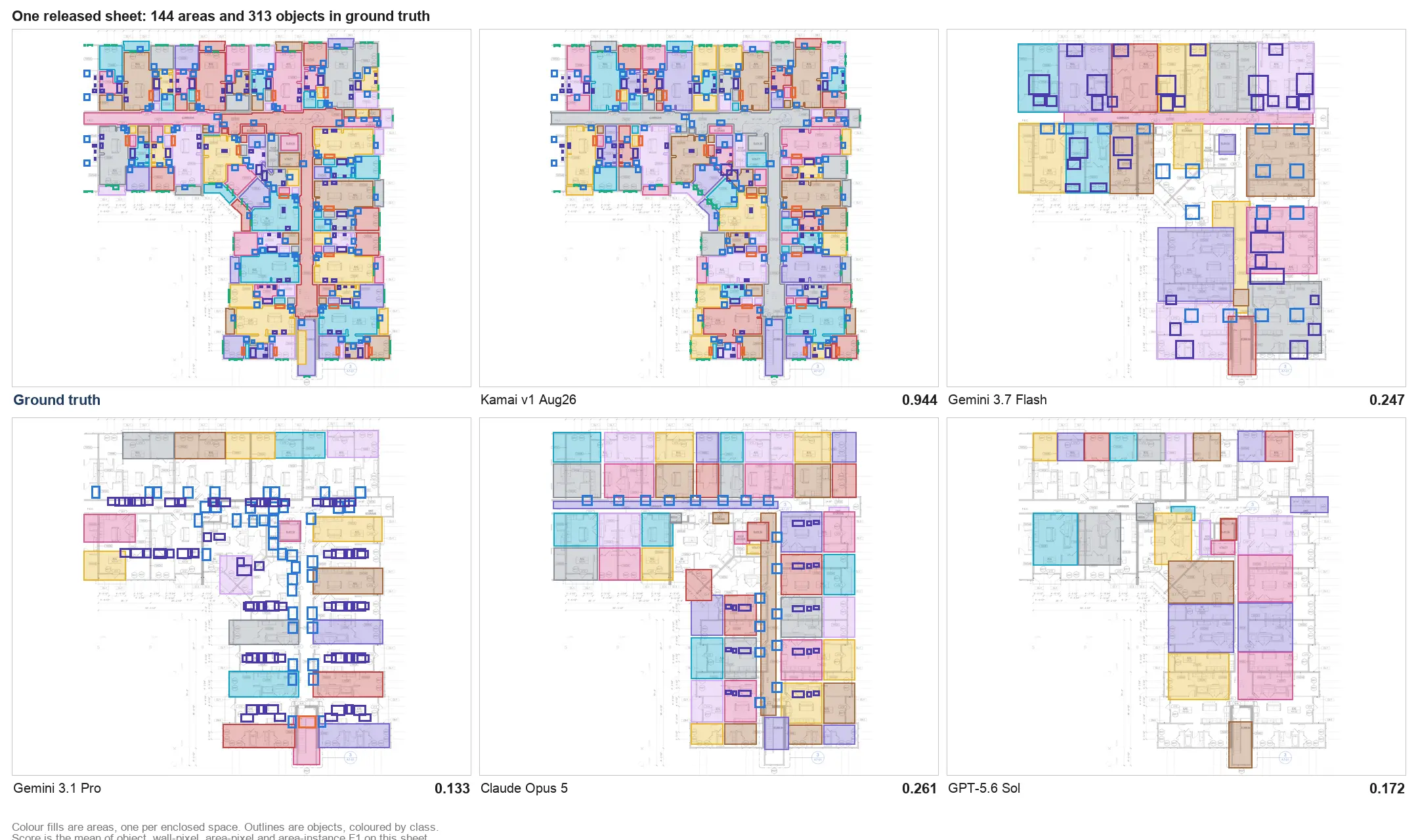
Kamai keeps what works about 2D drawings and takes out the retyping. Using AI and computer vision, Kamai's models read PDFs, scanned plans, and full blueprint sets and turn them into structured construction data. Not just the text on the sheet, but the geometry: rooms, walls, fixtures, and the measurable elements an estimator would trace by hand.
You upload the set and get organized quantities back, including:
- Flooring and ceiling areas
- Wall lengths and surface areas
- Door and window counts
- Fixture totals
- Room-based quantities
- Perimeter dimensions
- Multi-sheet project rollups
- Export-ready takeoff tables
Output is structured JSON, so it drops into the systems you already run, and it exports to Excel and PDF when you need to hand something off. The AI assistant lets you query a set in plain language instead of hunting across thirty sheets, and the supported trades and CSI divisions cover the conditions you actually take off. The point is not to retire the drawings. It is to stop paying a person to be a measuring transcription service.
2D and BIM are not a fight
People line these up as if one kills the other. On real projects they sit side by side. BIM earns its keep on design coordination, clash detection, and lifecycle planning. 2D drawings carry the tender, the validation, the documentation, and the contractual review.
There are also plenty of cases where the model is not an option. Contractors frequently want an independent quantity check rather than trusting a model's outputs on faith. Older buildings have no model. Renovations start from existing plans or a scan. None of that goes away because the industry got more digital.
Where this is heading
2D takeoff is shifting from manual measurement to data extraction. Less time tracing plans, more time on the parts of the bid that need judgment. In practice that looks like uploading a set and having the measurable elements detected, querying the drawings in plain language, comparing revisions to catch what an addendum changed, and exporting structured quantities straight into the estimating system.
The drawings are not the problem. Retyping them by hand was. Kamai takes the 2D set every estimator already lives in and gives back structured, priceable data, so the bid goes out faster and the numbers hold up when the job is won.
Get the next post in your inbox.
Low frequency. High signal.