What are Construction Takeoff APIs used for?
What construction takeoff APIs do: pull quantities and measurements out of PDF plans automatically so estimating software can skip manual takeoff.

A takeoff is the part of the bid where someone opens the plans and counts everything: linear feet of interior wall, square footage of flooring, every door and window, every fixture on the electrical sheets. A construction takeoff API does that counting in software instead of by hand. You send it a set of drawings, and it returns the quantities and measurements as structured data your other systems can read.
The point of doing it through an API, rather than a person with a scale ruler or an on-screen takeoff tool, is that the result is machine-readable and repeatable. The same set of plans produces the same numbers every time, and those numbers land in your estimating platform without anyone retyping them.
What a takeoff API actually does
You feed it construction documents and it gives back quantities. The inputs are the files estimators already live in:
- PDF plan sets and tender drawings
- CAD files
- Scanned and marked-up sheets
- Architectural, structural, and MEP plans
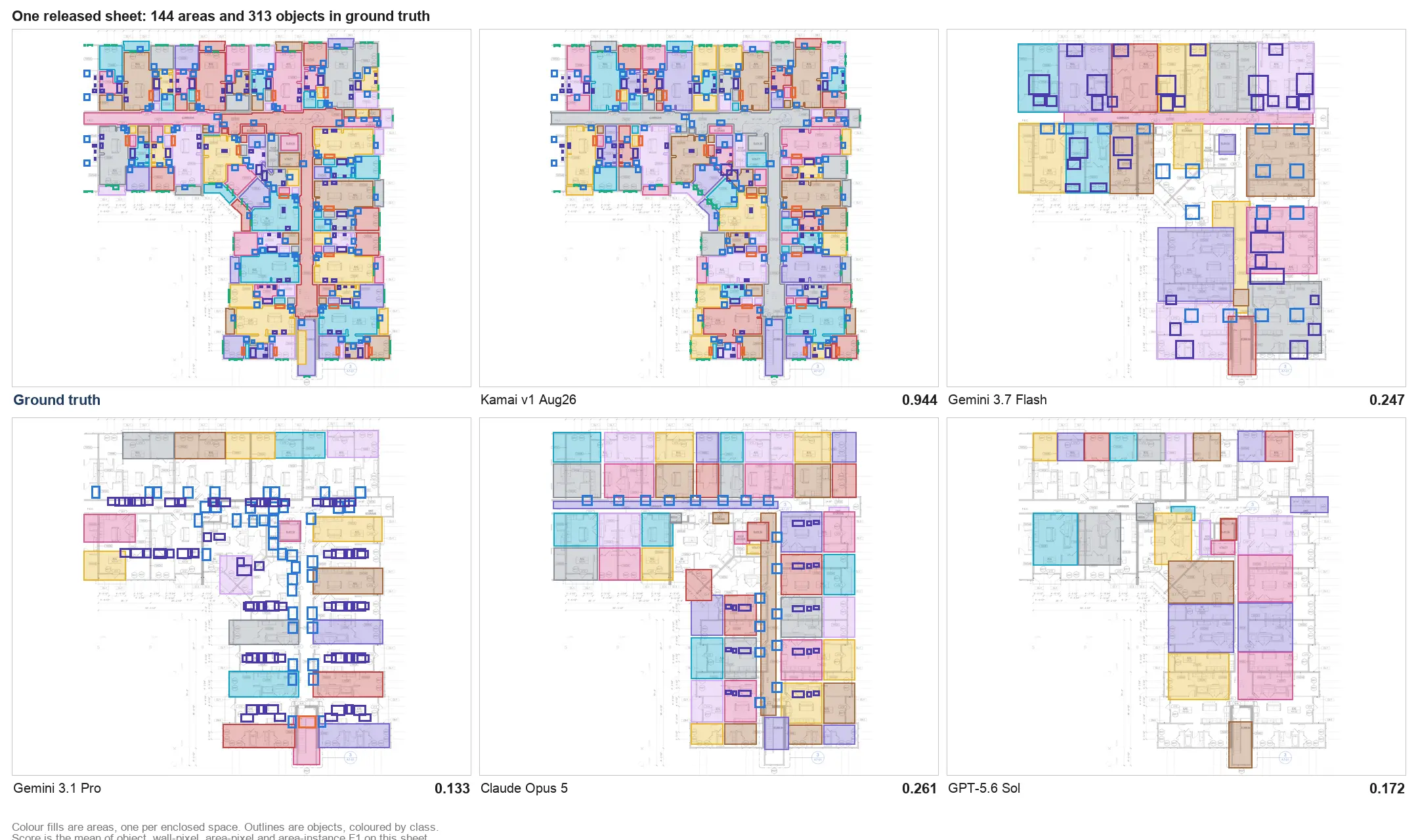
On the way in, the system reads the drawings with AI and computer vision: it locates the scale, recognizes rooms and symbols, traces walls, and identifies fixtures and elements across the sheet. What comes back is a dataset, not a marked-up picture. Wall lengths, flooring and ceiling areas, door and window counts, pipe runs, electrical fixture counts, concrete volumes, and the material quantities tied to each.
From there the data goes wherever you need it: into an estimating sheet, a procurement list, an ERP, or a report.
Why estimators reach for one
A full plan set for a mid-size job runs dozens of sheets, and the takeoff is the slowest, most error-prone stretch of preconstruction. Trace every wall by hand and a few things tend to go wrong:
- The scale gets read off the wrong detail, so every measurement on the sheet is off by a fixed ratio
- Fixtures hidden in a dense MEP plan get missed
- Shared walls between units get counted twice
- A revised sheet from an addendum gets estimated against the superseded version
An API removes the manual tracing, which removes most of those failure modes. Two estimators measuring the same drawing no longer produce two different numbers, because the measurement isn't a judgment call anymore. That consistency is the real win. It matters more than raw speed, though the speed is real too: instead of spending an afternoon counting receptacles, you upload the set and get quantities back to review.
That changes what the bid deadline looks like. You can turn around more tenders in the same week, and the crunch the night before a deadline gets shorter, because the counting is already done and your time goes to scope and pricing decisions instead.
Getting data out of static PDFs
Most projects still bid off 2D documents. BIM adoption is climbing, but the tender set that lands in your inbox is usually a PDF, and all the quantity data inside it is locked in a flat image. You can look at it, but you can't query it.
This is the gap a takeoff API closes. It turns the drawing into numbers you can act on: total flooring square footage, interior wall lengths, concrete volumes, fixture counts, room classifications, finish schedules. Once that exists as structured data, it can go straight into a spreadsheet, an estimating system, an ERP, or procurement software instead of being re-entered by hand.
How Kamai fits in
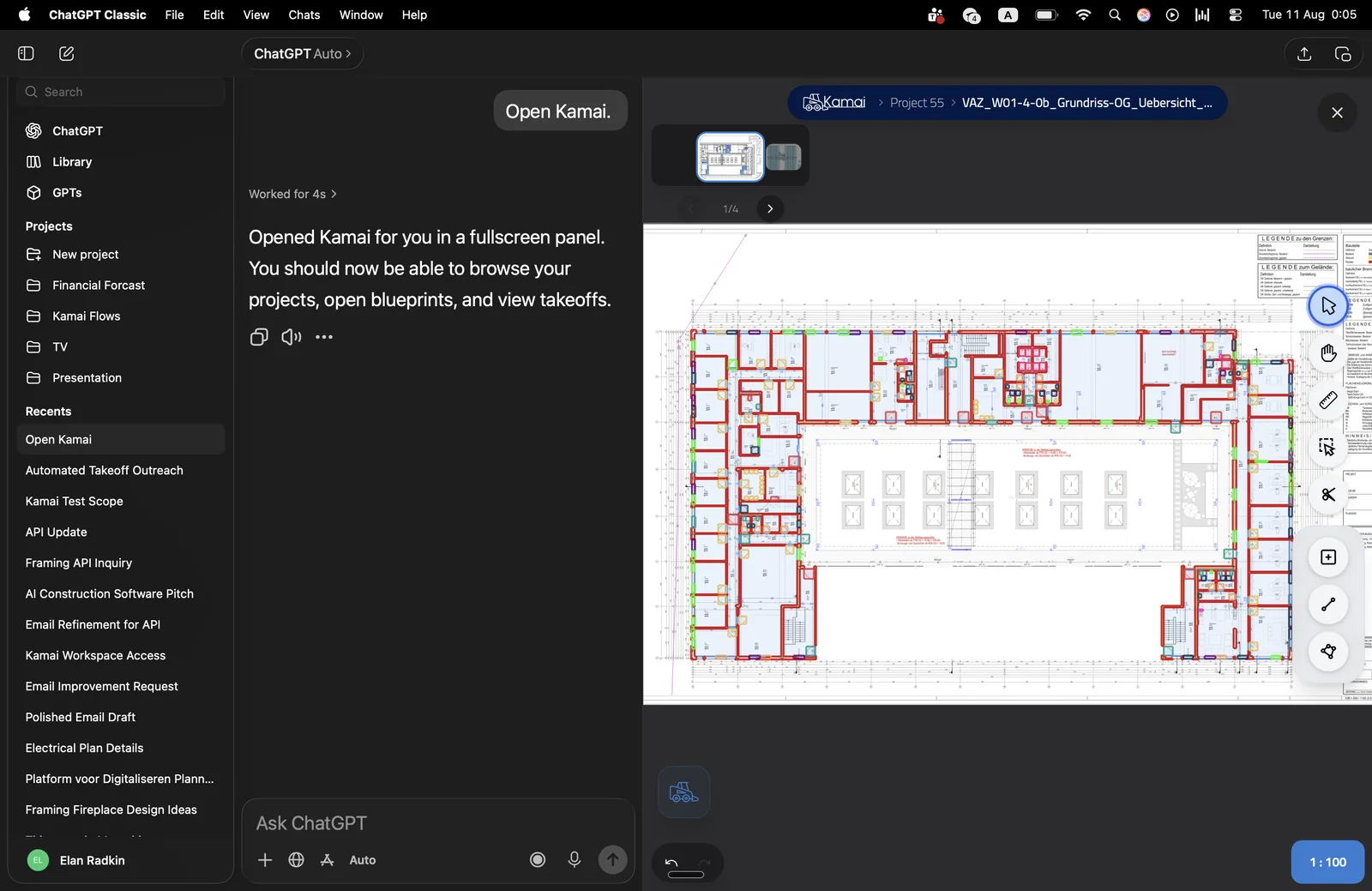
Kamai reads your uploaded plans with its own trained models and returns the takeoff as structured data. You upload the set, Kamai's models locate the rooms, walls, materials, and fixtures, and the quantities come back ready to use.
A few things that follow from that:
- No manual tracing. Dimensions, areas, and counts come straight off the plan, so the hours normally spent on a scale ruler go to reviewing the output instead.
- Full sheets at once. Rather than working through the set page by page, you get quantities across the drawings together, including counts that repeat across multiple sheets.
- Data, not a picture. Results come out as structured JSON and export to Excel and PDF, so the numbers move into pricing, procurement, and scope review without retyping.
The app also includes an AI assistant you can ask about the extracted data: validate a quantity, check scope, compare figures, sanity-check a count before it goes into the estimate. The takeoff is the input; the decisions you make on top of it are the point.
Integrating it into the software you already run
The other common reason teams use a takeoff API is to wire it into an existing stack. If you already run an estimating platform, an ERP, and procurement tools, the API connects quantity extraction to all of them so the same numbers don't get keyed in three times.
A typical flow looks like this:
- A PDF plan set comes in and gets uploaded
- The takeoff API runs against it
- Quantities come back as structured data
- Those quantities feed your pricing database
- The estimate gets assembled from there
Kamai exposes this through its API, and through MCP for teams building it into AI-driven tools. Either way, the path from a drawing to a priced bid stops depending on manual data entry at every handoff.
Where this is heading
The useful shift isn't "AI in construction" as a slogan. It's that a plan set stops being a static document and becomes something you can measure and search. AI and computer vision let the models recognize what's on a sheet, understand how elements relate, and carry counts across a multi-sheet set rather than treating each page in isolation.
For an estimator, that means the takeoff stops being the bottleneck in the bid. The counting is handled, the numbers are consistent between jobs, and the time that used to go into tracing walls goes into deciding whether the bid is right. That is what a takeoff API is for.
Get the next post in your inbox.
Low frequency. High signal.