Transforming 2D Drawings into Structured Data for Better Construction Workflows
How Kamai reads PDF plan sets and turns walls, fixtures, and dimensions into structured takeoff data you can query, price, and export.

Most takeoffs still start the same way: a PDF lands in your inbox, you set the scale on the title block, and you start tracing walls and counting fixtures with a mouse. BIM models and digital twins get the conference talks, but the estimator working a bid at 9pm is reading a 2D sheet set, just like the quantity surveyor validating a subcontractor's scope and the planner pricing a renovation where no model ever existed.
The problem with those sheets is not that they lack information. It is that everything you need - wall lengths, room areas, door and window counts, fixture symbols - is locked inside lines and annotations that a person has to interpret one sheet at a time. Kamai reads those drawings and turns them into structured data you can measure, query, and export.
Why 2D drawings still run the job
BIM adoption keeps climbing, and PDFs keep being the thing people actually estimate from. A few reasons this hasn't changed:
- Models aren't ready at bid time. During tender, you get incomplete design packages, revised PDFs, and early-stage sheets on a tight clock. Waiting for a coordinated model is rarely an option.
- Contractors validate independently. Even when a model exists, most teams won't price off the designer's quantities alone. Liability, omissions, and coordination gaps make independent measurement non-negotiable.
- Renovations and legacy work have no model. Additions, infrastructure upgrades, and older buildings often come with scanned plans and nothing else.
- The paper trail is still paper. Contractual approvals, RFIs, and addenda revolve around drawings, not model data.
So the day-to-day reality of estimating, procurement, and planning runs on 2D plans, and it will for a long time.
What static drawings actually cost you
The intelligence in a blueprint is real, but it is visual. Walls, openings, finishes, fixtures, and dimensions all have to be read by eye and rekeyed into a takeoff table before any of it is useful.
That manual step is where the bottleneck lives. Estimators burn hours measuring areas and counting symbols across dozens of sheets. Procurement waits on confirmed quantities before committing to material orders. And when an addendum drops late in the bid cycle, someone has to find every affected sheet and redo the count by hand.
This is also where errors enter. Double-counting a shared wall between two units, measuring off an old revision, working from the wrong scale, missing a scope item buried in the MEP set - none of these are exotic mistakes. They are the normal cost of interpreting drawings under deadline, and they show up later as eroded margin or change orders.
A PDF viewer with markup tools doesn't fix this. The drawing is still a flat image. What changes the math is converting it into data.
How Kamai reads a plan set
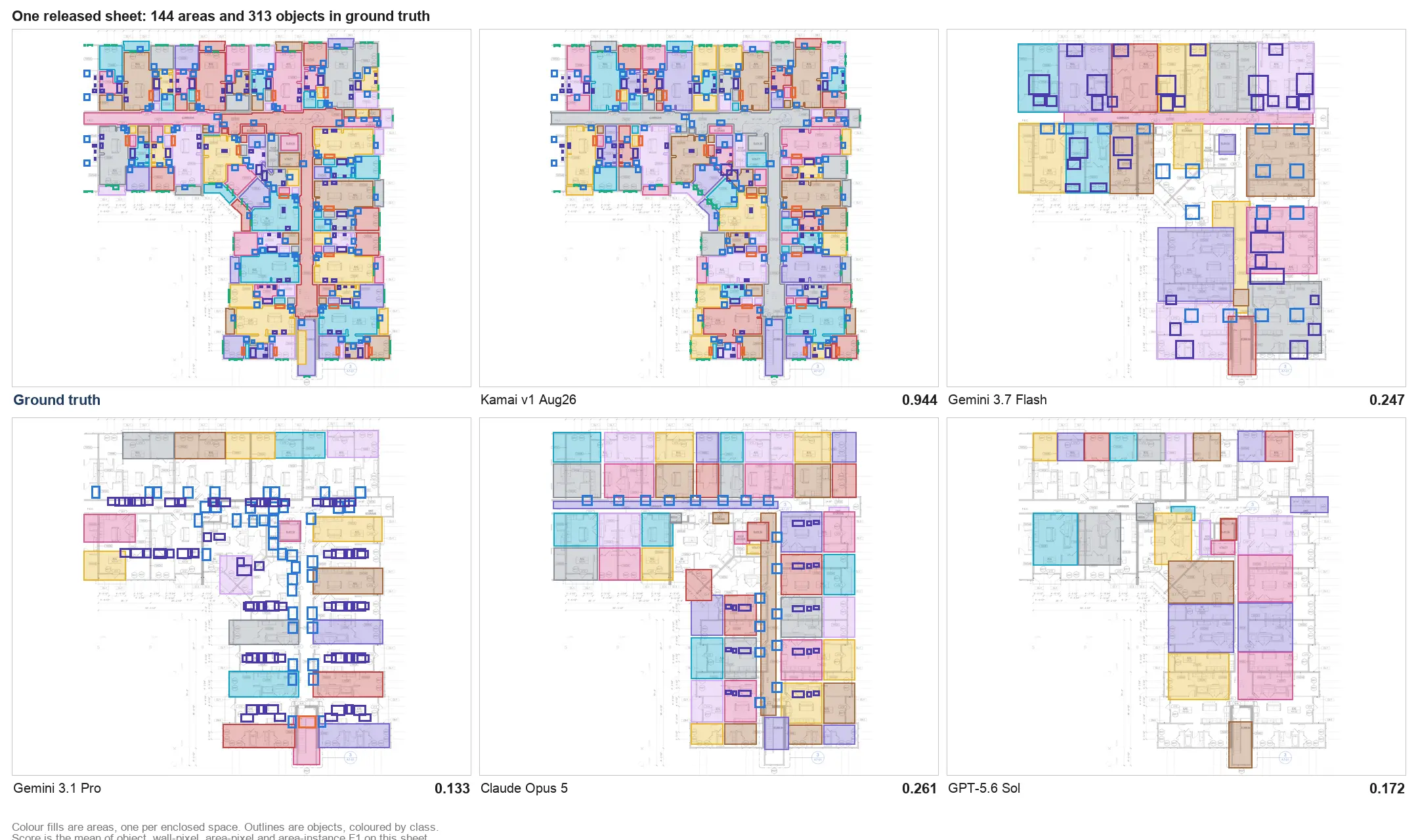
Upload a plan set and Kamai's models analyze the geometry, symbols, annotations, and layout directly, using computer vision trained on construction documents. Instead of treating a sheet as a flat image, Kamai interprets the relationships between lines and shapes to recover what they represent.
That means distinguishing architectural elements - walls, doors, windows, rooms - and identifying the MEP symbols and quantities that sit on top of them. You set the scale, point Kamai at the sheets, and get back measured quantities rather than a blank canvas to trace.
Faster cost and quantity estimates
A large multi-sheet package can eat hours or days, often split across several people to hit a deadline. Once the drawings are uploaded, Kamai starts working through the sheets: detecting dimensions, calculating areas, extracting perimeter lengths, identifying materials, and organizing the results into structured outputs you can price from.
- Estimators spend less time measuring and more time pricing.
- General contractors turn bids around faster.
- Developers see cost exposure earlier.
- Procurement plans against verified quantities instead of placeholders.
Takeoffs across disciplines
Real projects need more than floor areas. Kamai handles quantity extraction across the scopes a takeoff actually touches.
On the architectural side, that covers floor areas, wall surfaces, perimeter lengths, room zones, finish schedules, and space classifications. On the MEP side, it covers fixture counts, outlet quantities, piping runs, duct paths, and the repetitive symbols that are tedious to tally by hand. For a GC validating scope across trades, or a subcontractor who would otherwise be hand-counting receptacles across forty sheets, that is the difference between a morning and an afternoon.
Reading the whole set, not one page at a time
Plenty of takeoff tools work a single page at a time. Construction documents don't. A real package runs to dozens or hundreds of sheets spanning architectural, structural, MEP, reflected ceiling plans, sections, and revisions, and the relationships between those sheets are the point.
When you upload multiple files, Kamai analyzes them together - finding repeated layouts, floor-level continuity, and patterns across the set. That matters most on the projects built from repetition: multi-story residential towers, hotels, healthcare facilities, and schools where a typical floor recurs up the building. Instead of measuring level 3 and then re-measuring level 4 because it looks similar, you let the recognition carry across the package.
Asking the drawing questions
Here is the shift that changes a workday. Want to know how many wet rooms are on Level 5, or the total interior wall length in a given zone? The old answer was to dig through sheets by hand or rebuild the data in a spreadsheet first.
With the AI assistant in the app, you ask the plan set directly and get answers from the extracted data:
- Which rooms exceed a given area threshold?
- What is the total wall perimeter on this level?
- How many fixtures appear across the building set?
- Which zones call for a specific finish type?
That cuts the time spent answering RFIs, checking quantities, and settling internal coordination questions, because the data is already structured underneath the question.
Decisions move earlier
When the quantities are structured and accessible, the people who depend on them stop waiting on a hand-built report. Estimators compare options and refine pricing against real numbers. Preconstruction assesses constructability sooner. Procurement plans purchases off clean quantities. Operations builds schedules against actual scope. And leadership can see project exposure before a bid goes out the door rather than after.
Where the time goes instead
Manual takeoff is some of the most expensive labor in preconstruction, and it is spent on rulers, scale tools, repeated tracing, and spreadsheet re-entry. Pull that work off your senior estimators and it goes back into bid strategy, vendor negotiation, scope review, and value engineering - the parts of the job that actually decide whether the bid wins and holds margin.
Accuracy and risk
Every bad number carries risk. Under-count materials and you give away margin. Over-count and you price yourself out of the job. Miss a scope item and it comes back as a change order, a dispute, or schedule pressure.
Because Kamai extracts quantities the same way every time from the source drawings, the outputs are structured and repeatable. You get tighter control over assumptions and revisions, which counts most in a competitive bid where a small pricing gap decides who wins.
Getting the data out
Extraction only helps if the numbers land where you already work. Kamai exports to Excel and PDF for the takeoff and bid documents your team and clients expect, and structured JSON for anything you want to feed downstream. The API and MCP make that programmatic, so the same quantities can flow into your own tooling without a re-keying step.
Why this is worth doing now
Margins are tight, deadlines are short, skilled labor is hard to find, and bid volume keeps rising. Meanwhile a lot of teams are still running these jobs off static PDFs and manual measurement.
Kamai doesn't ask you to abandon the formats you already use. It reads the same 2D plans and turns them into structured data, which keeps adoption practical: the sheets stay the sheets, and the takeoff gets faster.
Bottom line
2D drawings aren't going anywhere. They sit at the center of bidding, validation, and execution, and the opportunity is to stop treating them as flat paper. Point Kamai's models at a plan set and the walls, fixtures, and dimensions come back as data you can query, price, and export - which is what moves a team from reading documents to working from numbers.
Get the next post in your inbox.
Low frequency. High signal.