Transform Your Estimating Process With PDF Drawing And Takeoff Software
How PDF takeoff software extracts quantities from blueprints, and where Kamai's AI takes estimators past on-screen measuring.

Open a plan set for a mid-size project and you are looking at a few hundred sheets: architectural floor plans, structural framing, mechanical, plumbing, and electrical, plus the details and schedules that tie them together. Before any of it becomes a number, an estimator has to read every relevant sheet, confirm the scale, measure, count, and write it all down somewhere it can be priced. That is the work that decides whether a bid wins and whether the job makes money. It is also where most of an estimator's week disappears.
PDF takeoff software was the first real fix. Instead of plotting sheets and walking them with a scale ruler, you load the PDF, set the scale once, and measure areas, lengths, and counts directly on screen. Kamai goes a step further: its models read the drawings and pull the quantities out for you, so the work shifts from generating numbers to checking them.
What PDF drawing and takeoff software actually does
A digital takeoff tool lets you measure on the drawing instead of on paper. You upload the sheet, calibrate the scale against a known dimension, then trace areas for flooring or roofing, measure linear runs for footings or pipe, and drop count markers on doors, fixtures, and devices. The measurements roll up into quantities you can price.
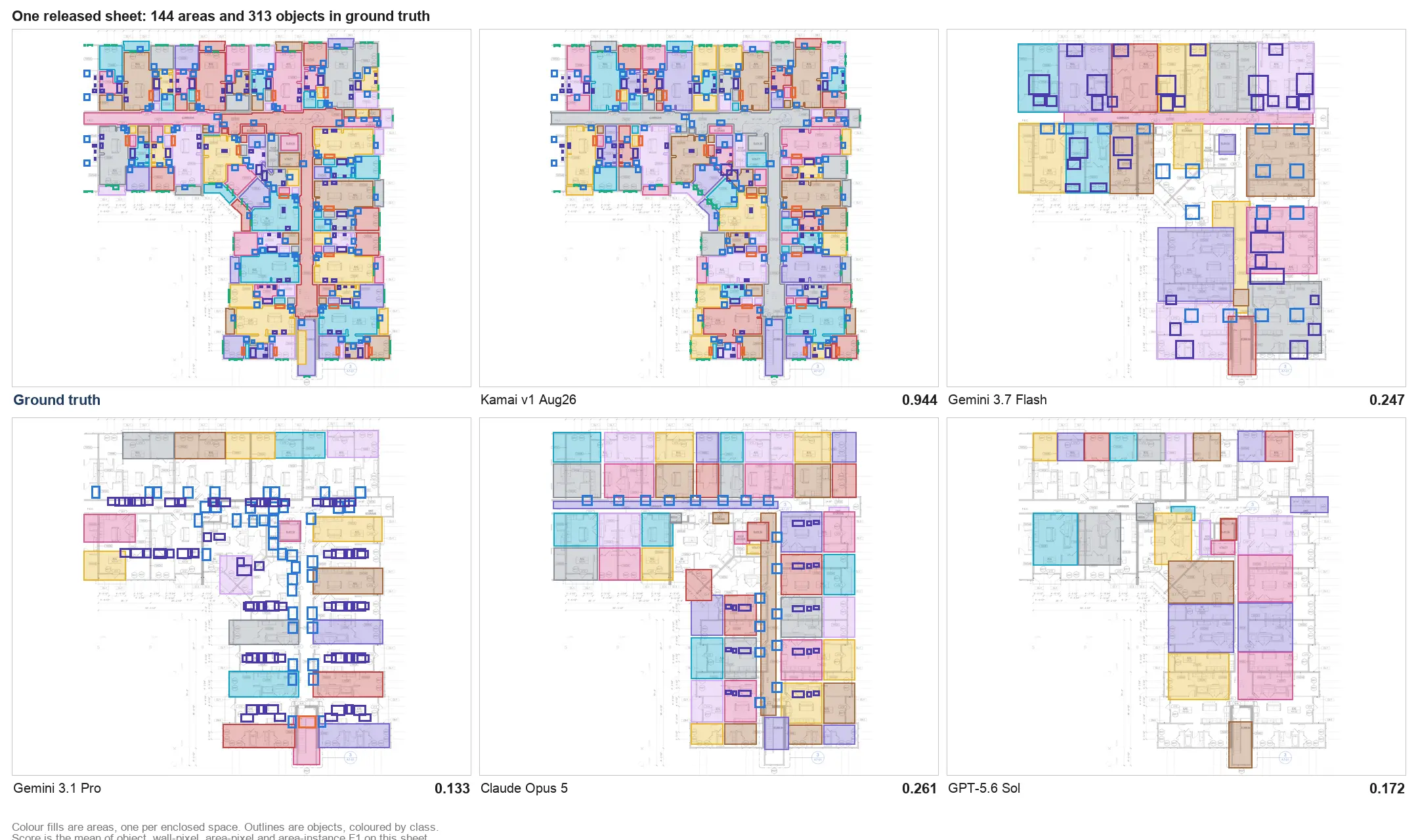
Where Kamai differs is that you are not the one tracing. Kamai's models scan the plan set, identify the measurable elements, and return the quantities as structured data. You spend your time reviewing what the models found and correcting edge cases, not redrawing every wall.
Why manual takeoff breaks down
Hand takeoff works, and good estimators get fast at it. The problem is volume and revisions.
Volume first: a single project can run several hundred sheets across every discipline. Reading all of them carefully, sheet by sheet, is hours of concentration, and concentration fades. Miss a scale note on one plan and every quantity off that sheet is wrong by the ratio.
Revisions are worse. An addendum lands, a few sheets change, and now you are diffing the new set against the old one looking for what moved. Catch the relocated wall and you are fine. Miss it, and the bad number rides all the way into the material order, where it shows up as a shortage or an overage on site.
From a stack of sheets to structured data
A drawing is dense but unstructured. Walls, slabs, doors, windows, pipe, duct, fixtures, and framing are all in there, but to a computer they are lines until something interprets them.
Kamai's models do that interpretation. They read the digital plans, recognize the measurable components, and convert them into datasets you can sort, price, and export. Surfaces become square footage, runs become linear footage, repeated symbols become counts. From there the data moves into pricing instead of sitting in your head as visual complexity.
Extracting quantities at speed
Kamai pulls quantities straight from the PDF set, which is the part that used to eat the most time. It reads surfaces like flooring, roofing, and wall area and returns the dimensions, and it finds repeating elements like doors or windows and counts them across the full set rather than sheet by sheet.
A takeoff that used to take an afternoon of tracing comes back in minutes. The hours you get back go into reviewing the numbers and pricing the job, not into clicking around the plans.
Spend your time on the decisions
Most of the value an estimator adds is judgment: which subs to trust on a scope, where the risk hides in the drawings, how to sequence procurement. Manual takeoff buries that judgment under measuring.
When the quantities come back already extracted, the measuring stops being your job. You move straight to evaluating material costs, pricing risk into the bid, and deciding how to buy. The same hours produce a better-reasoned estimate instead of a freshly traced one.
Turning drawings into more than measurements
A digital ruler measures what you point it at. Kamai reads the drawing.
Its models recognize structural components, pick up relationships between elements, and apply the same logic to every sheet in the set. That last part matters for consistency: when three estimators hand-measure the same project, you get three slightly different takeoffs. Run it through Kamai and the same drawing returns the same quantities every time, which takes a class of variance out of the estimate before pricing even starts.
Faster takeoff means more bids
In a competitive market you are usually one of several contractors chasing the same job, and the team that can turn around an accurate number fast gets to chase more of them.
Because Kamai processes a plan set in a fraction of the time a manual takeoff takes, you can pursue more bidding opportunities without adding estimators. More bids out the door is more shots at the work.
Fewer errors that cost real money
A measurement mistake is cheap to make and expensive to discover. Manual takeoff is where the classic ones come from: the wrong scale on a sheet, a detail nobody opened, a count that drifts, a shared wall billed to two rooms. Any of them can turn into a wrong material order, a budget overrun, or a schedule slip once the job starts.
Pulling quantities directly from the digital drawings cuts out the manual steps where those errors creep in. The result is numbers you can stand behind when the bid is on the line.
Working off the same numbers
Estimating is not a solo act. Architects, engineers, PMs, and subs all need the same quantity information to plan their piece of the work, and when each of them is reading the drawings separately, the numbers drift apart.
Kamai gives the team one set of structured quantities to work from. When everyone is pricing and planning off the same data, there is less to reconcile and fewer arguments about whose count is right. Quantities come out of Kamai as structured data you can export to Excel or PDF, and the AI assistant in the app answers questions about a sheet directly, so the people who need a number can get it without re-measuring.
Where this is going for estimating
Takeoff is moving off the printout for good. PDF software got the measuring onto the screen; AI takes the measuring off the estimator's plate.
Kamai reads the plan set, returns the quantities as structured data across the trades and CSI divisions it supports, and hands them back ready to price. That frees the estimator to do the part a model cannot: read the risk in a set of drawings and decide how to bid it. For a shop trying to put out more accurate numbers without hiring more estimators, that is the trade worth making.
Get the next post in your inbox.
Low frequency. High signal.