The Rising Cost of Inaccurate Construction Estimates
Why estimating errors compound into lost margin, blown schedules, and lost trust - and how AI takeoff with Kamai cuts the risk.

A bad estimate rarely shows up as one big mistake. It shows up as a transposed quantity on a structural sheet, a wall counted twice because two trades shared it, or a revised foundation detail that came in with addendum 3 and never made it into the spreadsheet. By the time the project team finds it, the bid is already submitted and the margin is already gone.
With material prices moving and labor harder to schedule than it used to be, there's less room to absorb that kind of slip. The estimate is the one number everything downstream depends on, and most teams are still building it by hand.
Why estimating errors are so expensive
Construction runs on thin margins, so the math is unforgiving. A quantity that's off by ten percent on a line item that drives the job can erase the profit on the whole contract. There's no recovery later in the schedule, because procurement, crew sizing, and the delivery date are all priced off the takeoff. Get the takeoff wrong and you've mispriced everything that follows.
How one bad number spreads
Underestimate material quantities and crews run short mid-pour or mid-install. The fix is a rush order, usually at a worse price than the original buyout, plus the downtime while you wait for it. Underestimate labor and the schedule slips: now you're paying overtime or pulling in a second crew to hit a date you committed to off a number that was wrong from the start.
The project manager spends the job chasing these instead of running it. Every hour spent reworking a shortfall is an hour not spent sequencing the next phase. A small error at bid time rarely stays small once it's loose in the field.
The cost that doesn't show up on a spreadsheet
The financial hit is the part you can measure. The harder one to recover is trust. A GC who watches you blow two budgets in a row stops calling, and they tell the people they work with why. In a market where most of your work comes from people who've hired you before, a reputation for missing the number is the most expensive error of all.
Where estimates actually go wrong
If you want to stop making the same mistakes, it helps to name them.
Manual takeoff and re-keying. Counting fixtures off a printed MEP sheet, scaling dimensions with a wheel, then typing it all into a spreadsheet is slow, and every handoff is a chance to drop a digit. A misplaced decimal or a fill-down formula that grabbed the wrong row doesn't announce itself. It just sits in the total.
Stale cost data. Prices move, especially on steel, copper, and lumber. An estimate built on last quarter's numbers prices a job that no longer exists. Real costs need current pricing plus adjustments for region and the specifics of the job in front of you.
Treating every job as a standard job. Site access, soil conditions, an awkward structural grid, a tight downtown logistics window - these swing cost, and a takeoff built on default assumptions ignores them. The plans tell you the building is unusual. The estimate has to reflect that.
Estimating and the field reading the plans differently. When the people who priced the work and the people who build it interpret a detail two different ways, the gap turns into a change order or a redo. Most overruns trace back to that disconnect more than to bad arithmetic.
No contingency for known risk. Weather, a late permit, a supplier who can't deliver on time - none of these are surprises in this business. A takeoff that carries no allowance for them turns an ordinary delay into a job that's over budget.
What changes when the takeoff is automated
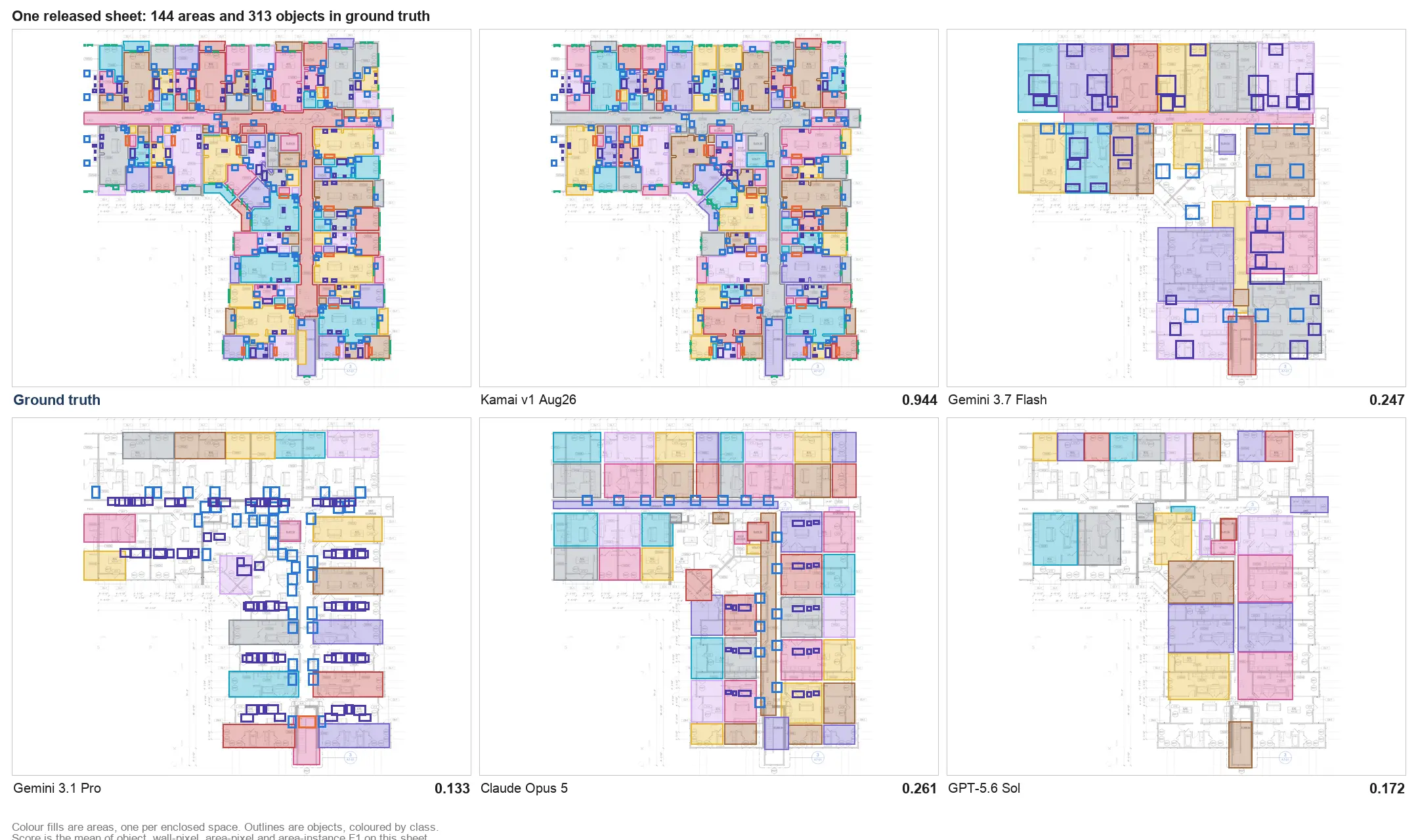
Digital takeoff already beats paper plans and a wheel: measurements track automatically, line items are harder to miss, and you have a record of what was assumed. Kamai works from that and removes the measuring entirely.
You upload the drawing set and Kamai's models read it - architectural, structural, MEP. They detect areas, volumes, and material counts directly off the sheets and return them as structured data, in seconds rather than over an afternoon at a light table. The estimator stops counting and starts checking: comparing options, pressure-testing assumptions, deciding what to carry. That's where judgment actually adds value, and it's the part manual takeoff leaves no time for.
The output is structured from the start, so the quantities export to Excel or PDF and feed straight into your cost model instead of being re-keyed. When a detail is ambiguous, the AI assistant lets you ask about it in plain language and trace where a number came from, so you're reviewing the takeoff rather than redoing it.
Closing the loop with real costs
Quantities are half the estimate; the price you put on them is the other half. Pulling current cost data in keeps the estimate aligned with what the work costs today rather than last quarter. And once you're tracking estimates against actuals, the back-check writes itself: where you came in high, where you came in low, and what to adjust on the next bid of the same type.
Tools fix part of it
Software won't save a process that's built on sand. The teams that estimate well also standardize how they do it: a consistent takeoff method, a maintained history of what jobs actually cost, and estimating, PMs, and the field looking at the same set of assumptions before the bid goes out. Train people on the tooling so it's used the way it's meant to be used. Kamai removes the manual measuring and the re-keying; the discipline around it is still yours to build.
The bottom line
The cost of a wrong estimate is never just the miscalculation. It's the rush order, the overtime, the PM stuck firefighting, and the client who doesn't call back. On thin margins in a competitive market, the takeoff is where the job is won or lost, and doing it by hand leaves too much to chance.
Kamai turns the drawing set into structured, checkable quantities so your estimators spend their time on the decisions that move the number, not on counting. That's the difference between an estimate you defend and one you hope is close.
Get the next post in your inbox.
Low frequency. High signal.