The Rise of AI in Construction Estimating
How AI takeoff tools are changing construction estimating: faster quantity takeoffs, fewer measurement errors, and more bids per estimator.

For most of its history, the takeoff has been a person, a scale, and a stack of drawings. An estimator traces every wall, counts every fixture, and tallies quantities sheet by sheet, often working nights to hit a bid deadline. That work is skilled, but it doesn't scale. As plan sets grow and bid windows shrink, the manual approach is where accuracy and margin quietly leak away.
AI is changing the mechanics of that work. Tools like Kamai read digital drawings, pull quantities directly from the linework, and return structured data an estimator can price against, instead of measuring the same conditions by hand on every job.
What AI actually does in estimating
Estimating is the process of pricing a project before anyone breaks ground. You read the drawings, quantify materials, figure labor hours, account for equipment, and tie all of it back to the scope. The hard part isn't any single calculation. It's doing thousands of them accurately, across a full plan set, under a deadline.
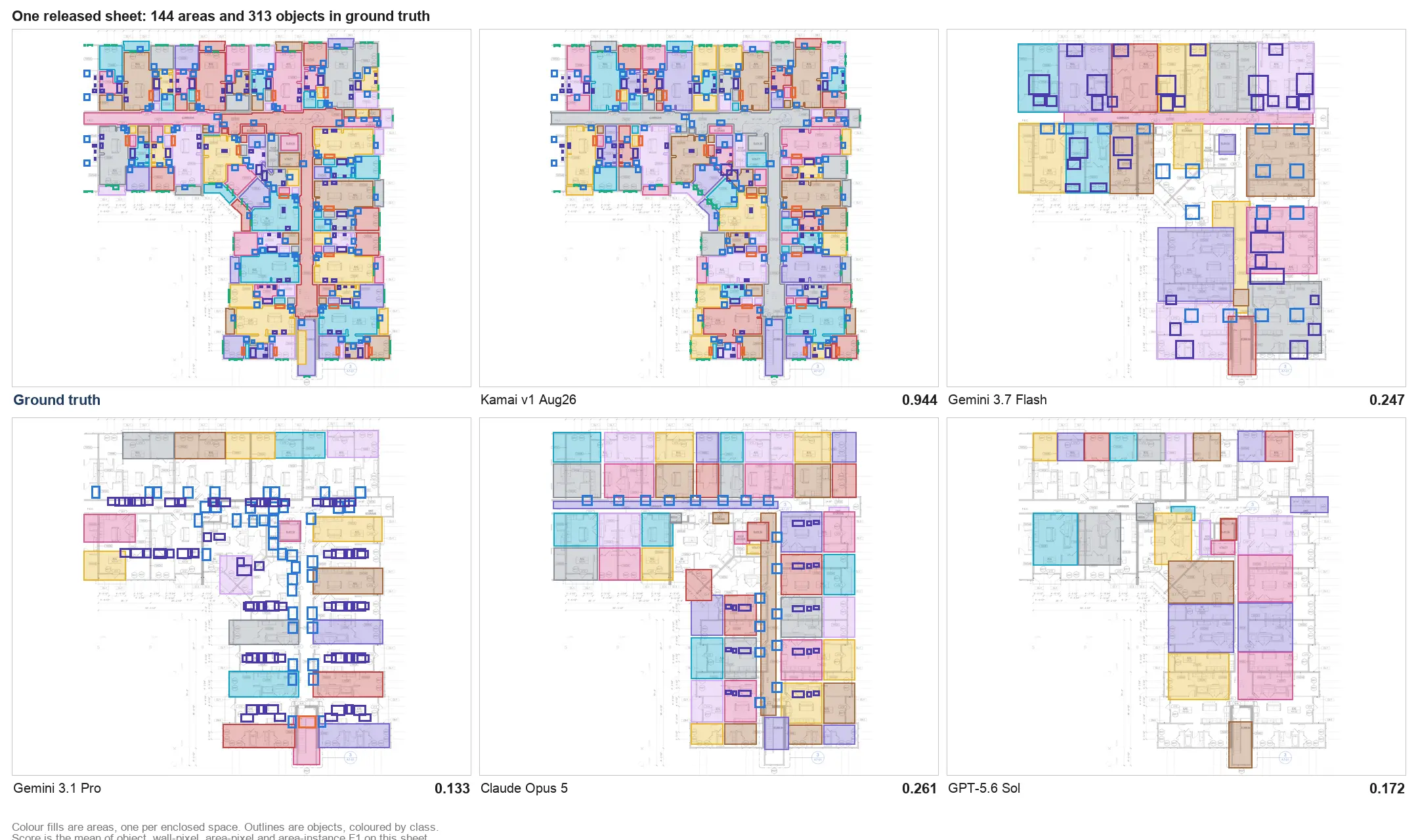
Manual takeoff is where that pressure shows up most. A 200-sheet set with a mid-bid addendum is exactly the situation where things slip: a wall counted on two sheets, a fixture schedule missed, a detail traced at the wrong scale. Kamai's models read the same drawings and convert what's on them - walls, floor areas, fixture counts, pipe runs - into measurable quantities, so the estimator isn't the one tracing every line.
Why drawings are a good fit for AI
Preconstruction generates a lot of structured information. Architectural plans, structural drawings, MEP sheets, and specifications all carry quantities an estimator has to interpret and total. Computer vision is well suited to that: finding repeated conditions, reading consistent linework, and applying the same measurement logic on sheet 1 and sheet 180.
Kamai uses its own foundational models, trained on construction documents, to extract that data and turn it into quantities. Those quantities feed cost estimates, procurement, and scheduling downstream. The estimator's judgment still drives the bid; the models handle the repetitive measuring underneath it.
Automated takeoff
A quantity takeoff answers one question: how much material does this project need? Manual takeoff means measuring walls, slabs, ceilings, pipe, and structural members across the whole set, then adding it all up.
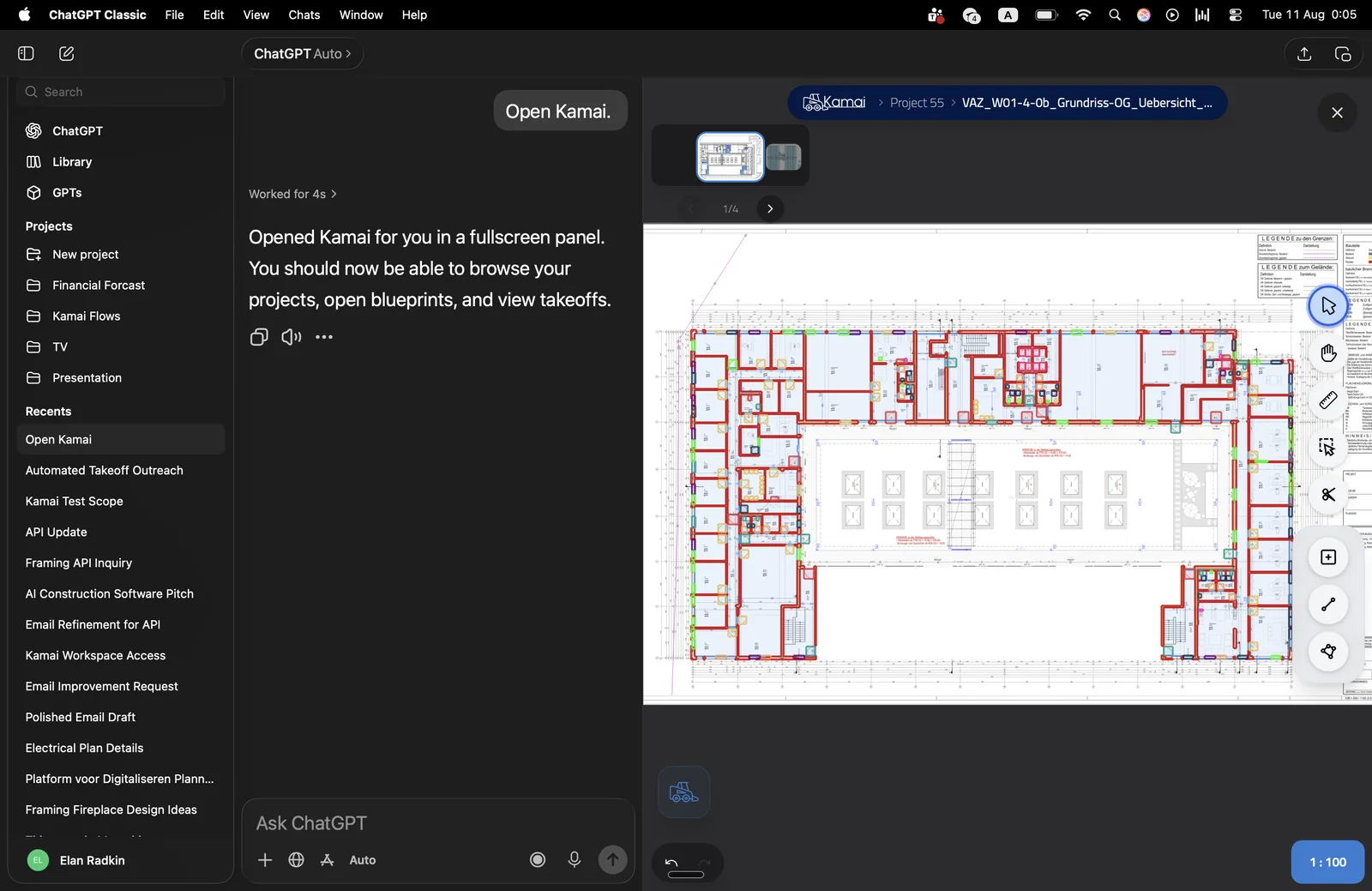
Upload a set to Kamai and the models detect measurable elements in the drawings and return dimensions, areas, volumes, and counts. That covers a range of trades and CSI divisions across architectural, structural, and MEP scopes. What changes for the estimator is the starting point: instead of an hour spent measuring a slab, you start with the quantity and spend the hour deciding whether it's right.
Where accuracy comes from
A small measurement error doesn't stay small. Under-buy a material and you're into shortages, delays, and emergency orders at a worse price. Over-buy and you've eaten the waste against your margin.
Most of those errors trace back to a few causes: the wrong scale, a missed addendum, or a shared wall double-counted between two areas. Kamai applies the same scale and measurement logic to every sheet, which is where consistency beats a tired estimator on sheet 150. Quantities come back as structured data, and the AI assistant in the app lets you check a number against the drawing it came from before it lands in the bid.
More bids, same headcount
Bidding is a volume game. The more qualified bids you put out, the more you win, and manual takeoff caps how many a team can produce in a week.
Kamai cuts the takeoff portion from days to hours. That has two effects. You can bid more work without adding estimators, and you get time back on the bids you do submit - time to pressure-test the scope, sharpen pricing, and catch the gap a competitor missed.
Less measuring, more judgment
Takeoff is the visible part of estimating, but it isn't the valuable part. The value is in reading risk, comparing means and methods, negotiating with suppliers, and deciding where to be aggressive on a number. Those are the calls that win or lose money.
When Kamai handles measurement and quantity extraction, that work moves off the estimator's plate. The time that went into tracing walls goes into pricing strategy and risk instead.
Handling the full set
A real project isn't one discipline. Architectural, structural, mechanical, electrical, plumbing, and finishes each bring their own sheets and specs, and they have to be reconciled against one another. That cross-referencing is slow by hand and easy to get wrong.
Kamai processes drawings across those disciplines and extracts quantities for each, organized as structured data. That gives a clearer read on total scope, and it holds up as the set gets larger rather than degrading the way a manual count does.
Shared data in preconstruction
Estimating pulls in project managers, architects, engineers, subs, and suppliers, and they all plan against the same quantities. When those numbers live in one estimator's takeoff, everyone downstream is working from a copy.
Kamai keeps quantities as structured data the team can review together. Exports to Excel and PDF, plus JSON for systems that consume it directly, mean the same numbers move into procurement and scheduling without being re-keyed. Fewer hand-offs is fewer places for a quantity to drift.
The assistant in the app
The takeoff number is only useful if you trust it, which means checking it. The AI assistant built into the app - the Co-Pilot - is there for that. It pulls data from the drawings, helps verify measurements, and answers questions about what the models found and where, so an estimator can confirm a quantity instead of taking it on faith.
It's a feature of the app, not a separate product, and it's where the back-and-forth of reviewing a takeoff actually happens.
Where this is heading
The near-term direction is connection: takeoff quantities feeding BIM, scheduling, and procurement without manual re-entry, so the same data carries through preconstruction instead of being rebuilt at each stage. Kamai's part is the front end of that - turning drawings into structured quantities reliably enough to build the rest on.
The short version
AI doesn't replace the estimator. It takes the measuring, which is the slow, error-prone, low-judgment part, and hands back structured quantities to work from. The estimator spends the recovered time on scope, risk, and price, which is where bids are actually won.
For a contractor, that's the practical case for Kamai: read the set, get clean quantities, export them where they need to go, and put out more accurate bids than a manual process can in the same week.
Get the next post in your inbox.
Low frequency. High signal.