Takeoff from Drawings: Turning PDF Plans into Accurate Structured Data
How Kamai turns PDF plans into structured takeoff data: quantities, counts, and trade-by-trade exports ready for estimating.

Takeoff is the moment a set of drawings becomes a number. An estimator opens the plans, reads the architectural sheets for room layouts and finishes, the structural sheets for slabs and columns, the MEP sheets for fixtures and pipe runs, and turns all of it into lengths, areas, counts, and volumes that a price can attach to. Get the quantities right and the bid stands on solid ground. Get the scale wrong on one sheet, double-count a shared wall, or miss an addendum, and the error rides straight through to the number you submit.
For most of the industry's history this meant scale rulers, highlighters, a calculator, and a spreadsheet, working sheet by sheet through the set. Good estimators still produce good results that way. It is just slow, and on a thin-margin job a single missed area can wipe out the profit the rest of the takeoff earned.
Kamai changes the input method. You upload the PDF plans and Kamai's models read the drawings and return structured quantities you can use for estimating, procurement, and planning, instead of you tracing every line by hand.
What a takeoff actually has to capture
Drawings carry the information, but they are not an estimate until someone converts them into numbers. A complete takeoff usually pulls:
- Flooring and ceiling areas, room by room
- Wall lengths and paintable wall surfaces
- Concrete volumes and steel counts
- Door, window, and fixture quantities
- Pipe runs and duct lengths
- Trade-specific material totals
Each of these has a failure mode. Areas get measured against the wrong scale. Openings get skipped because they sit on a sheet nobody opened. Shared walls between units get counted twice. None of these are exotic mistakes - they are the everyday ones that happen when a person is measuring hundreds of sheets against a deadline.
Where manual workflows break down
Plenty of teams have gone digital without changing the work. The drawings live in a PDF instead of on paper, but the loop is the same: zoom in, measure a line, count a symbol, type the value into a cell, move to the next sheet, repeat a few hundred times.
That loop has three predictable costs. The first is time - a large multi-discipline package can take days to work through. The second is inconsistency, because two estimators will measure the same scope two different ways, and a rushed bid is exactly when scope goes missing. The third is revisions. When updated plans land 48 hours before submission, someone has to diff the old set against the new one by eye and redo every affected measurement. Scaling any of this means hiring more people to run more highlighters.
What Kamai returns
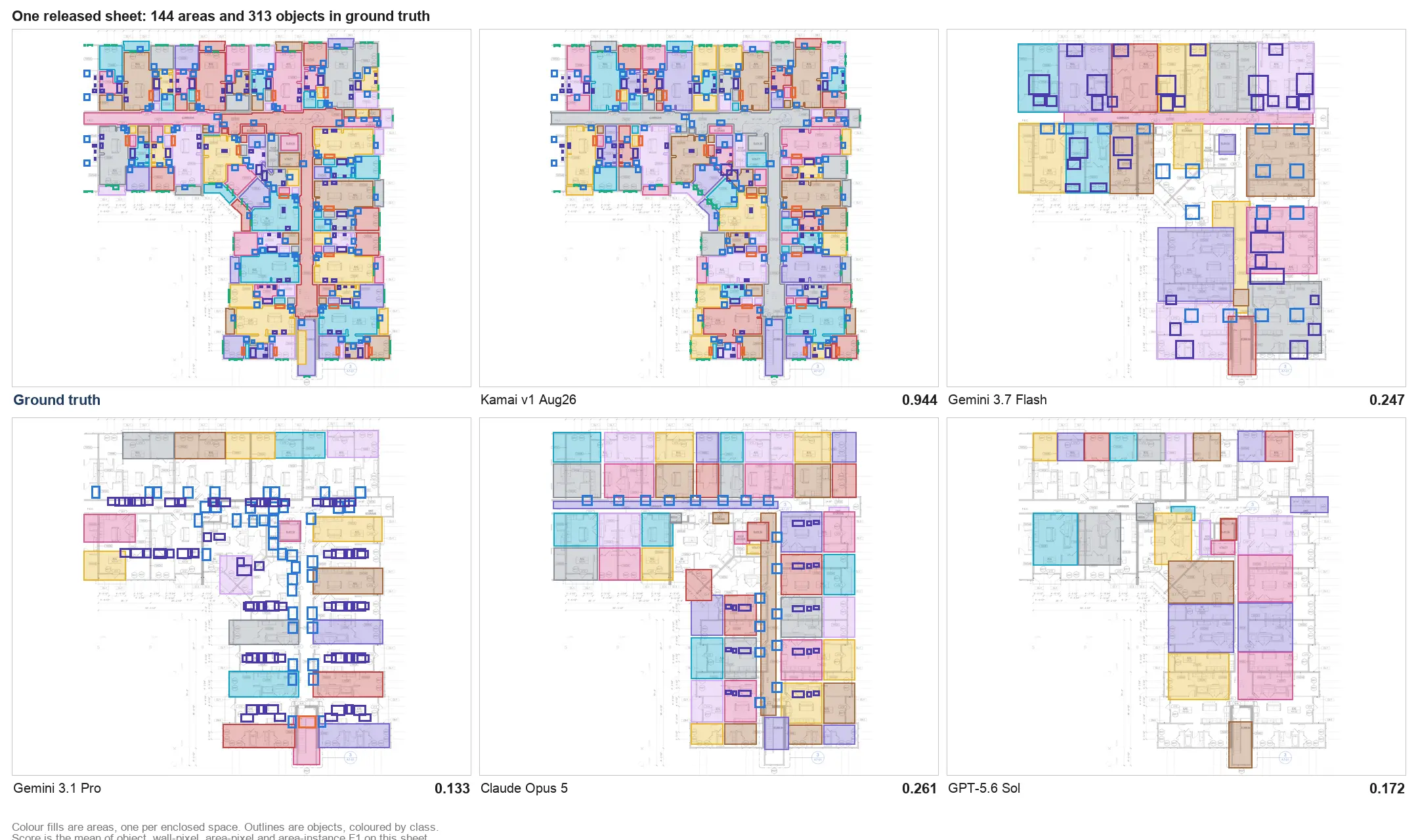
Upload a PDF or a full blueprint package and Kamai's models start reading the set. Rather than only scraping text labels, they evaluate geometry, symbols, boundaries, and how the layout fits together, which is what lets them measure scope a label search would miss. The output is structured data, not another drawing to review:
- Area calculations by room or zone
- Linear measurements for walls and perimeter items
- Counts for fixtures and openings
- Surface areas for finishes
- Volume calculations for structural scope
- Project summaries across multiple sheets
- Trade-specific exports
Because the result is structured, it moves through the rest of the company. Estimators price against it directly. Procurement sees material demand earlier instead of waiting on a finished takeoff. Project managers read scope off organized quantities rather than re-deriving it. And because every takeoff follows the same logic, the output is reviewable - you can check it, correct it, and trust that the next one was built the same way. You can pull the numbers into Excel or PDF, and the in-app AI assistant can answer questions about a set or help you query the quantities without reopening every sheet.
Speed that buys back the right work
Bid deadlines are short, and a team that cannot finish takeoff in time either rushes the estimate or passes on the job. Moving the measurement off the estimator's desk gives that time back to the work that actually decides whether a bid is good:
- Pressure-testing scope risk
- Refining labour assumptions
- Comparing subcontractor quotes
- Value engineering
- Final bid review
The second-order effect is volume. When the same team can turn around more estimates in a month, you can bid more without adding headcount first.
Handling revisions
Addenda, design changes, and late clarifications are normal, and in a manual workflow each one means comparing sheets by hand and reworking sections of the takeoff. Re-running an updated set through Kamai is faster and applies the same logic every time, which lowers the cost of a change and the odds of pricing against superseded scope - the kind of responsiveness that matters most in a competitive tender.
Residential to complex commercial
The job is the same whether the package is a single house plan or a multi-sheet hospital set: turn drawings into quantities you can stand behind. Kamai supports work across sectors, including:
- Residential developments and apartment buildings
- Office fit-outs, retail, and hospitality
- Schools, universities, and healthcare projects
- Warehouses and industrial facilities
- Mixed-use developments
- Renovations and extensions
The estimator's job is changing
The role is shifting from measuring and counting toward commercial judgment - reading cost risk, setting bid strategy, understanding where the margin actually lives. That is hard to do when most of the week goes to repetitive takeoff. Pulling the measurement work off their plate lets estimators spend their time on which projects to chase and at what margin, which is where their experience pays off.
PDFs are still the reality
BIM adoption is growing, but most work still arrives as PDFs and 2D drawings: tender documents, consultant sheets, scanned legacy plans, and design revisions. Extracting quantities from those files is still the daily problem, and Kamai works with the formats teams already receive rather than waiting for every project to become model-based.
Bottom line
Takeoff is not going away - it is the foundation the whole estimate sits on. What changes with Kamai is that pulling quantities off a PDF stops being the slow, error-prone part of the week. You get structured data you can price, share, and check, and your estimators get their time back for the decisions that win the right jobs at the right margin.
Get the next post in your inbox.
Low frequency. High signal.