Skip Manual Measurements and Make Faster Decisions With Kamai
Upload blueprints to Kamai and get areas, volumes, and material counts back in minutes, so your team spends its time on bids instead of tracing lines.

Most takeoffs still come down to one person, a PDF set, and a mouse. You set the scale on each sheet, zoom in until the linework is readable, trace the perimeter, count the symbols, and write the totals into a spreadsheet. On a small renovation that is an afternoon. On a full set with architectural, structural, and MEP sheets it is days, and the clock is usually running against a bid deadline.
The problem is not just the hours. It is what the hours cost you. Every dimension you trace by hand is a dimension you are not using to question the scope, price the risk, or sanity-check the design. Manual measuring also fails in quiet ways: a sheet set to the wrong scale, a shared wall counted twice, a fixture schedule skimmed in a hurry. By the time those show up, they are in the number you already submitted.
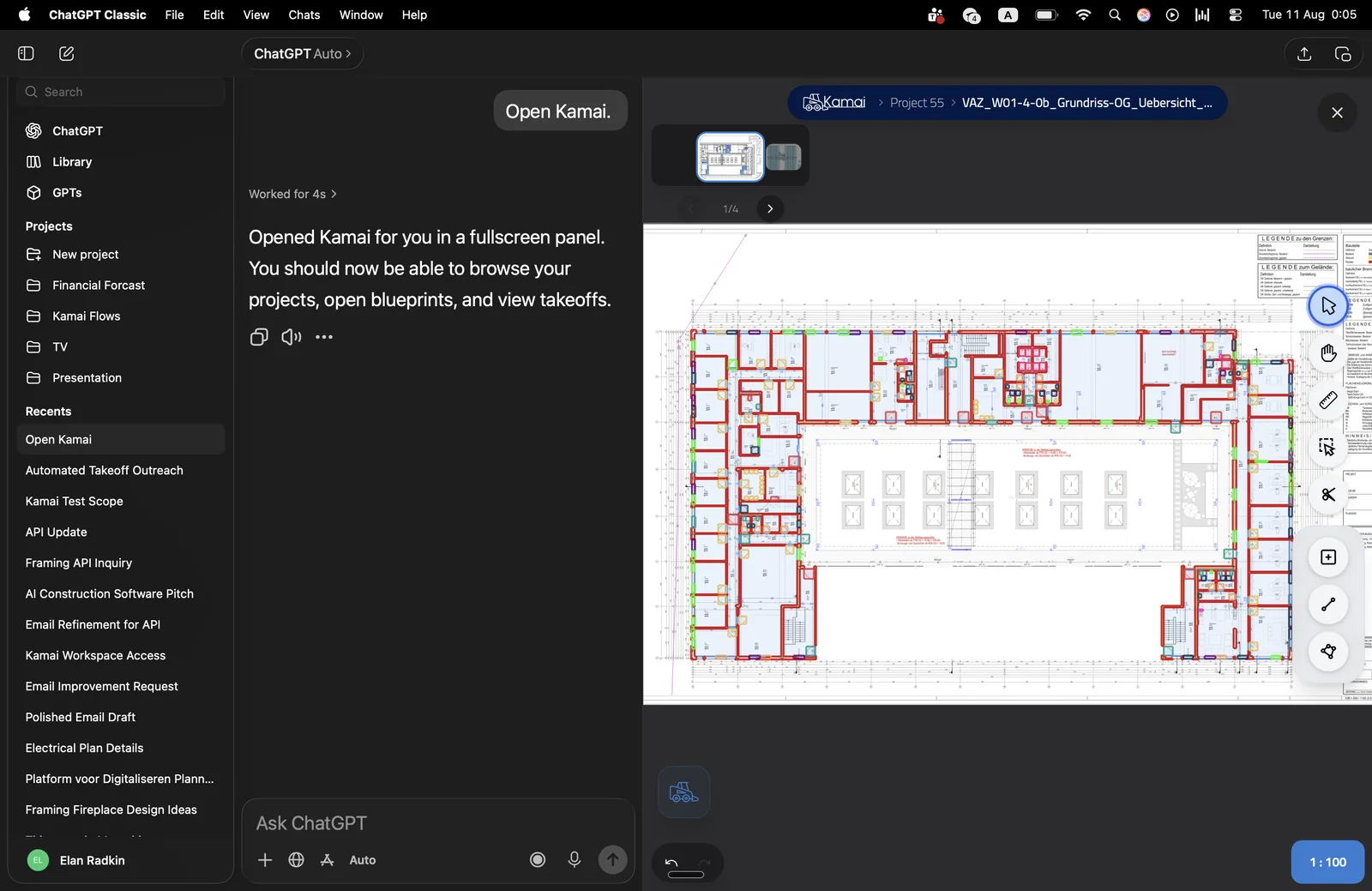
Kamai takes the tracing off your desk. You upload the drawings, Kamai's models read them, and you get back structured quantities you can review and adjust.
Upload the set, get quantities back
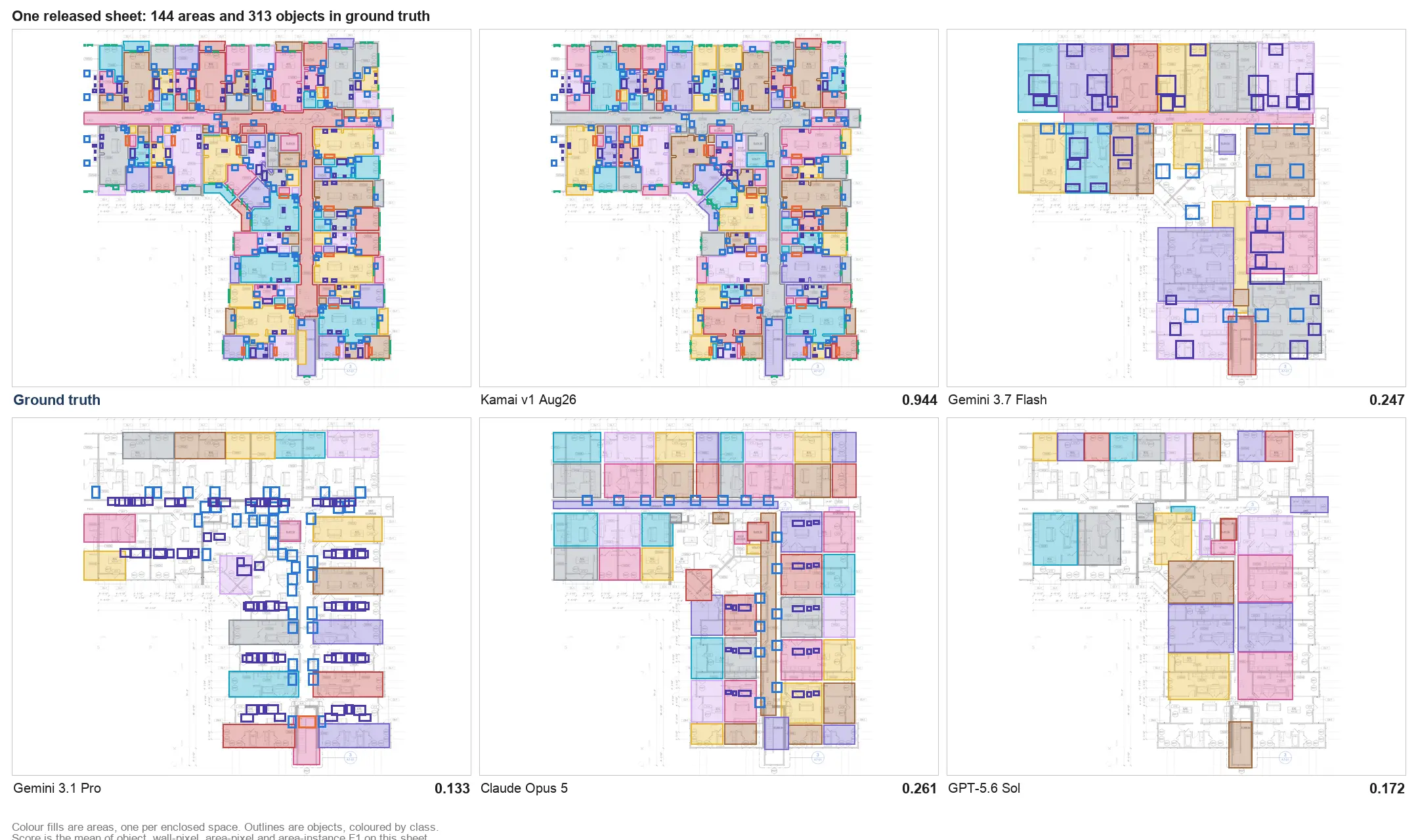
Upload your sheets and Kamai's models read the drawings the way an estimator would, only faster. They pick up the scale, follow the linework, and pull out the areas, volumes, and material counts the set actually describes. You are not tracing or clicking through every page to produce a starting number.
What lands on your screen is structured data, not a flat image you have to re-measure. Quantities come out as values you can sort, filter, export to Excel, and drop into a PDF takeoff package. Because the output is structured, it carries into the rest of your workflow instead of dying inside a markup tool.
From a 40-sheet set to a takeoff in minutes
The point of instant detection is the gap it closes. A drawing set goes from "something I still have to measure" to "quantities I can work with" in minutes. That changes what you do during the back half of a bid window.
Instead of racing to finish the takeoff, you spend that time on the parts that decide whether the bid wins or loses money: which line items carry the risk, where the design is still loose, what an addendum just changed. The measuring is done. The judgment is where you put your hours.
One scale, applied the same way every time
Manual takeoffs drift. The same plan measured by two people, or by one person at 9 a.m. and again at 6 p.m., rarely lands on the exact same number. Most of that drift comes from the scale: read it slightly off on one sheet and every quantity on the page inherits the error.
Kamai applies the same reading to every sheet in the set, so a wall is a wall whether it is on page 4 or page 44. You spend less time re-checking your own work and asking whether a dimension was a mistake or a real condition, and more time deciding what the verified numbers mean for the price.
Speed that does not cost you accuracy
Fast and rough is easy. Slow and careful is easy. The hard part of estimating has always been doing both inside a bid window, and that is where manual takeoffs force the trade-off. Kamai reads the set quickly and reports the quantities the drawings support, so a faster turnaround does not mean a looser number.
That matters most in preconstruction and bidding, when you are committing to a price on a set that may still be moving. Getting reliable quantities early leaves room to test scenarios before the bid is due, not after.
Decisions that start earlier
When the takeoff is no longer the bottleneck, the schedule moves up. You can price options, compare assemblies, and answer the project manager's "what if we switch this" while there is still time to act on the answer.
It also changes how you handle revisions. When a new sheet set or an addendum lands, you reanalyze the affected drawings and see the delta instead of restarting the count by hand. That keeps your numbers current through the rounds of changes every real project goes through.
What estimators do with the time back
Cutting the tracing does not make estimators less necessary. It points them at the work that actually needs a person. Scope coverage, cost analysis, risk on the line items that can sink a job, the conversations with subs and owners - none of that is measuring, and all of it gets shortchanged when measuring eats the week.
Kamai handles the repetitive extraction so your experience goes where it earns its keep. The same team can carry more bids without the quality of any single one dropping, because the hours that used to disappear into tracing are back on the table.
Scaling across sheets and disciplines
A single-trade plan and a coordinated multi-discipline set are very different to measure by hand, and the larger one is where manual work breaks down. Kamai reads large sets and holds the same approach across them, so the architectural, structural, and MEP sheets all get measured the same way without the count degrading as the page total climbs.
For a firm running several bids at once, that consistency is the point. The number that comes off a quiet renovation and the number that comes off a complex set are produced the same way, which makes them easier to trust side by side.
Skip the tracing, keep the judgment
Manual measuring is the part of estimating no one would choose to keep if the quantities could come from somewhere reliable. Kamai is that somewhere: upload the set, get structured areas, volumes, and material counts back, and start working the bid instead of building it from scratch.
The drawings have always held the answer. The work was getting it out of them by hand. Kamai does that part, and leaves the decisions to you.
Get the next post in your inbox.
Low frequency. High signal.