Plan Takeoff Inside Your Platform Using Kamai's Takeoff API
Embed plan takeoff in your platform with Kamai's Takeoff API: upload drawings, get structured areas, volumes, and counts back as JSON.

Most estimating and project-management platforms stop at the drawing. A user uploads a PDF set, and then the actual work of pulling quantities off it happens somewhere else: a standalone takeoff tool, a spreadsheet, or a measuring wheel and a printout. The numbers come back as a CSV that someone re-keys into your product. Every one of those handoffs is a chance to lose the scale, miss an addendum, or paste a wall length into the wrong row.
Kamai's Takeoff API removes the round trip. Your platform sends a drawing set; Kamai's models read it and return structured quantities you can drop straight into an estimate, a cost model, or a report.
The cost of sending users out to a separate tool
The usual takeoff flow is a relay race. Upload the plans into a measuring app, set the scale on each sheet, trace conditions, export, then import the results back into the system where the bid actually lives. Each leg adds time, and the seams between tools are where errors hide. A sheet gets measured at 1/8" when it was drawn at 1/4". A revised foundation plan from Addendum 2 never makes it into the takeoff. Shared walls between two units get counted twice.
For your users, that fragmentation slows the bid and erodes trust in the numbers. For you, it means the most valuable moment in the workflow, turning drawings into quantities, happens in a competitor's interface, not yours.
What the API does
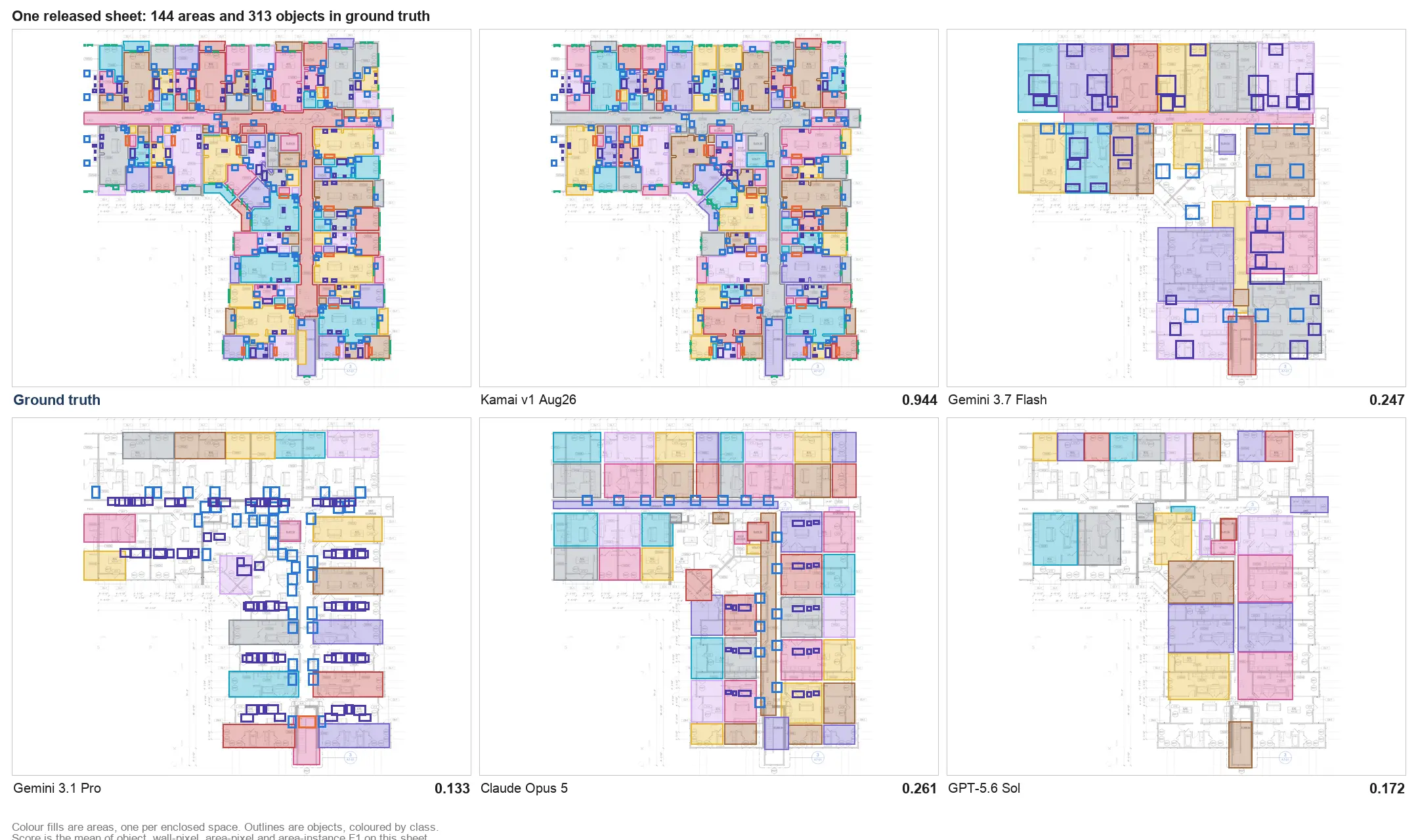
You post a drawing set to the API. Kamai's models interpret the sheets the way an estimator reads them: architectural plans for areas and finishes, structural sheets for framing and concrete, MEP sheets for fixtures and runs. Back comes structured data, not an image, areas, volumes, linear measurements, and counts, scoped to the conditions you asked for.
Because the response is JSON, your platform treats quantities as first-class data the moment they arrive. They can feed an estimate, populate a cost model, drive analytics, or roll up across a portfolio of projects. There is no export step and no re-keying, because the output never leaves a structured form.
Reading drawings instead of measuring them
Manual takeoff is linear: someone clicks every condition on every sheet, and a large set is a full day of tracing. Kamai's models do the interpretation, identifying the elements on a plan and returning the measurements, so your users start from quantities rather than from a blank canvas.
That shifts the user's time from clicking to checking. They review what came back, adjust assumptions, and move to pricing, which is the part of the job that actually wins or loses the bid.
Coverage across trades
The API isn't limited to one discipline. It pulls quantities across the trades an estimator works through on a typical set, the divisions that make up a full bid, so a platform can support concrete, framing, finishes, and the rest from a single integration rather than stitching together point tools per trade.
Built to run at volume
A general contractor's platform might process a few sheets for a tenant fit-out one hour and a hundred-sheet hospital set the next. The API handles both without a queue of estimators behind it, so takeoff capacity scales with your customer base instead of with headcount. The same drawing run twice returns the same quantities, which matters when several people on a bid team need to trust one set of numbers.
Fitting into what you already built
The API is an addition, not a migration. You keep your upload flow, your project model, and your UI; the takeoff call slots in wherever drawings enter the system. Users don't learn a new tool, and you don't rebuild a workflow to adopt it.
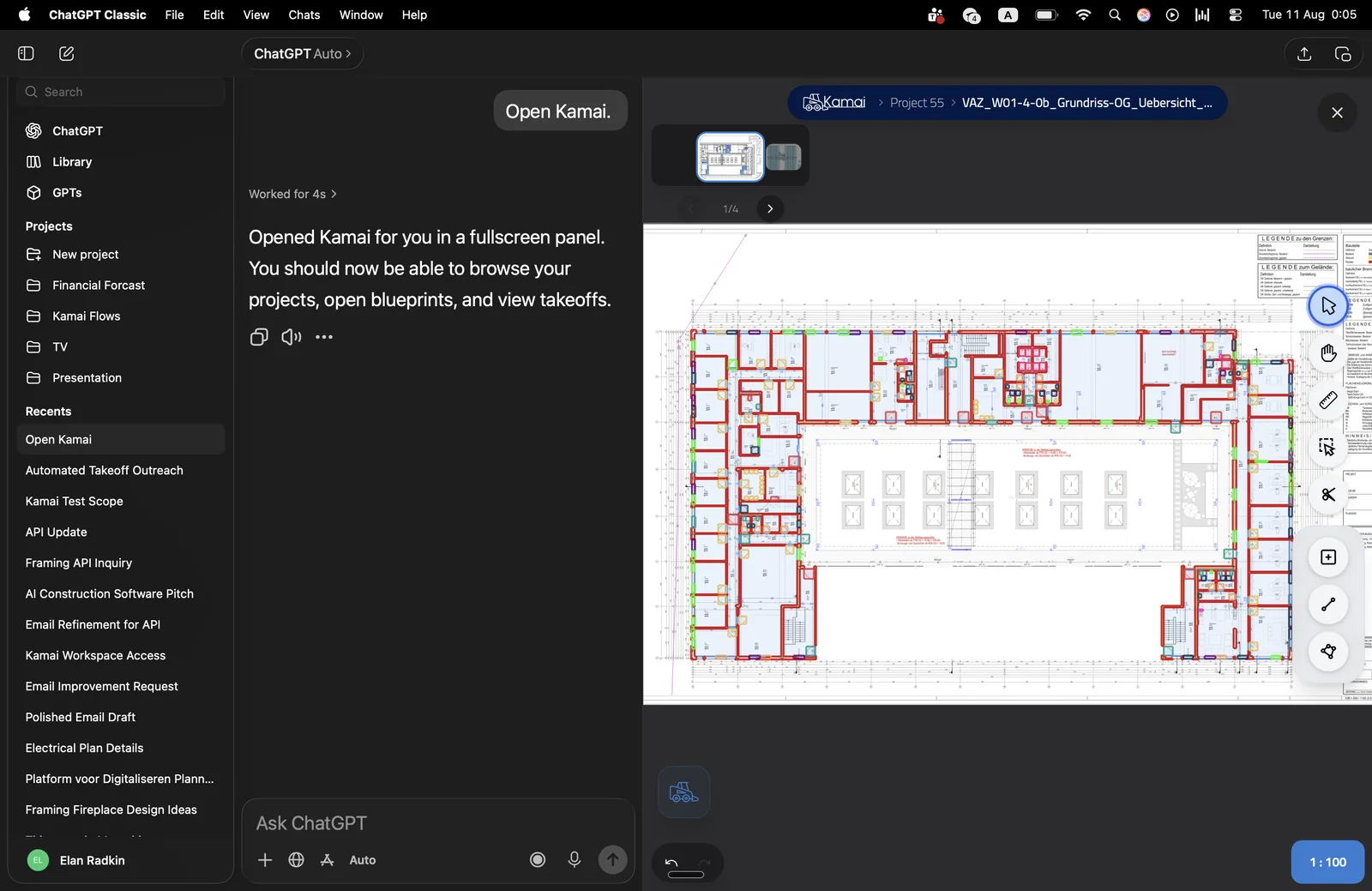
For teams that want a hands-on path alongside the API, Kamai's app at app.kamai.io covers the same takeoff with the AI assistant built in, so you can validate the output against the product your customers would otherwise have to leave for.
Where this leaves your platform
Takeoff is the step where a set of drawings becomes a number someone bids on. Keeping that step inside your product, with quantities arriving as structured data instead of a CSV to import, means your users finish a bid in one place and trust the totals when they get there. That is the difference between a platform that stores drawings and one that does something with them.
Get the next post in your inbox.
Low frequency. High signal.