Is Embedded Takeoff API suitable for all types of construction projects?
A takeoff API that reads PDFs and 2D drawings works across residential, commercial, infrastructure, and renovation. Here is why, and where the limits are.

Yes, with one caveat worth stating up front: a takeoff API earns its keep on every project type because every project type still ships as a PDF. Whether you are pricing a single-family remodel or a 40-sheet hospital fit-out, the quantities you bid on come off 2D drawings, and pulling those quantities by hand is the same slow, error-prone work regardless of scale. An embedded takeoff API attacks that work at the source, so the project type matters far less than the format of the documents, and the format is almost always a drawing set.
The caveat: a takeoff API is only as good as the inputs. A clean architectural plan set with a stated scale reads beautifully. A blurry scanned as-built from 1978 with handwritten markups is harder, and you should expect to verify more. That is true of any tool, including a human estimator squinting at the same sheet.
Why 2D drawings still run the job
BIM and digital twins keep getting promised as the end of 2D. On the ground, estimators, GCs, and planners still live in PDFs, scanned tender packages, and 2D drawings, because those are the documents the bid is contractually built on.
A few reasons 2D refuses to die:
- Liability. A contractor cannot price off the architect's model and call it a day. Quantities have to be independently verified to protect the margin, and verification happens against the drawings of record.
- The tender phase. Bidding usually means early or incomplete documents, delivered as PDFs, on a deadline. Nobody hands you a clean federated model two weeks before a bid is due. You get sheets, sometimes mid-addenda, and you make them work.
- Existing buildings. Renovations, retrofits, and additions rarely come with a complete digital model. You get legacy drawings, partial datasets, and field measurements.
So the ability to read accurate quantities out of a 2D input is not a niche need. It is the common denominator across the whole industry.
What an embedded takeoff API actually does
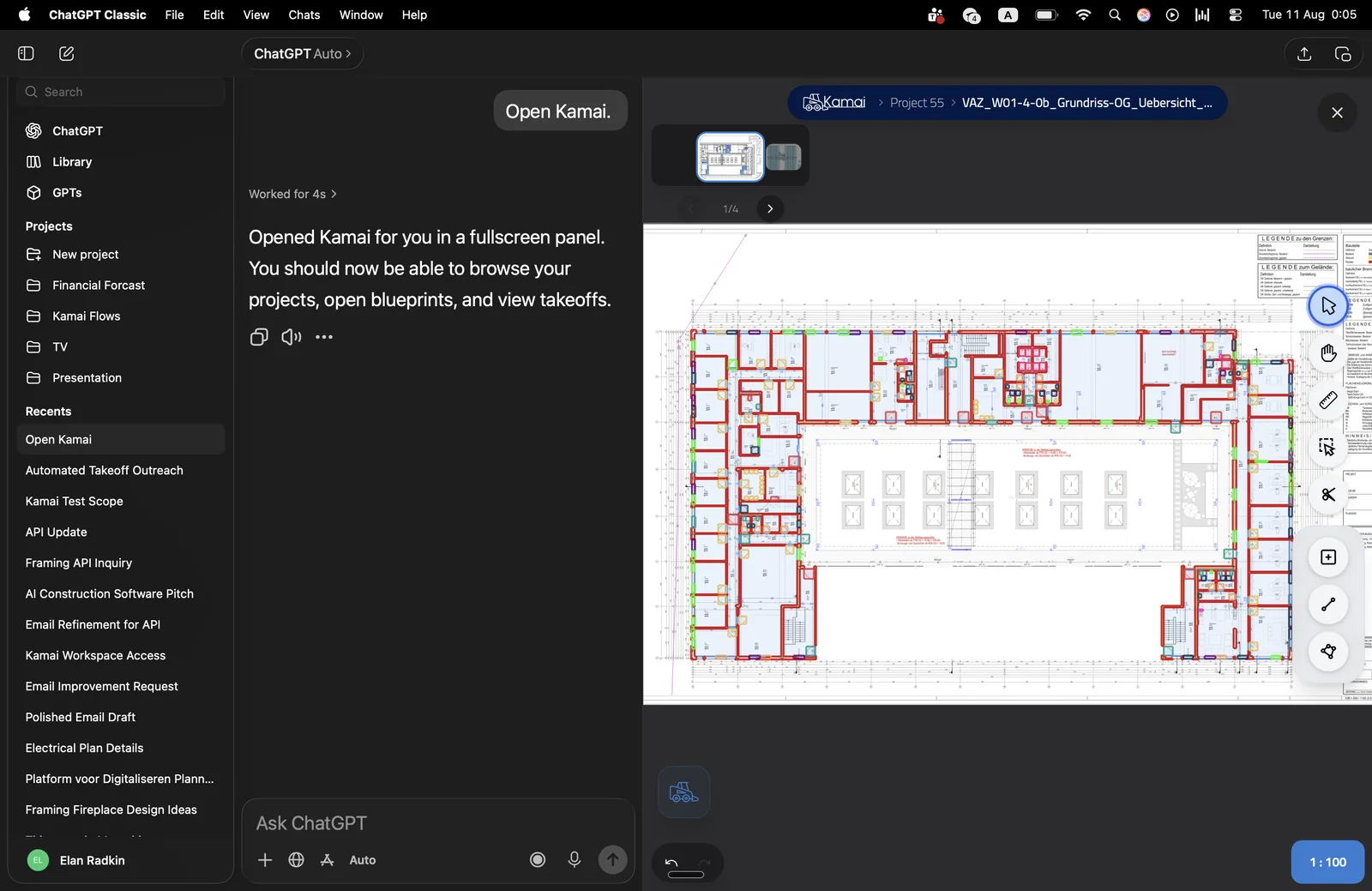
The point of an embedded API is that it works inside the formats and tools your team already uses. There is no requirement to stand up a BIM environment first. Kamai's models read PDFs and scanned drawings directly, which is why the same approach holds whether the project is a residential build, a commercial development, an industrial facility, or a piece of infrastructure. The job is identical underneath: turn drawings into quantities and structured data.
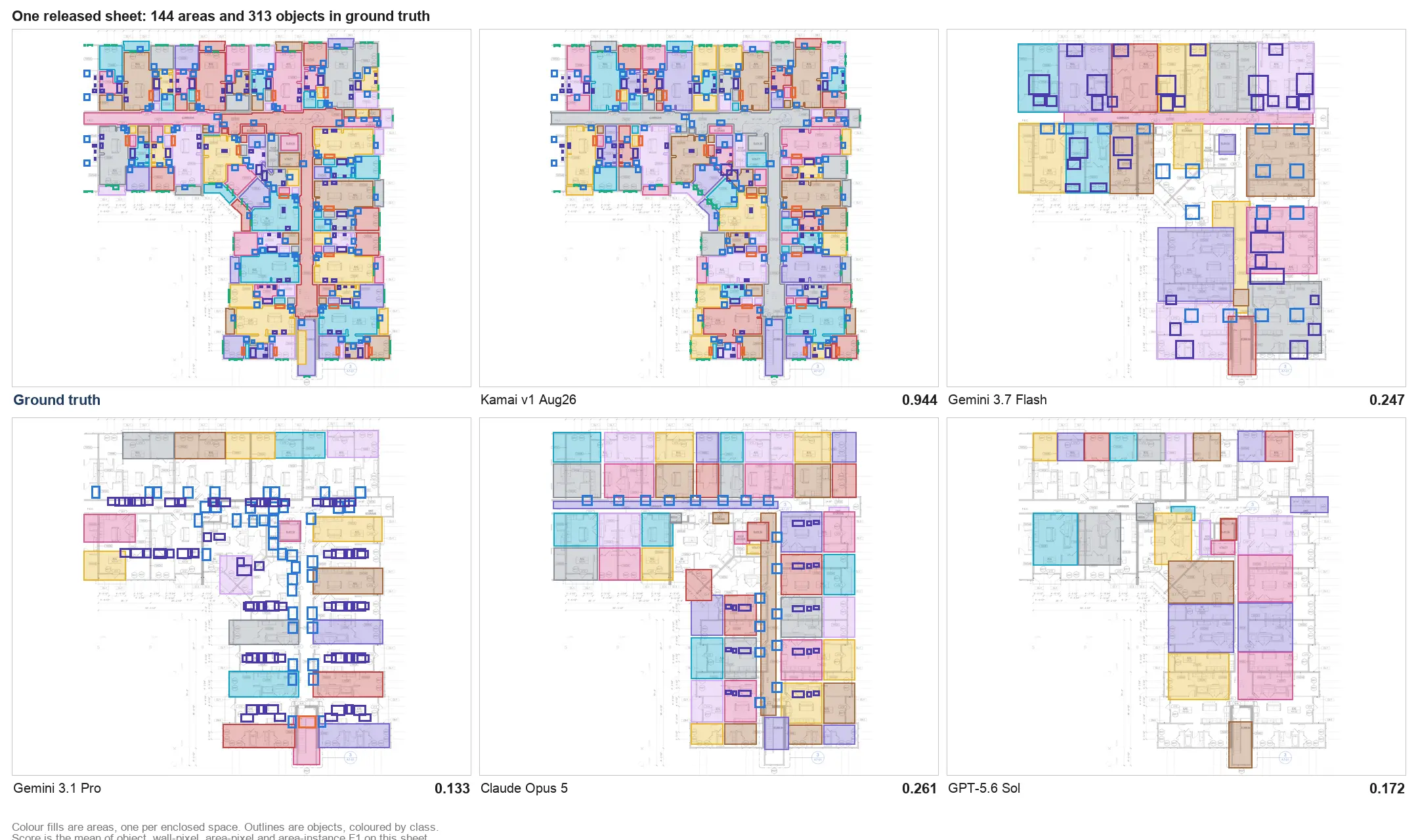
Kamai uses computer vision and in-house foundational models to do this, not OCR. The distinction matters. OCR reads text. Kamai's models read the drawing - they tell an architectural wall from a structural member, recognize MEP symbols, and hold onto spatial relationships like rooms and zones. The output is a structured dataset, not a pile of recognized characters.
Quantity takeoffs without the clicking
Upload a plan set and Kamai starts working the sheets: identifying geometry, detecting repeated elements, and pulling the counts. What comes back is areas, lengths, counts, and material quantities - the same line items you would otherwise build cell by cell in a spreadsheet.
The work is the same shape whether you are after flooring area for a residential unit or pipe runs for an industrial plant. That is the whole argument for project-type independence: the underlying operation does not change when the building does.
Whole sets, not single sheets
Real estimating is never one drawing. It is an architectural set, a structural set, MEP, and details, and the quantities have to reconcile across all of them. Kamai processes the full set rather than one sheet at a time, and it tracks the relationships between plans so a shared wall does not get counted twice or a stair shows up consistently across levels.
For a multi-floor, multi-discipline development, that is the difference between a coherent takeoff and a stack of disconnected sheet exports you still have to stitch together by hand.
Drawings you can ask questions of
Once a set is processed, the data is queryable. Rather than scrolling sheets or hunting through a spreadsheet, you ask: what are the room areas on level three, total wall length for partition type B, fixture counts across the set. The structured output comes back as JSON your own systems can consume, and the in-app AI assistant lets estimators interrogate the same data conversationally without writing a query.
This is where the embedded angle pays off. The quantities do not live in a takeoff tool you have to log into separately. They live in your workflow, exportable to Excel or PDF for the bid package, available over the API for whatever you have built on top.
Where it lands by sector
The format-first argument shows up differently depending on what you build:
- Residential. Fast material planning and quantity counts on plan sets that are usually clean and well-scaled.
- Commercial. The win is handling large, dense drawing sets without the days of manual measurement they normally cost.
- Infrastructure. Multi-discipline data and large-scale quantities, processed as one set instead of one sheet at a time.
- Renovation and retrofit. This is the hard case, and it is the one where automation helps most: legacy drawings, missing models, partial data. You still verify more, but you are not starting from a blank page.
What you get back from removing the manual pass
Hand takeoff is one of the largest sources of both wasted hours and quiet errors in a bid - wrong scale on an imported sheet, a missed addendum, a double-counted shared partition. These mistakes do not announce themselves; they surface as a margin that evaporates on the actual build.
Automating the measurement pass does two things. It cuts the hours, and it removes a whole class of transcription error. What it frees up is the part that actually needs an estimator's judgment: scoping, pricing strategy, constructability, and the cost analysis that wins or loses the job. The quantities should be table stakes. The thinking on top of them is where the work is.
So, all project types?
Yes, with the honest version of the answer. Every construction project relies on reading accurate quantities off drawings, and every project carries the same drag of doing that by hand. A takeoff API that reads PDFs and 2D drawings meets the industry where it already is, which is why the project type is the wrong question. The right question is whether your documents are legible enough to extract from - and across residential, commercial, infrastructure, and even messy renovation sets, the answer is usually yes.
Get the next post in your inbox.
Low frequency. High signal.