How to Turn Construction PDFs Into Accurate Quantities in Minutes
How Kamai reads construction PDFs and returns reviewable quantities in minutes, so estimators spend their time on bids instead of tracing lines.

A set of bid documents lands in your inbox at 4 p.m. on a Tuesday. The bid is due Friday. Inside is a multi-sheet PDF: architectural plans, structural, a full MEP package, a finish schedule, and an addendum that quietly revised three of the plan sheets. Before you can price anything, someone has to open every sheet, confirm the scale, and start tracing.
That tracing is where most estimating time goes, and it is also where most estimating risk lives. Kamai reads the PDF instead and returns quantities you can check against the drawings in minutes.
Why PDFs slow estimating down
The PDF is the lingua franca of construction documents, and it is a terrible format for getting work done. A drawing set is a stack of flat images. The geometry that a wall, a slab, or a duct run represents is locked inside lines and symbols that mean nothing to a spreadsheet.
So the estimator becomes the parser. You read each sheet, interpret the linework, measure off the scale, count fixtures and openings, and retype the totals into an estimating package by hand. Every one of those steps is a place to drop a number or misread a callout.
The usual failure modes are boring and expensive. A sheet gets measured at the wrong scale because the title block said 1/8" and the plotter output it at something else. An addendum revises a partition layout and the old quantities never get updated. A shared demising wall gets counted twice because two people split the floor plan between them. None of these are exotic mistakes. They are what happens when a person is tracing hundreds of lines against a Friday deadline.
What Kamai does with the drawing
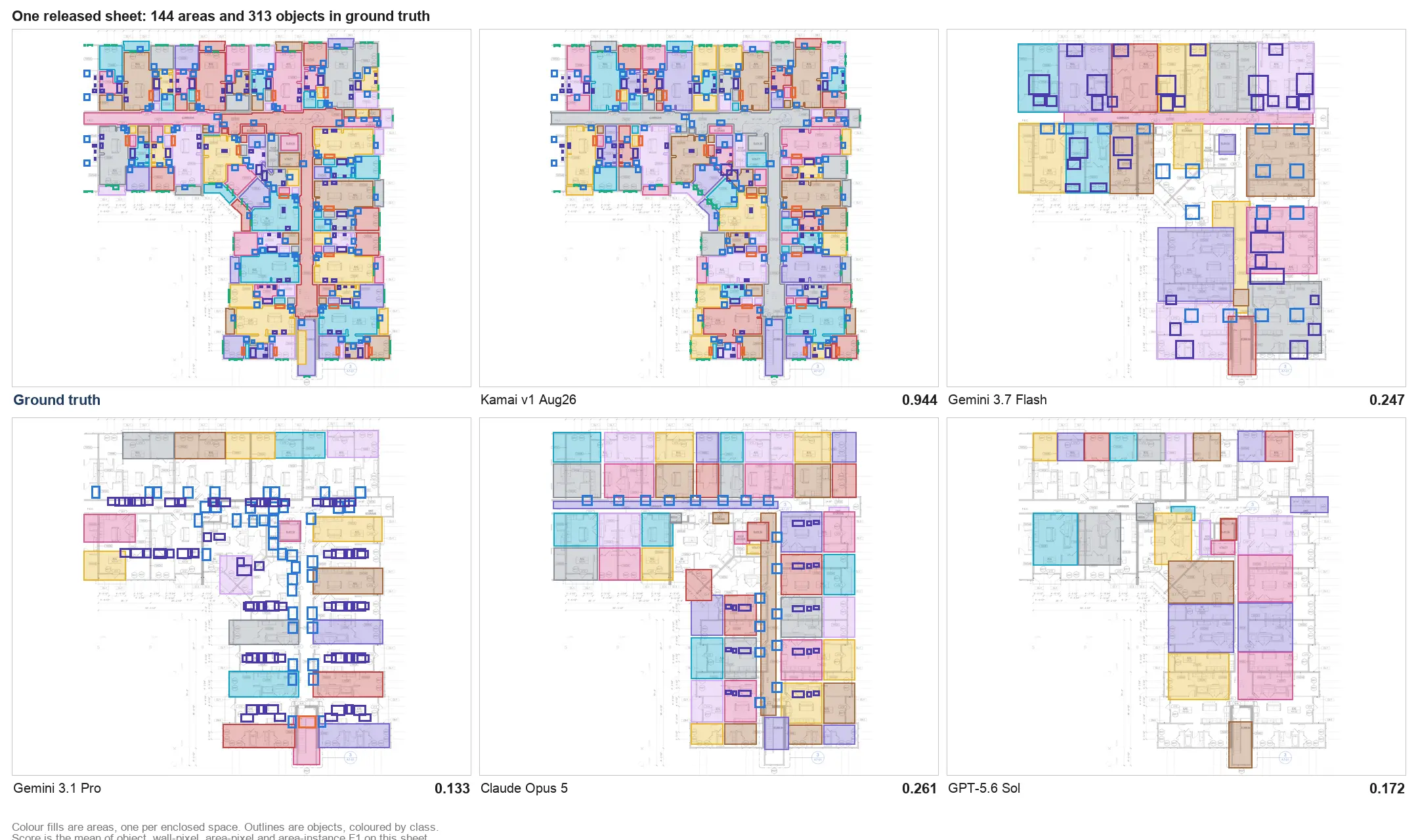
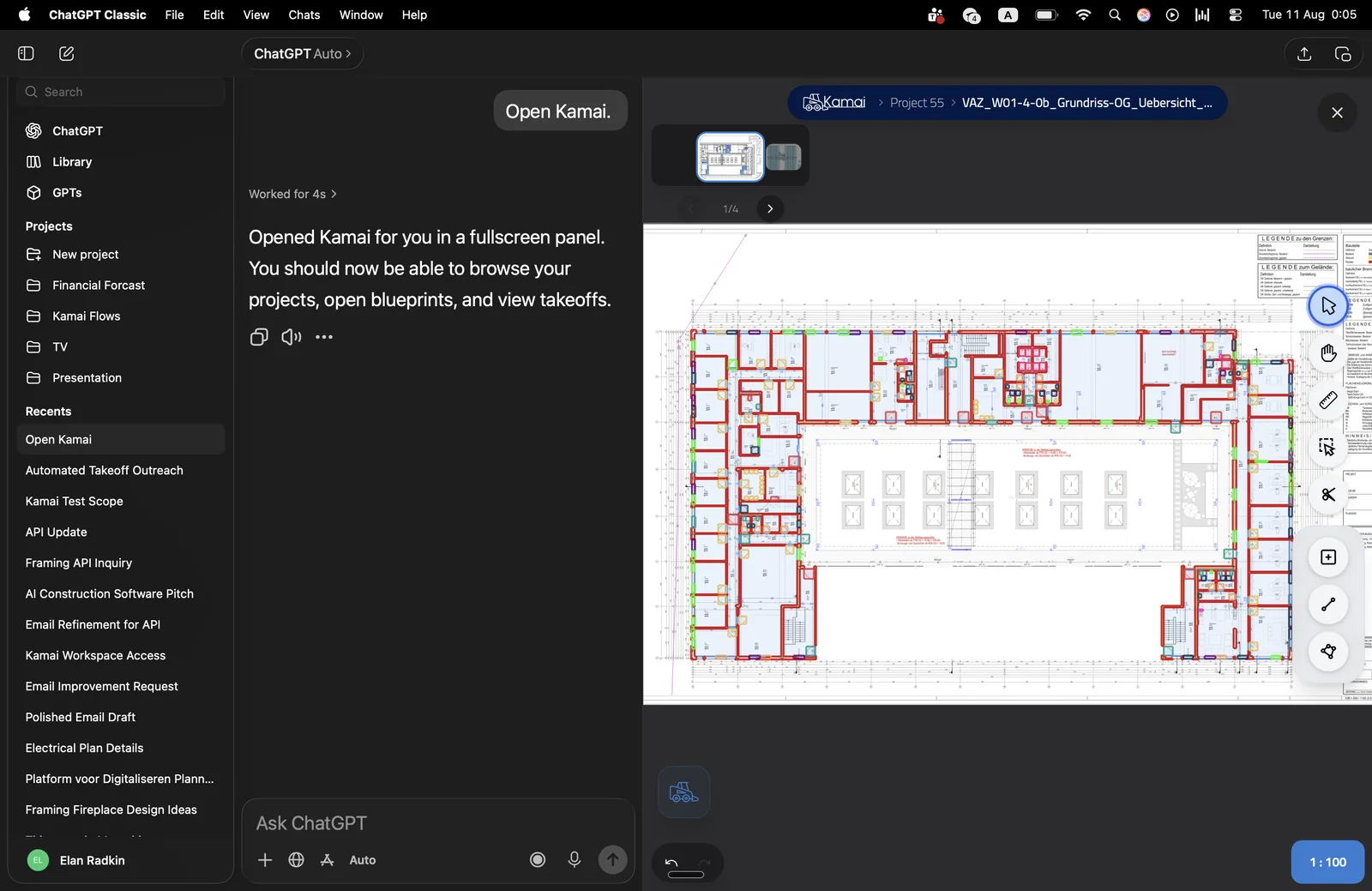
Upload the PDF and Kamai's models read it the way an estimator does, sheet by sheet. The models were trained on construction documents, so they recognize what they are looking at: plan views, sections, schedules, the scale in the title block, the symbols for doors, windows, and fixtures, and the conventions that separate an architectural sheet from a structural or MEP one.
From that, Kamai produces structured quantities instead of a pile of images. Areas and volumes, materials and coverings, doors and windows, and the installation losses and allowances that a takeoff has to account for all come out as data you can read, sort, and check against the source drawings.
Because the quantities are extracted from the sheets themselves rather than re-keyed by hand, they stay tied to what the drawings actually show. When you review a number, you are reviewing the drawing, not someone's transcription of it.
Reviewing instead of measuring
The point is not that the work disappears. It is that the work changes. Instead of spending the first two days of a three-day bid tracing geometry, you spend that time reviewing extracted quantities and pricing the job.
The output is structured, so it moves into the next step without a round of manual data entry. Export quantities to Excel or PDF, or pull the structured data into your estimating package, internal systems, or analytics. The same data feeds procurement and project setup downstream, which is where re-keyed numbers usually drift out of sync.
When you have a question about a takeoff, the AI assistant in the Kamai app answers it against the actual sheets. Ask what is driving a square-footage total or which sheet a count came from, and you are checking the work rather than redoing it.
Consistency across a portfolio
Two estimators handed the same plan set will produce two slightly different takeoffs. That is not a knock on either of them. It is the nature of manual interpretation, and it is why the same scope can get priced three different ways across three offices.
Kamai applies the same reading to every set. The logic that finds a wall or counts a fixture does not change between projects or between people, so a firm running many bids at once works from a consistent baseline. For a distributed team, that matters more than any single time savings, because it means a number means the same thing no matter who pulled it.
Where this helps and where judgment still rules
Faster, repeatable quantities give you room to do the part of estimating that actually wins or loses money: evaluating cost, comparing alternates, catching scope gaps, and pricing risk. Those are judgment calls, and they are better calls when they are made early in the bid window instead of in the last hour before submission.
Kamai handles takeoff across a range of trades and divisions and scales from a small tenant fit-out to a large infrastructure package. What it does not do is replace the estimator. It hands you reviewable quantities tied to the drawings, fast enough that you can spend the saved hours on the decision, not the measurement.
Get the next post in your inbox.
Low frequency. High signal.