How to Overcome Manual Estimation Challenges with a PDF Takeoff API
How a PDF takeoff API automates quantity extraction from construction plans, so estimators stop tracing walls by hand and bid faster.

A commercial bid set can run hundreds of sheets across architectural, structural, and MEP disciplines, with thousands of elements to count. For most of the history of the trade, an estimator worked through all of it by hand: print the plans, scale a ruler against the drawing, trace every wall, count every fixture, and key the totals into a spreadsheet. Good estimators got fast at it. None of them got fast enough to make the math work when three bids land in the same week.
A PDF takeoff API attacks that bottleneck directly. Instead of tracing geometry sheet by sheet, you send a plan set to the API and get back structured quantities - areas, lengths, counts - in minutes. This post walks through where manual takeoff breaks down, why PDF plans make it worse, and what changes when extraction is automated.
Where manual takeoff goes wrong
The cost of manual takeoff is not just the hours. It is the specific, repeatable ways a hand count fails under deadline pressure:
- Missed scope - a fixture schedule on a sheet nobody opened, or a detail callout that never made it into the count.
- Wrong scale - a sheet plotted at a different scale than the rest of the set, or a ruler calibrated once and trusted for the next two hours.
- Double counts - shared walls counted from both rooms, or an element tallied on the plan and again on the section.
- Spreadsheet rot - a formula dragged one row too far, a unit left in feet when the column expects inches.
- Version drift - measuring off a sheet that an addendum already superseded.
None of these are exotic. They are the everyday slips that turn into a material shortage on a Tuesday or a margin that quietly disappears between award and closeout. And the tighter the bid window, the more of them slip through, because the only lever a manual estimator has against the clock is to check the work less.
Why PDF plans make it harder
Most projects still bid off 2D PDFs. Even teams with full BIM models usually start from a flat tender set, because that is what the GC distributes. PDFs travel well, but they fight the estimator in a few predictable ways.
Scanned and low-resolution sheets
Plenty of plan sets are scans, not native exports. Faded text, broken linework, symbols you have to squint at. Every time an estimator zooms in to resolve an ambiguous detail, the count slows and the odds of a misread go up.
Missing or inconsistent scales
Some sheets arrive without a stated scale, or with a scale that drifts between drawings in the same set. Before a single measurement is valid, someone has to calibrate against a known dimension. Get that calibration wrong by a hair and the error rides through every quantity on the sheet.
Revisions and addenda
Drawings change all the way through bidding. Addenda reissue sheets, revisions move walls, and it is not always obvious which version is current. Estimate from a superseded sheet and the rework is expensive, assuming you catch it at all.
Overlapping disciplines
Mechanical, electrical, and plumbing runs intersect with walls, ceilings, and structure. To avoid missing scope, an estimator constantly cross-references the architectural background against the MEP overlays, jumping between sheets to confirm what belongs to whom. That cross-referencing is exactly the kind of tedious, error-prone work that eats an afternoon.
What changes with an automated takeoff API
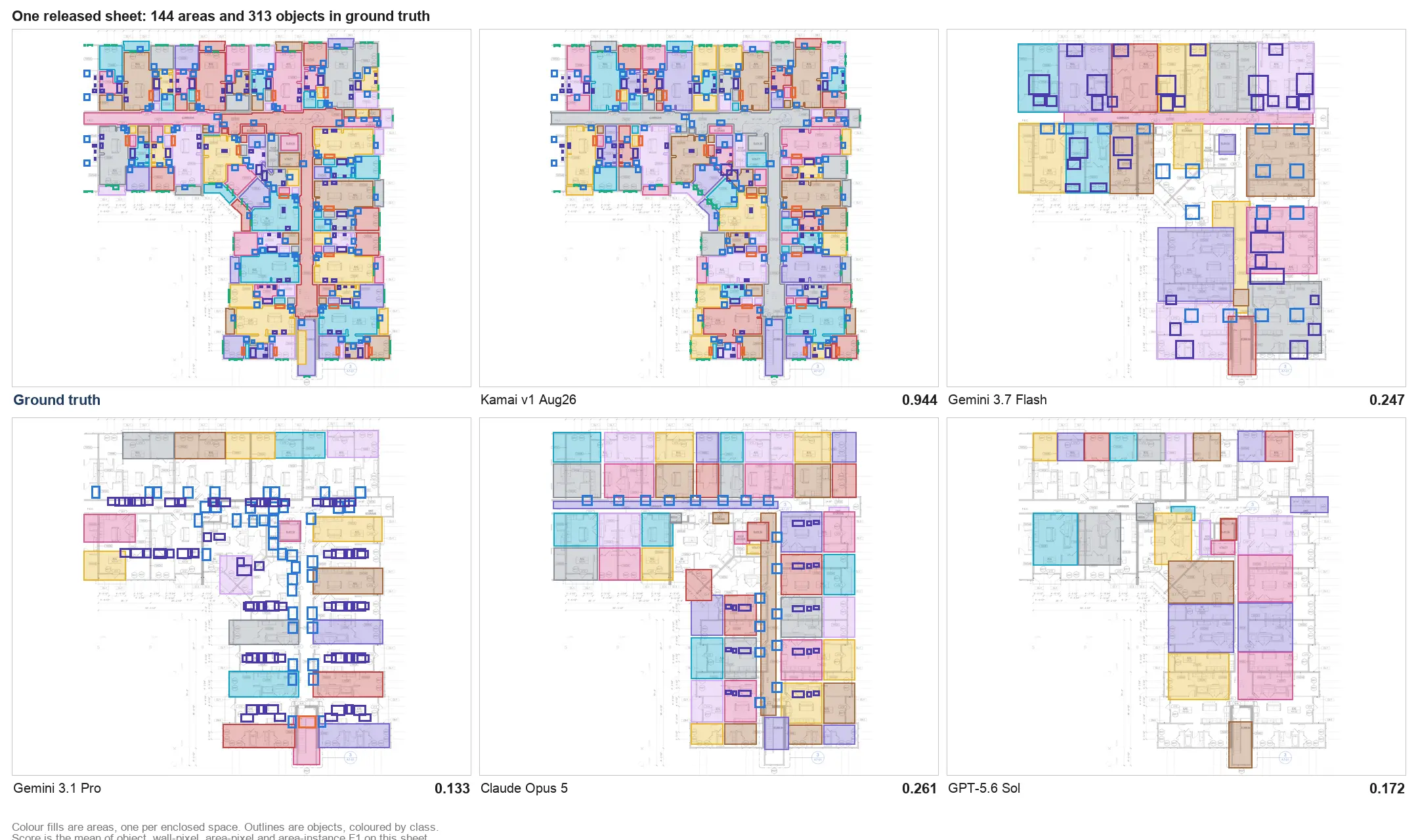
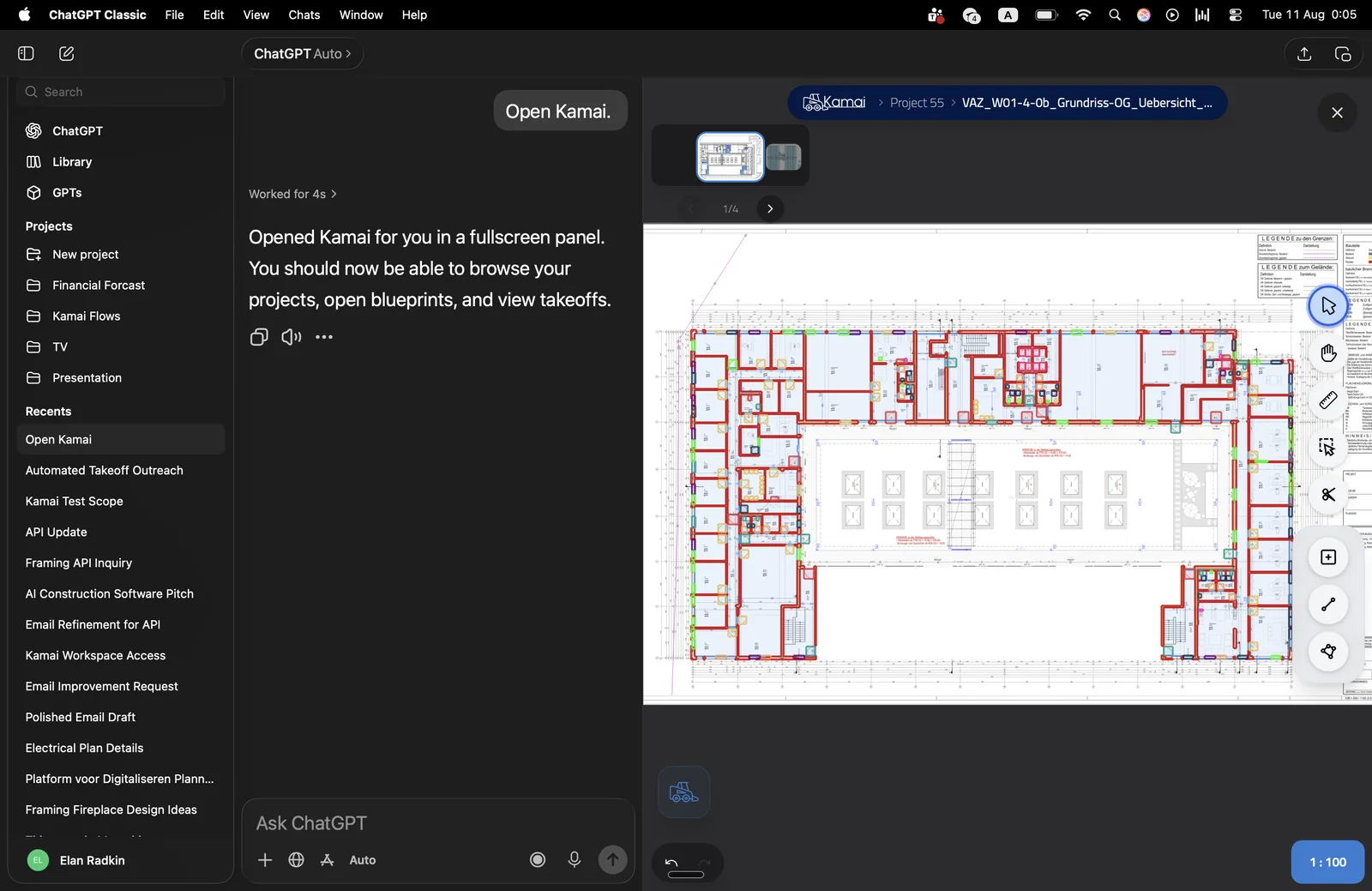
A PDF takeoff API reads the drawing instead of asking a person to. Kamai's models analyze each sheet with computer vision and return the quantities as structured data, so the geometry that used to take days of tracing comes back in minutes.
Extraction comes back as data, not pixels. From an uploaded plan set, Kamai identifies areas, lengths, volumes, fixtures, rooms, material quantities, and MEP components, and hands them back as structured JSON. That last part matters: the output is not a screenshot of a colored-in plan, it is data your systems can consume directly. You can export it to Excel for pricing, drop it into a PDF for the bid file, or pipe the JSON straight into procurement and scheduling tools.
Consistency improves because the process stops depending on whose ruler it was. Hand two estimators the same sheet and you get two slightly different counts. The API applies the same analysis to every set, which strips out the person-to-person variance that makes manual takeoffs hard to audit. When a number looks off, you can interrogate it with Kamai's AI assistant inside the app rather than re-tracing the sheet to find out where it came from.
Speed turns into more shots on goal. Bidding rewards turnaround. When a set that used to take days comes back in minutes, the constraint shifts off measurement entirely. Teams use that headroom to:
- Bid work they would have passed on
- Take on larger packages without adding estimators
- Re-run a takeoff against a fresh addendum instead of dreading it
- Spend the recovered hours on pricing and scope, where judgment actually pays
That last point is the real trade. The hours an estimator saves not tracing walls are hours spent on the parts of the bid a machine cannot do: vendor strategy, risk, the call on whether to chase the job at all.
From a flat plan to numbers you can act on
A PDF is a sealed container. The quantities are in there, but getting them out by hand is the whole problem. Once Kamai extracts them, the same dataset feeds the rest of preconstruction: pricing the estimate, planning procurement, forecasting budget, sequencing the schedule, and validating scope against the drawings. The takeoff stops being a one-off chore and becomes the source the downstream work pulls from.
Manual estimating will keep producing missed scope, scale errors, and version mix-ups as long as the count happens by hand under a deadline. A takeoff API does not make those failure modes smarter to manage. It removes the manual step where most of them start. For a contractor weighing whether to keep tracing plans by ruler, that is the case to weigh - not novelty, just fewer afternoons lost to work a model can do in minutes.
Get the next post in your inbox.
Low frequency. High signal.