From 2D Plans to Accurate Estimates: Solving the Data Gap in Construction
How Kamai reads 2D plans and PDFs to pull structured quantities, so estimators spend less time tracing walls and more time pricing the bid.

A bid set lands in your inbox at 4 p.m.: forty sheets of architectural, structural, and MEP drawings, two addenda that moved a stair and changed a wall type, and a submission deadline three days out. Everything you need to price the job is in those PDFs. None of it is in a form you can actually use yet. That gap, between what a drawing contains and what an estimate requires, is where most of the takeoff hours go.
The industry talks about BIM, digital twins, and connected project ecosystems, but the day-to-day reality is still 2D. Scanned blueprints, consultant markups, revised PDFs, and tender packages drive the work. Estimators read lines, symbols, and notes by eye and retype the results into a spreadsheet. The data is right there in the sheets. It just isn't structured.
Why 2D plans still run the job
Coordinated models rarely show up when you need to bid. At tender stage you get partial sets, revised PDFs, and incomplete design packages on a deadline. A model, if one exists, often isn't shared.
Even when there is a model, plenty of contractors won't price off it. Scope omissions, coordination gaps, and commercial risk all sit on you, not the designer, so the quantities get verified independently.
Then there's the existing-building work. Renovation, retrofit, and legacy assets usually have no usable model at all. The archived plan set, or a scan of one, is the only source of truth. For a large share of the market, estimating starts where it always has: at a 2D drawing.
What the data gap actually costs
A single sheet can hold everything you need to price a scope and still cost you a day to extract it. You open multiple sheets, scale them, measure walls, calculate areas, count fixtures, reconcile a revision against the version you already took off, and move the numbers into your estimating software. On a large package that runs into hours or days.
Along the way, the failure modes stack up:
- A wrong scale setting that throws every length on the sheet
- Miscounts on fixtures, doors, and devices
- Shared walls double-counted between adjacent rooms
- Scope buried three sheets deep that nobody catches
- An addendum that lands late and silently invalidates a finished takeoff
- Two estimators measuring the same plan and landing on different numbers
A slow estimate misses the deadline. An inaccurate one wins the job and loses the margin. Both come out of the same bottleneck.
Accurate estimates start with the inputs
Pricing inherits whatever quality the quantities had. Wrong material counts make the unit pricing meaningless. An incomplete room area underestimates the finishes. A missed revised sheet blows the labor budget before a single crew shows up.
So the point isn't to digitize paperwork. It's to turn a static drawing into structured quantities an estimating team can stand behind. That's the problem Kamai is built for.
How Kamai reads a drawing
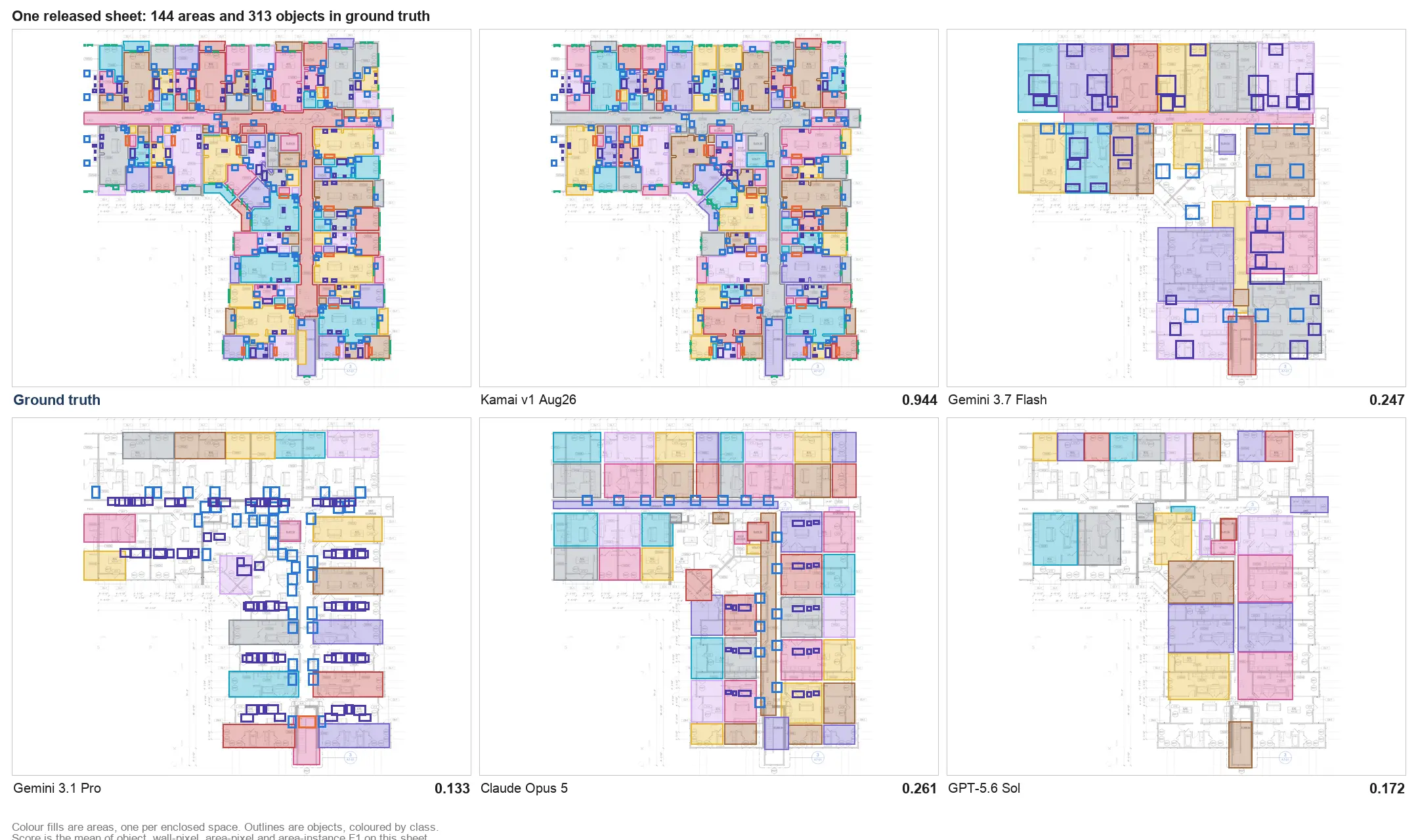
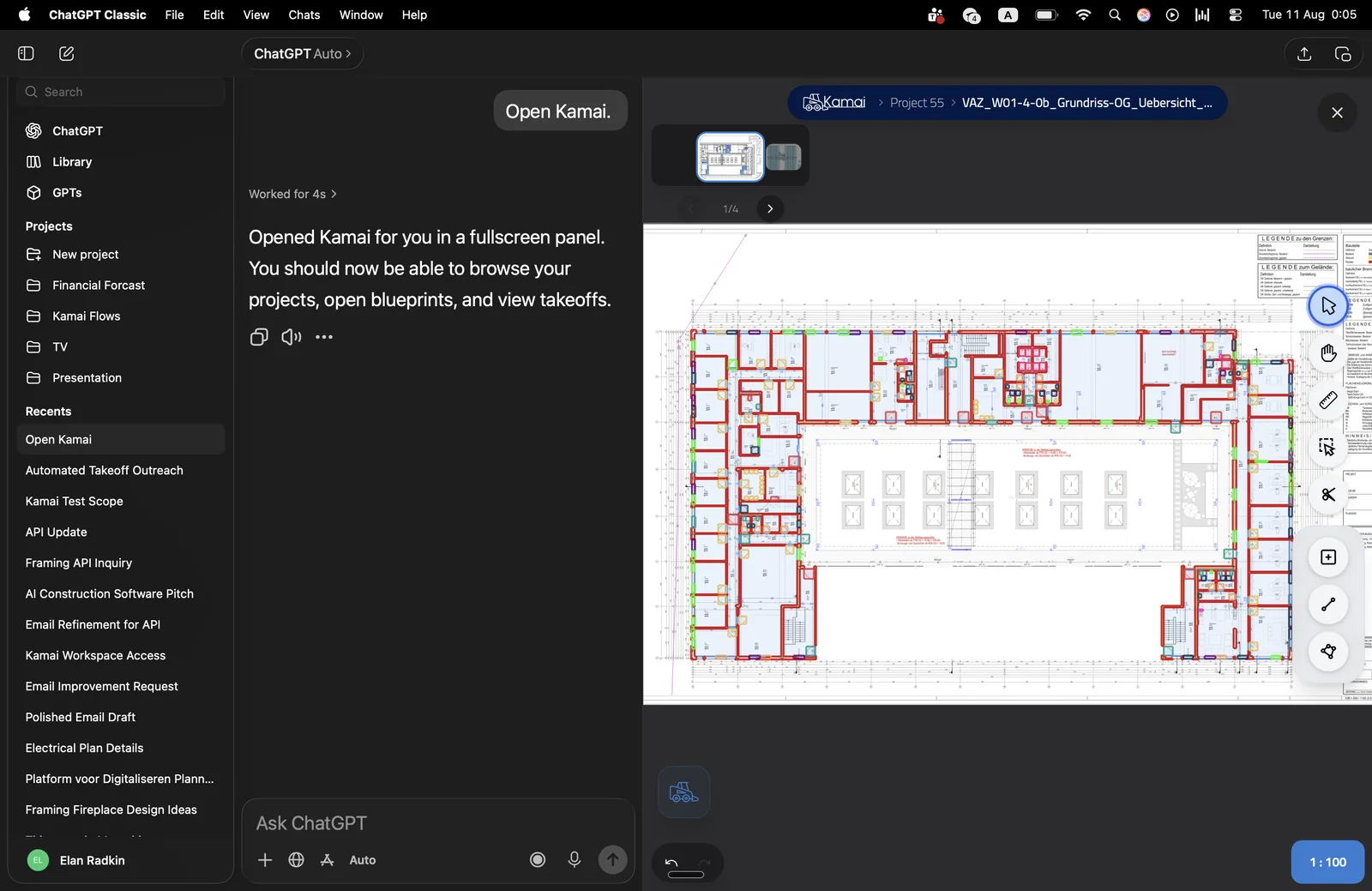
Kamai's models run on the uploaded plans, PDFs, and scans directly. Using computer vision, they read a sheet as a data source rather than a flat image, picking up architectural elements like rooms, walls, openings, floor zones, and measurable surfaces, along with many of the symbols and patterns that define scope.
Instead of tracing every space and measuring every wall by hand, you upload the set and get quantities back: areas, dimensions, wall lengths, and room data, in a structured form. The work shifts from manual review to checking and using the output.
Where the recovered hours go
Takeoff eats a large slice of every bid cycle, and it's your most skilled people doing it. Hours that could go to pricing strategy, subcontractor outreach, or risk review get spent on measurement.
Move that measurement off their plate and the time goes somewhere useful:
- More bids out the door before the deadline
- The same team covering more projects
- Less overtime when several deadlines collide
- More room for bid review and sharpening the number
- Quantities that come out the same regardless of who ran them
Speed alone isn't the win. Speed with quantities you trust is.
Accuracy is a margin question
In a trade with thin margins, a small takeoff error has an outsized bill. Drop a section of flooring, undercount the fixtures, or price off a superseded sheet, and the profit on the job goes with it.
Because Kamai's models pull quantities from the source drawing the same way every time, you get repeatable extraction instead of one person's interpretation on one particular afternoon. That consistency is what lets a team tighten contingency, plan procurement against real numbers, and defend pricing when a change order gets disputed.
Full sets, not single sheets
Real packages don't arrive as one tidy drawing. You get architectural, structural, MEP, reflected ceiling plans, revisions, and several floor levels, all at once. Handled by hand, that volume is where inconsistencies creep in.
Kamai processes the whole set rather than a page at a time, recognizing repeated layouts across floors, zones, and project-wide quantities. On an apartment development, a hotel, a hospital, a school, a commercial tower, or an industrial facility, that's the difference between rebuilding quantities sheet by sheet and seeing the package as a whole.
From reading sheets to querying them
Once a drawing is structured, you stop reopening plans to answer questions. Total wall length on Level 2, room counts above a given area: in a manual workflow that means pulling up the sheet and measuring again. With Kamai, those answers come out of the structured output, and the AI assistant in the app will pull them for you on request.
That matters mid-bid, during a scope review, or in a meeting where someone needs a number now and the plans are still rolled up on a desk.
It fits the workflow you already have
Most projects already show up as 2D plans, so Kamai works where the industry already is. The structured output goes where your estimate lives: export to Excel or PDF, pull the data over the API, or wire it into your stack through MCP. You're not abandoning your spreadsheets and estimating software. You're feeding them better inputs, faster.
The gain doesn't stop at bid day
Clean quantities outlive the bid. Procurement plans against real counts instead of padded guesses. Scheduling leans on scope data that holds up. The project team starts execution with stronger assumptions and fewer surprises waiting in the drawings.
That's the case for treating estimating tooling as more than an admin line item. The numbers you generate at tender set the terms for everything downstream.
The takeaway
2D plans aren't going anywhere, and they don't need to. The drawings already hold the data. The job is getting it out cleanly, before the deadline, without a wrong scale or a missed addendum quietly costing you the margin. That's the gap Kamai closes: the plans you already work from, turned into quantities you can price against.
Get the next post in your inbox.
Low frequency. High signal.