Extract Reliable Quantities From Floor Plans for Government and Infrastructure Projects
How Kamai turns government and infrastructure floor plans into auditable, structured quantities your agency can defend in review.

A public project lives or dies in review. When an estimator hand-measures a few hundred sheets for a courthouse or a transit hub, two things have to be true at the end: the numbers have to be right, and someone has to be able to explain how they got there six months later when an auditor asks. Manual takeoff is weak on both counts. It is slow, it varies by who held the scale tool, and it leaves almost no trail.
That last point is what separates public work from private. A private GC who overstates concrete eats the margin and moves on. An agency that overstates concrete on a federally funded job has to account for it in an audit, a contractor protest, or a hearing.
Why the numbers carry more weight on public work
Budgets are fixed before the project starts, timelines are published, and every decision has to survive an audit. The quantities feed three separate stages, and each one fails differently:
- Planning and funding. Feasibility and budget allocation ride on early counts. Overstate quantities and you tie up public funds that another project needed. Understate them and the budget request was wrong from day one.
- Procurement. Bid tabs and contractor selection depend on the quantities in the documents. If the takeoff is off, the award is built on a bad baseline.
- Execution. Material orders, scheduling, and progress draws all reference the original counts. An understated quantity here surfaces as a change order, a delay, and usually a dispute.
The data also has to be consistent across the portfolio. When every consultant and contractor measures their own way, you cannot benchmark a school against a school or standardize anything across regions.
What makes floor plans hard to read
Floor plans hold more scope information per sheet than almost anything else in the set. They define rooms, dimensions, and the spatial relationships that drive cost. They are also delivered as 2D PDFs drawn for a person to interpret, not for software to parse.
So the work goes manual: set the scale, trace the walls, count the fixtures, type the results into a spreadsheet. On a large infrastructure package that means hundreds of sheets, each one a chance to set the wrong scale on a detail, double-count a wall shared between two units, or miss a quantity that an addendum revised after the original issue. Two estimators working the same set will land on different totals, and neither can hand you a clean record of how they got there when the review starts.
From PDF to structured data
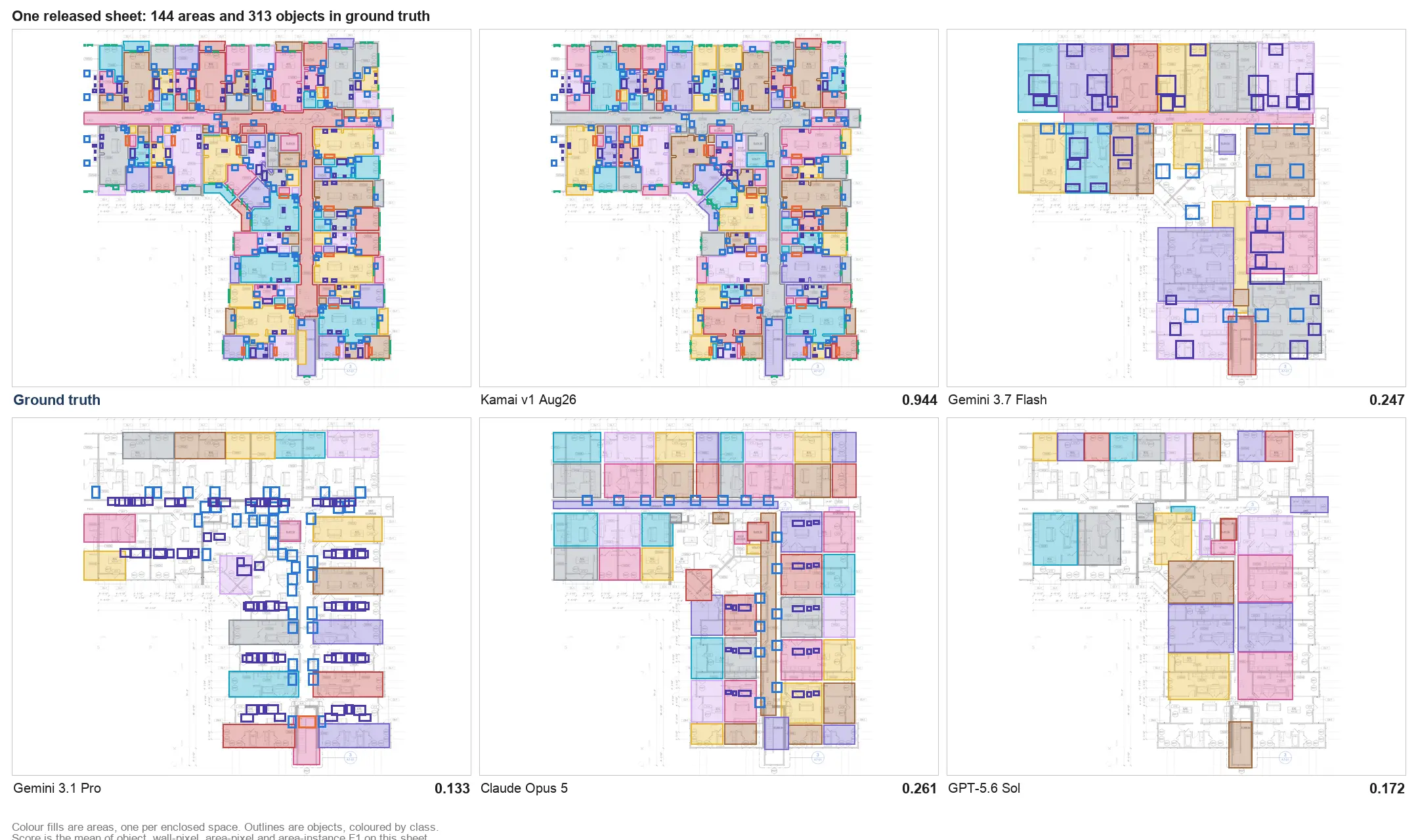
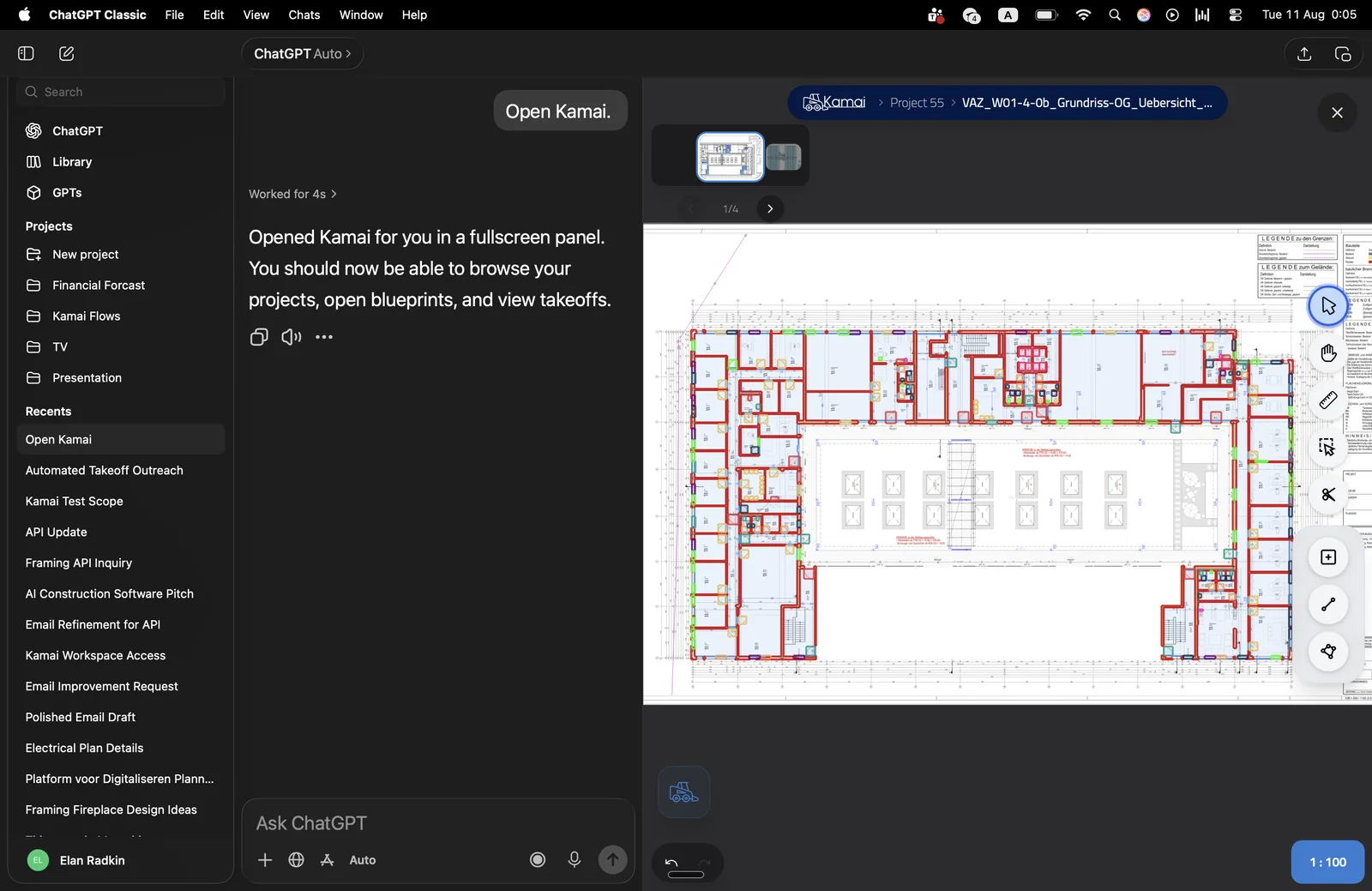
Kamai reads the drawing instead of looking at the image. Walls resolve to lengths, rooms to areas, and fixtures and components to counts. The output is structured data, exportable to Excel or PDF and available as JSON through the API, so the quantities move straight into your estimate, your reports, and your analytics without anyone retyping them.
Kamai's models are trained on construction and infrastructure drawings, so they recognize the conventions an estimator already knows: architectural, structural, and MEP sheet types, standard symbols, and the spatial relationships across a set. The same drawing runs through the same logic every time, which is the part manual takeoff cannot promise. Two runs of the same sheet produce the same numbers, and that repeatability is what makes the result defensible.
Standardization across agencies and contractors
The hardest problem in a large infrastructure portfolio is that different teams use different tools and arrive at numbers you cannot compare. Run every sheet through Kamai and the method stops depending on who did the work. A wall is measured the same way whether the drawing came from your in-house team or a consultant three states away.
That consistency is what lets you benchmark across projects, set up centralized oversight, and stop relying on a single estimator's habits to hold a program together.
Fitting into systems you already run
Agencies plan, procure, and manage assets in platforms that are already approved by IT and security. A new standalone tool that nobody signed off on is a non-starter. Kamai is API-first, so quantity extraction embeds inside the systems your team already uses. Quantities flow from the floor plan into the estimate or dashboard automatically, and you can ask the in-app AI assistant to pull or check a count without leaving the workflow. Nothing new to procure, nothing outside the security perimeter.
Auditability is the point, not a side effect
Every public decision has to be explainable, which is exactly where a manual takeoff leaves you exposed. Because Kamai produces structured, traceable quantities, you can review a number, validate it, and compare it across drawing revisions. When an addendum changes a corridor, the count changes with a record of what moved and why.
That trail is what holds up in a contractor protest or an audit. The estimate rests on consistent, verifiable data rather than one person's recollection of how they measured a sheet last quarter.
Where else it applies
The same extraction supports adjacent sectors. In construction it speeds preconstruction and tightens bid accuracy. In insurance it pulls quantities off plans and drawings for faster damage assessment and cost evaluation. The common thread is structured quantities produced fast enough to decide on.
Closing the gap between drawing and decision
Infrastructure packages keep getting larger, and manual takeoff does not scale with them. The agencies handling this well are connecting the drawing directly to the data: pulling reliable quantities early, flagging scope changes before they become change orders, and adjusting plans while there is still room to. That is the difference between catching a problem in preconstruction and absorbing it in a draw three months later.
For a public-sector team, the value is plain. The quantities come out faster, they come out the same way every time, and you can show your work when someone asks.
Get the next post in your inbox.
Low frequency. High signal.