Automate Your Takeoff Process for Maximum Efficiency and Profitability
How automating construction takeoff with Kamai cuts measurement time, reduces quantity errors, and lets estimators bid more work.

A takeoff is where every bid lives or dies. Get the concrete yardage, the linear feet of wall, or the fixture count wrong on a single sheet, and the error follows you all the way through to the number you submit. Most estimators still pull those quantities by hand: opening a 200-sheet PDF, setting the scale, zooming into details, tracing measurements, and typing the results into a spreadsheet. It works, but it eats the part of the day you would rather spend on pricing and bid strategy.
Automating the takeoff is the most direct way to get that time back without giving up accuracy. Kamai reads digital plan sets, pulls the quantities, and hands them back as structured data you can work from. Here is what changes when you stop measuring sheets by hand.
What a takeoff actually has to get right
The takeoff is the first real step in estimating, and everything downstream inherits its numbers. An estimator reviews the architectural, structural, and MEP drawings, then identifies and quantifies the materials the project needs: concrete and rebar, framing, fixtures, fasteners, finishes. Those counts and measurements become the cost projection and, eventually, the bid.
When the quantities are wrong, the consequences are not abstract. Underestimate, and you hit shortages mid-job that stall the schedule and force rush orders. Overestimate, and you have either padded the bid out of contention or eaten the surplus on your margin. The same numbers drive labor planning and equipment allocation, so a bad takeoff misroutes crews and gear too, not just material.
A few failure modes account for most of the damage:
- Reading a sheet at the wrong scale, so every measurement on it is off by a fixed ratio
- Missing an addendum that revised quantities after the original set went out
- Double-counting shared walls or assemblies that appear on more than one sheet
- Losing track of a detail in a dense set and leaving a line item out entirely
None of these are exotic. They happen because the work is repetitive and the sets are large, and human attention is the thing being asked to scale.
Why the manual workflow caps your output
A manual takeoff is slow in a specific way: it demands sustained concentration across hundreds of sheets, and the risk of a slip climbs as the set gets more complex. An estimator measuring individual components and double-checking calculations can only move so fast, and the bigger the project, the more of the day disappears into measurement.
That is the real cost. Estimators end up spending most of their hours tracing drawings instead of analyzing cost, coordinating with suppliers, or deciding which jobs are worth chasing. For a firm trying to take on more work, the takeoff becomes the bottleneck: you cannot bid more without hiring more, because the measuring does not parallelize.
What Kamai does with the drawings
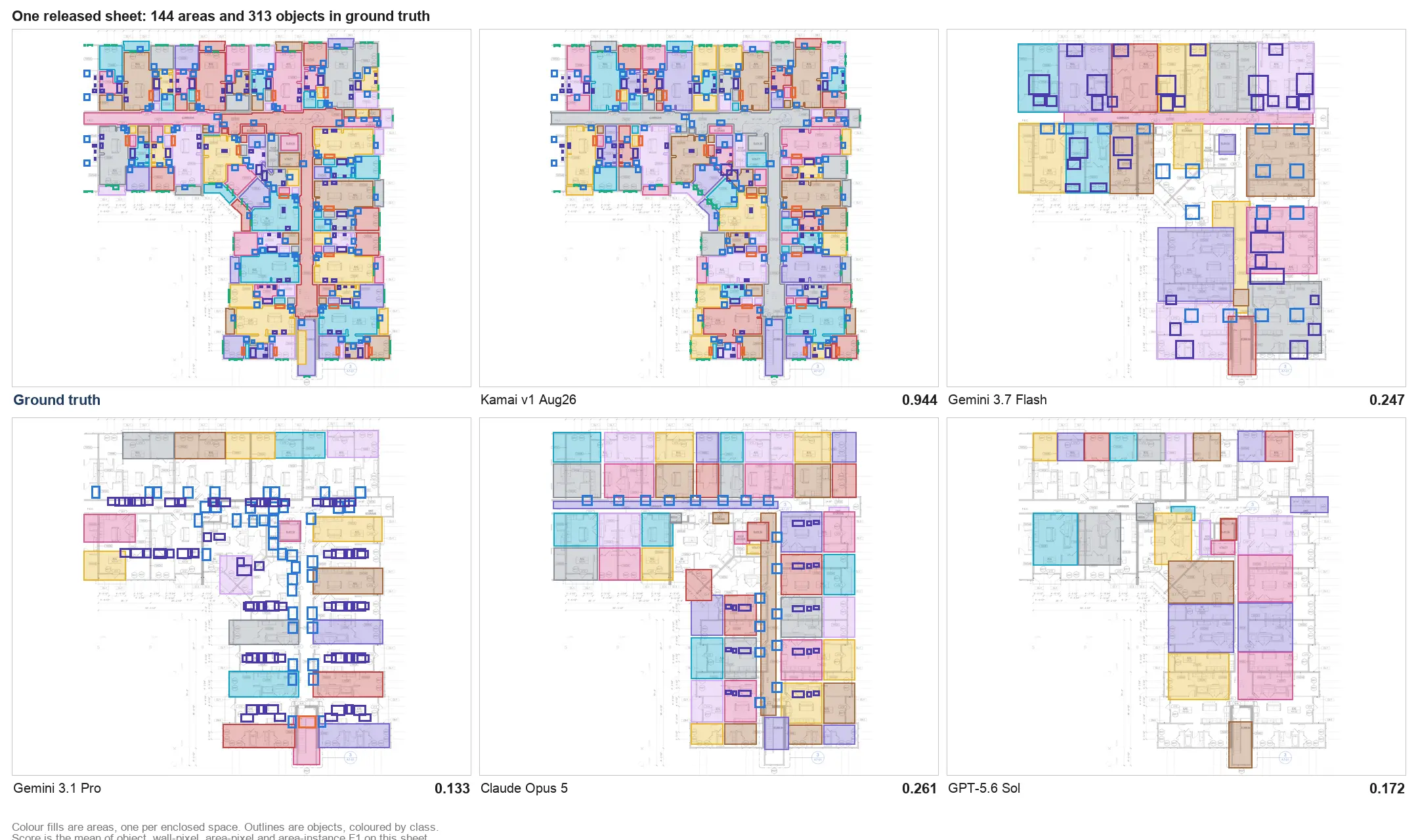
Kamai's models read the plan set and extract quantities directly, with little manual tracing on your end. The computer vision recognizes elements in the drawings, applies measurement rules consistently across every sheet, and converts what it finds into structured data rather than a static count. Because the same logic runs over the whole set, the kind of inconsistency you get when a tired estimator measures sheet 180 differently than sheet 12 largely goes away.
A few things that follow from that:
- Speed on large sets. Multi-trade projects and dense detail sheets that would take hours come back far faster, so a big set stops being a multi-day commitment.
- Consistent measurement. The rules are applied the same way everywhere, which cuts down on missed items and misread scales.
- Structured output you can use. Results come back as structured JSON and export to Excel and PDF, so the quantities drop into your existing pricing workflow instead of forcing a new one.
You stay in control of the numbers. The point is not to remove the estimator's judgment; it is to remove the hours of tracing that stand between you and the judgment.
Time back, and what to do with it
The most immediate change is the hours. A takeoff that consumed a large share of an estimator's day comes back quickly once Kamai is pulling the quantities. That time does not just vanish into the next job, though it can. You can also put it back into the bid itself: refining the estimate, checking your unit costs, comparing supplier quotes, and tightening the number before it goes out.
In a tight bidding environment, the firm that can turn a clean, well-reviewed bid around quickly is the one that gets to bid on more of them.
Fewer errors, steadier bids
Standardizing the measurement is where the accuracy gain comes from. Instead of a person re-deciding how to count a given assembly on every sheet, Kamai applies the same logic across the set, which trims the missed items, the off-scale measurements, and the arithmetic slips that creep into a long manual session. Cleaner quantity data means fewer surprises during execution, and a bid built on numbers you can defend is one a client is more likely to trust the second and third time around.
Working with the data, and with your team
Because Kamai is cloud-based, the quantities and the underlying set are not stranded on one estimator's machine. The team works from the same current data, so when a drawing or a quantity changes, everyone is looking at the same version rather than reconciling three spreadsheets later.
You can also interrogate the takeoff directly. Kamai's AI assistant, built into the app, lets you ask questions of the extracted data instead of scrolling a spreadsheet hunting for a line. That keeps the focus on the decisions - which supplier, which scenario, which scope to include - rather than on assembling the data in the first place.
Bidding more without growing the team
Scale is the practical payoff. A manual process ties throughput to headcount: more bids means more estimators, full stop. When Kamai handles the measuring, the same team can run more sets through in the same week. You take on more bids and keep the turnaround fast without expanding the estimating department to match, which is the difference between growth that pencils out and growth that just adds cost.
The short version
Manual takeoff is accurate when an estimator has unlimited time and perfect focus, and neither of those holds on a 200-sheet set with an addendum that landed yesterday. Kamai reads the architectural, structural, and MEP sheets, extracts the quantities, applies the same rules across all of them, and gives the results back as structured data you can export to Excel or PDF and query through the app's AI assistant. The estimator spends the recovered hours on pricing and strategy instead of tracing lines. That is the whole trade, and for a firm trying to win more profitable work, it is a good one.
Get the next post in your inbox.
Low frequency. High signal.