AI Takeoff and Estimating Software for Construction
How AI takeoff and estimating software like Kamai reads construction drawings, extracts quantities, and exports structured data for faster bids.

A takeoff is the part of a bid where you sit with a set of drawings and count: linear feet of wall, square footage of slab, fixture counts off the plumbing sheets, structural members off the framing plans. Do it by hand or by clicking around a PDF and a 40-sheet set can eat a day or two before you ever open a cost database. AI takeoff and estimating software is meant to collapse that step. You upload the drawings, models trained on construction documents read them, and you get back quantities you can price.
This post covers what that software actually does, where it helps, and how Kamai approaches it.
What AI takeoff and estimating software does
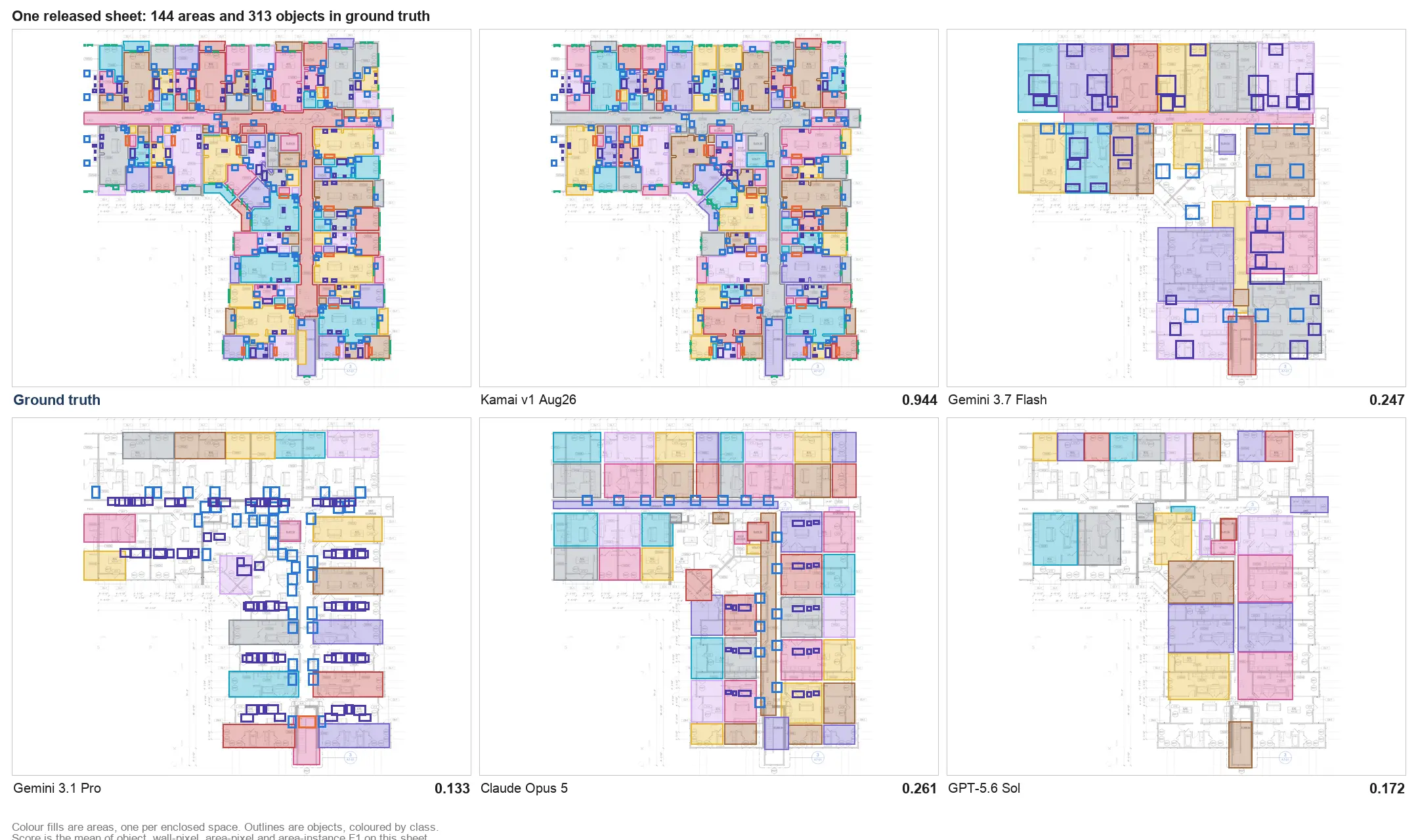
The job is the same as digital takeoff has always been: turn a drawing into a count. The difference is who does the measuring. With on-screen tools you still trace every wall and drop every count point yourself. With AI, Kamai's models scan the sheet, recognize building elements - walls, floors, fixtures, structural members - and return the quantities as structured data instead of marks you placed.
That structured output is the part worth slowing down on. The result isn't a colored-up PDF you have to re-key into a spreadsheet. It's organized data - areas, lengths, counts, and the items they belong to - that you can export to Excel or PDF, or pull through the API as JSON straight into whatever estimating workflow you already run.
From rulers to computer vision
Estimating used to mean a printed set, a scale ruler, and a wheel. Digital takeoff moved that on-screen, which removed the paper but not the clicking - you were still placing every measurement by hand, just with a mouse. The slow part never went away; it moved.
What changed recently is that the tool can now read the drawing rather than wait for you to trace it. Computer vision handles the repetitive measuring so estimators spend their time on the parts that need judgment: pricing assumptions, scope gaps, which alternates to carry.
How Kamai reads a set
Upload the drawings and Kamai's models go through the sheets the way an estimator would, working across architectural, structural, and MEP pages instead of one isolated plan. They pick up the elements on each sheet and calculate quantities - material counts, areas, volumes - then organize them into structured data ready to price.
Two things this avoids that trip up manual takeoff. First, scale. Set the wrong scale on a sheet and every measurement on it is off by a constant; consistent reads keep that from quietly poisoning a section of the estimate. Second, shared geometry - a wall counted once from the architectural plan and again from a partition schedule. Pulling quantities into one structured set makes those overlaps visible instead of buried in two separate markups.
Speed where bids are won or lost
Bids run on deadlines. A general contractor sends an invitation Tuesday and wants numbers Friday, and the subs who can turn a clean takeoff fast are the ones who get to bid at all. When each takeoff is a day of clicking, you triage - you bid the jobs you have time for and pass on the rest.
Cutting the measuring from hours to minutes changes that math. You move from drawings to priced quantities faster, which means you can carry more bids in the same week without adding estimators. The constraint stops being how fast you can trace walls.
Accuracy and the cost of a miss
A quantity error doesn't show up at bid time. It shows up at buyout, when the slab takes 18% more concrete than you carried, or at closeout when you eat the difference. Manual takeoff is where those misses start: a fixture skipped on a dense plumbing sheet, a room measured twice, an addendum that revised the floor plan after you'd already counted the original.
Reading every sheet with the same logic narrows the gap. Kamai's models apply consistent measurement across the set, so a fixture type that appears on six sheets gets counted the same way each time rather than depending on which estimator handled which page. You still review the numbers - but you're checking a complete, consistent count instead of hoping nothing slipped through a 40-sheet set at 5 p.m.
Structured data you can actually use
A drawing holds a lot of information and almost none of it is in a form a spreadsheet can read. The value of AI takeoff is less the measuring and more what you get at the end: quantities tied to the items they belong to, in a format your tools accept.
From there it's portable. Export to Excel to drop into a bid sheet, to PDF for a record set, or take the JSON through Kamai's API to feed an estimating system or an internal database directly. Because the structure is consistent from job to job, last quarter's estimate and this one are comparable - you can see where your unit costs drifted instead of re-deriving them from scratch every time.
Working across a team
A bid isn't one person. Estimators, project managers, and engineers all touch the same set, and the usual failure is people working off different revisions. Kamai keeps the takeoff in one place so the quantities everyone references come from the same source. When a sheet or a count changes, the update is in the shared data rather than in someone's local markup that never made it around.
The AI assistant in the app
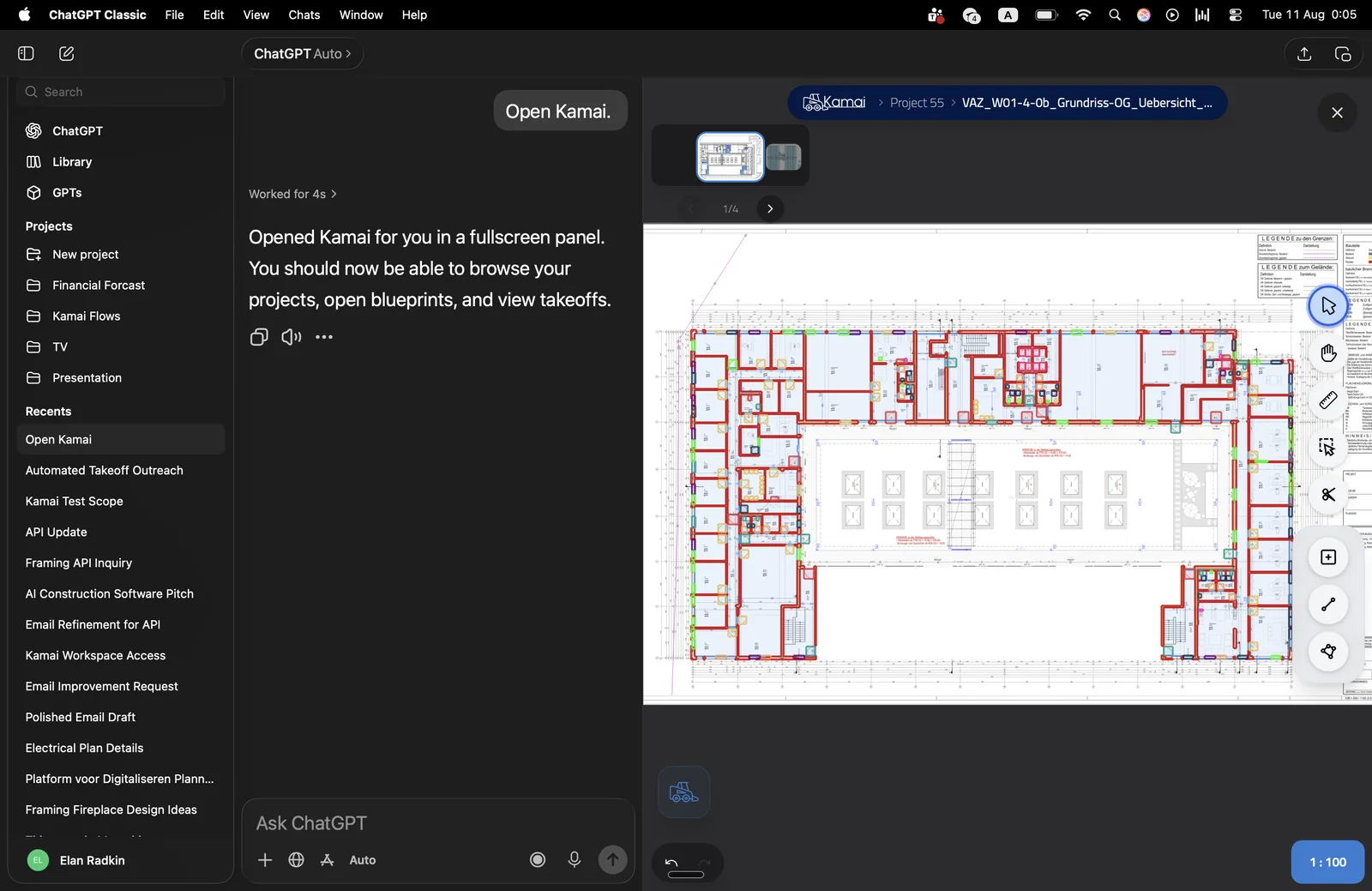
Inside the app, Kamai works as an AI Co-Pilot. It's a feature of the app, not a separate product - you can ask it about the quantities it pulled, have it surface what's on a given sheet, and use it to sanity-check the takeoff against the drawings. It's there to help you interrogate the numbers, not to replace the review.
Scaling without scaling the team
Bid volume is capped by estimator hours. Three estimators who each get through two takeoffs a day cap the company at six, and the only way up is hiring. When the measuring is automated, that ceiling moves - the same team can push more sets through in the same week, so you can chase more work without the headcount that used to require.
Where Kamai fits
Kamai is built to do takeoff and produce structured estimating data from a set of drawings. Upload blueprints, get back quantities for materials, areas, and volumes, organized so they're ready to price. Export to Excel or PDF, pull the data through the API, and lean on the Co-Pilot inside the app when you want a second read on what came out.
The honest pitch is narrow: it takes the slowest, most error-prone step in a bid and makes it fast and consistent, then hands you data you can use. For an estimator deciding which jobs to bid this week, that's the part that matters.
Get the next post in your inbox.
Low frequency. High signal.