10 Benefits of Using Construction Takeoff Software
How construction takeoff software speeds up measurement, cuts estimating errors, and helps you bid more work - plus where Kamai fits in.

Pulling quantities off a set of paper plans with a scale ruler and a highlighter still works. It also takes hours, doesn't survive an addendum, and falls apart the third time the architect reissues the drawings. Most estimators already know this. The question is what you actually get back when you move the takeoff onto a screen, and where the time savings are real versus marketing.
Here are ten places digital takeoff earns its keep, and how Kamai handles each one.
1. Repeating layouts measured once, not fifty times
A 200-room hotel is the same guest room over and over. So is a four-story walk-up, a dorm, or a school with eight identical classrooms. Measure one by hand and you still have to measure the next forty-nine, because nothing carries over.
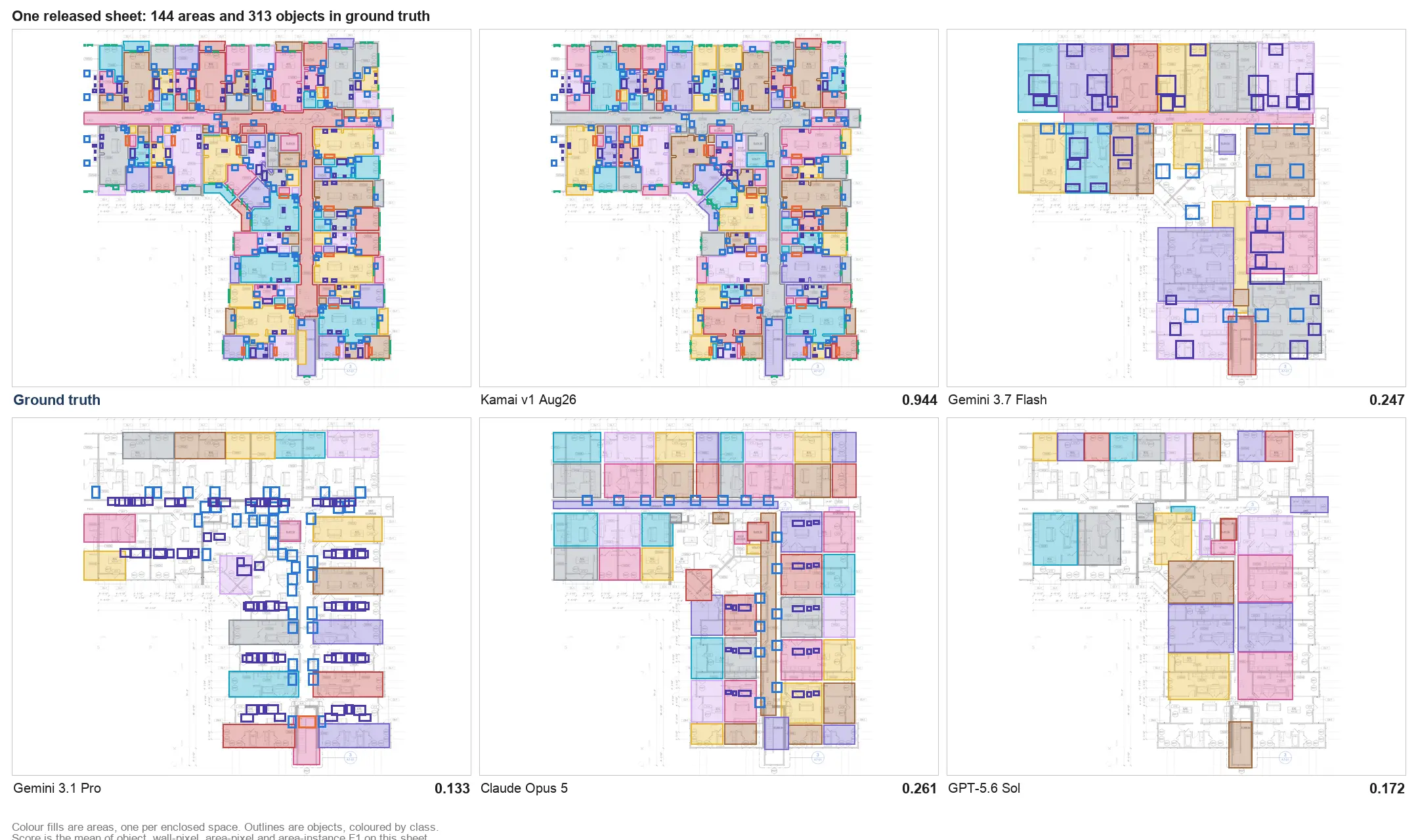
Digitally, you scope the repeating unit once and apply that quantity across every instance of it. On a large project that is the difference between a morning and a full day. Kamai's models read the typical room or unit from the drawings and let you replicate the count across the floors and wings where it occurs.
2. Counting fixtures without scanning every sheet
Doors, windows, plumbing fixtures, receptacles, light fixtures - counting symbols by hand means scanning every page and trusting your eyes not to skip one. Skip one on a 60-sheet set and you find out at buyout.
Kamai counts the symbols for you. Point it at the door schedule and floor plans and it tallies the count across the sheets, so the number you carry isn't a guess you made at 6 p.m.
3. Catching what changed between revisions
Addenda are where bids go to die. The architect issues Addendum 3, the title block updates, and somewhere on sheet A-401 a wall moved and two fixtures got added. Diff that by eye across two PDFs and you will miss something.
Overlay the old sheet against the new one and the additions and deletions show up in color. You see exactly what moved instead of re-checking the whole sheet. That is the single fastest way to keep a missed revision from eating your margin.
4. Areas, perimeters, and volumes in one pass
Walls, ceilings, and floors are three separate calculations when you do them by hand, repeated for every room and corridor. The geometry is the same shape each time; only the dimension you want out of it changes.
Select the spaces once and pull surface area, perimeter, and volume together. For a contractor carrying multiple trades off the same set - drywall, paint, flooring - that is one pass instead of three trips through the same rooms.
5. Templates and conditions you reuse across bids
The estimators who move fast aren't faster at clicking. They've standardized. Saved conditions, naming conventions, and assemblies they apply the same way on every job, so the output of a takeoff looks the same whether it ran in January or July.
Build your common conditions once and reuse them. The payoff is consistency: two estimators on the same project produce numbers that reconcile, and a takeoff from six months ago is still legible when the project comes back.
6. Time back for the part that actually wins work
The measuring is not where bids are won or lost. Job costing, risk allocation, where you're sharp on a subcontractor number and where you pad - that's the work. When the takeoff eats the whole day, that work gets the leftover hour before submission.
Cut the measurement time and you get those hours back for the estimate itself. That is the real argument for takeoff software: not that clicking is faster than a scale ruler, but that it frees up the judgment that decides whether the bid is any good.
7. One shared source of truth, plus clean exports
Files emailed back and forth go stale the moment someone opens an old copy. Two people working from two versions of the same takeoff is its own category of error.
Kamai keeps the project data in one place and outputs structured data you can move downstream. Export quantities to Excel for your estimate, export marked-up sheets to PDF for the record, or pull the same numbers as structured JSON through the API and MCP into whatever cost system you already run. The takeoff stops being a file someone owns and becomes data the whole team works from.
8. Fewer of the errors that blow up a bid
A takeoff is only as good as the inputs underneath it. The classic failures are mechanical: wrong scale set on a sheet, an outdated plan revision still in the set, a missed addendum, a shared wall counted twice between two rooms. None of them are exotic. All of them are expensive.
Setting scale per sheet, managing which revision is current, and computing area, volume, perimeter, and height from the drawing geometry removes most of that risk. Kamai's models do the extraction; you check the work rather than perform every measurement by hand. The bid that results is one you can defend line by line.
9. Bidding earlier, with time to review
In hard-bid work the contractor who finishes the takeoff a day early isn't just done sooner. They have a day to review subcontractor coverage, second-guess the thin numbers, and decide where to get aggressive. The one finishing at 11:58 p.m. is submitting whatever they have.
Compressing the takeoff buys that review window. Over a year of bids, the team that consistently has time to sanity-check before submitting wins a different mix of work than the team that's always scrambling.
10. Less grind, fewer burned-out estimators
Tallying fixtures across a 60-sheet set at the end of a long day is exactly the kind of repetitive work that produces both burnout and mistakes - usually together. The tedium is not a badge of honor; it's a source of risk.
Hand the mechanical counting and measuring to the software and the estimator spends the day on the parts that need a person. The work gets more interesting and the numbers get more reliable, which is not a coincidence.
Where this leaves you
Takeoff software doesn't win bids on its own. What it does is collapse the hours you spend moving a scale ruler across a set so that the estimating - the costing, the coverage, the judgment calls - gets the time it deserves. Kamai's models handle the extraction across the architectural, structural, and MEP sheets; you review, adjust, and export.
If you want to see it run on your own drawings, you can try it at app.kamai.io.
Get the next post in your inbox.
Low frequency. High signal.