The Role of Quantity Takeoff in Accurate Estimating
Quantity takeoff is the layer every estimate rests on. Get it wrong and the best pricing database in the world still gives you a wrong bid. Here is how the takeoff sets the ceiling on accuracy.

There is a hierarchy to a bid that does not get talked about enough. Pricing gets the attention: the cost database, the labor rates, the markup strategy. But all of it sits on top of one layer, and that layer is the quantity takeoff. If the quantities are wrong, nothing above them can be right. The most sophisticated estimating software and the most experienced estimator both produce an unreliable bid when the takeoff underneath is off.
That is the whole case for treating quantity takeoff as the foundation rather than a chore to rush through. It sets the ceiling on how accurate the estimate can possibly be. Everything else is refinement inside that ceiling.
What quantity takeoff actually is
Quantity takeoff, sometimes shortened to QTO, is the process of reading the drawings and specifications and determining every measurable component the project requires. Concrete volumes, structural steel, lumber, drywall, flooring, roofing, plumbing fixtures, electrical devices, HVAC equipment, doors and windows, finishes. The output is a detailed list of quantities, often called a bill of quantities, and it answers one question:
How much of everything does this project require?
Only once those quantities are settled can pricing begin. The takeoff is the "what." The estimate is the "how much will it cost." They are different jobs, and the takeoff comes first for a reason: pricing is meaningless without something to price.
Why the quantities set the ceiling
Construction runs on thin margins, which is exactly why a small quantity error is expensive out of proportion to its size. Underestimate and you get material shortages, emergency purchases, delays, and unplanned labor. Overestimate and you tie up capital in inventory you did not need, grow your waste, and pad the bid until it stops winning.
Accurate quantities do the opposite. They let you bid competitively, budget with confidence, order material correctly, cut change orders, reduce waste, schedule realistically, and protect the margin. Reliable quantities are what make a project predictable, and predictable projects are the ones that stay profitable.
The takeoff process, done carefully
Good estimators follow a consistent sequence, because consistency is what keeps things from slipping through.
- Review the whole package first. Architectural, structural, MEP, and the specifications. Understanding the scope before measuring anything is how you avoid discovering a missing assembly halfway through pricing.
- Measure everything relevant. Lengths, areas, volumes, and counts for every component the drawings show.
- Organize into a bill of quantities. Group each item by trade, material type, or assembly so it maps cleanly onto pricing.
- Hand off to estimating. The quantities move into the pricing step, where labor, equipment, and markup get applied.
When each stage is done with care, the estimate built on top of it inherits that care. When a stage gets rushed, the error hides until procurement or the field finds it, which is the most expensive place to find it.
Where manual takeoffs leak accuracy
Plenty of firms still run this on printed plans, spreadsheets, and repeated data entry. Experienced people can do good work this way, but the workflow itself invites specific errors:
- Measuring from a superseded drawing
- Missing a revision or addendum
- A wrong drawing scale throwing off a whole sheet
- Duplicate measurements on shared conditions
- A forgotten assembly
- Transcription slips when numbers get typed
- Unit conversion mistakes
Notice that most of these are not pricing failures. The single biggest source of trouble is not getting a number wrong on the drawing. It is moving that number from one system to another.
The hidden cost of rekeying
A lot of estimating still depends on manually transferring quantities into Excel or an estimating package. It feels routine, and it is quietly risky. One mistyped value, a duct length or a concrete volume or a flooring area, and every downstream calculation shifts with it. Rekeying produces incorrect totals, pricing inconsistencies, version conflicts, and lost drawing references, and it usually goes unnoticed until the field is already committed to the number.
The fix is not to type more carefully. It is to stop retyping.
How Kamai keeps the takeoff clean
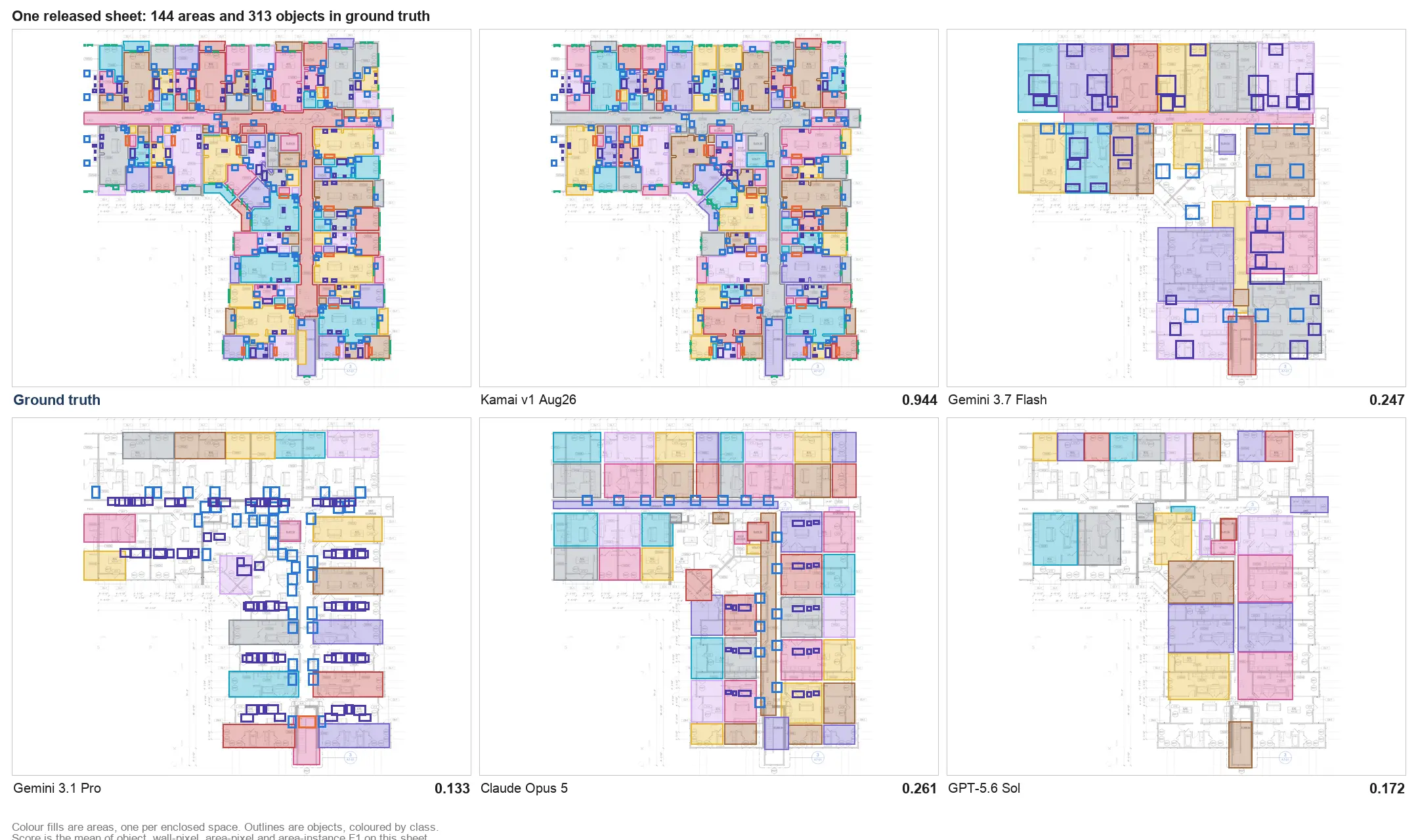
Kamai automates the most time-consuming part of preconstruction: pulling structured quantities straight out of the drawings. Instead of tracing plans and keying numbers into a spreadsheet, you run the drawing set through Kamai and get structured quantity data back, ready for estimating. It reads native vector geometry from the PDF and CAD files rather than flattening the drawing into an image and guessing from pixels, so the measurements come from the drawing's own coordinates.
Every quantity stays linked to the sheet and layer it came from. That provenance turns verification into a spot-check against the source instead of a full rebuild, and it gives the estimate an audit trail from the final number all the way back to the drawing.
Because the output is structured, it flows into your estimating workflow through an export or the API without being retyped. You keep your labor rates, supplier pricing, assemblies, and markup exactly where they are. Kamai just makes sure the quantities arrive correct and structured, and the same pipeline runs across electrical, plumbing, mechanical, concrete, structural steel, framing, and interior finishes, so the data stays consistent no matter the trade.
Structured quantities help more than pricing
Clean quantity data is not only for the estimator. When architects, engineers, procurement, and project managers all reference the same structured numbers, and every one of those numbers traces back to a drawing, the whole preconstruction conversation gets easier. Nobody has to ask where a figure came from, because the answer is one click back to the sheet. That transparency cuts the misunderstandings that otherwise turn into change orders and hard conversations with the owner.
The takeaway
Every accurate estimate starts with accurate quantities. Quantity takeoff is the step that turns drawings into the measurable data that budgeting, procurement, scheduling, and bidding all depend on, and it sets the accuracy ceiling for everything above it. By pulling structured quantities directly from the drawings and keeping every one traceable to its source, Kamai lets estimators spend their time validating and pricing rather than measuring and retyping, so the number at the bottom of the bid is one they can defend.
Frequently Asked Questions
What is the role of quantity takeoff in construction estimating?
Quantity takeoff identifies the exact quantities of materials, components, and assemblies a project requires. Those quantities are the foundation the entire cost estimate is built on, so their accuracy sets the ceiling on how accurate the bid can be.
What is the difference between quantity takeoff and estimating?
Quantity takeoff measures the quantities of work from the drawings. Estimating applies labor, material, equipment, overhead, and profit to those quantities to calculate total project cost. The takeoff answers "how much work," the estimate answers "how much money."
Why is quantity takeoff so important?
Accurate takeoffs improve budgeting, reduce material waste, prevent cost overruns, cut change orders, and keep bids competitive. Small quantity errors compound into expensive problems once procurement and construction begin.
How does Kamai improve quantity takeoff?
Kamai reads native drawing geometry to extract structured quantities directly from the plans, eliminating manual measuring and rekeying while keeping every quantity traceable back to its source sheet and layer.
Can Kamai integrate with estimating software?
Yes. Kamai produces structured quantity data that exports or integrates through APIs into estimating platforms, spreadsheets, and construction management systems, without manual re-entry.
Get the next post in your inbox.
Low frequency. High signal.