The Future of Low-Tech Is Here: Kamai's AI Translates Construction Blueprints into Structured Data in Minutes
iHLS on Kamai: geometry-based AI that reads construction blueprints and turns them into structured data, bills of quantities, and specifications in minutes.
This article was originally published by iHLS on August 12, 2026.
Kamai is a graduate of the INNOFENSE Innovation Center operated by iHLS in collaboration with IMoD. This unique acceleration program removes entrance barriers to the technological ecosystem, turning startups into mature, leading companies while connecting them with relevant investors, which is designed to strengthen the links between the civilian and defense markets via the collaborative development of the technologies, thus advancing and improving their integration in both markets.
Every construction project begins with a stage that has remained virtually unchanged for decades: reading blueprints and extracting material quantities, specifications, and cost estimates. Contractors, engineers, and project managers spend days, and often weeks, manually reviewing hundreds of drawings to determine how much concrete, steel, piping, doors, windows, and other materials will be needed. Errors at this stage can lead to inaccurate estimates, project delays, budget overruns, and reduced profitability.
This is where Kamai comes in. The company has developed an artificial intelligence platform capable of reading construction blueprints and automatically converting them into structured data, bills of quantities, and specifications, in minutes and with a high degree of accuracy. The company was founded after its founders, who came from the technology and cybersecurity worlds, responded to an Israeli Ministry of Defense call for proposals in those fields. While preparing, they consulted with contractors working with the Ministry on construction projects, their first real exposure to the industry. A casual conversation there sparked the idea of solving one of the biggest problems contractors face: understanding a project precisely from its construction drawings, both at the tender stage and during execution. That led to an AI layer designed to automate the entire process.
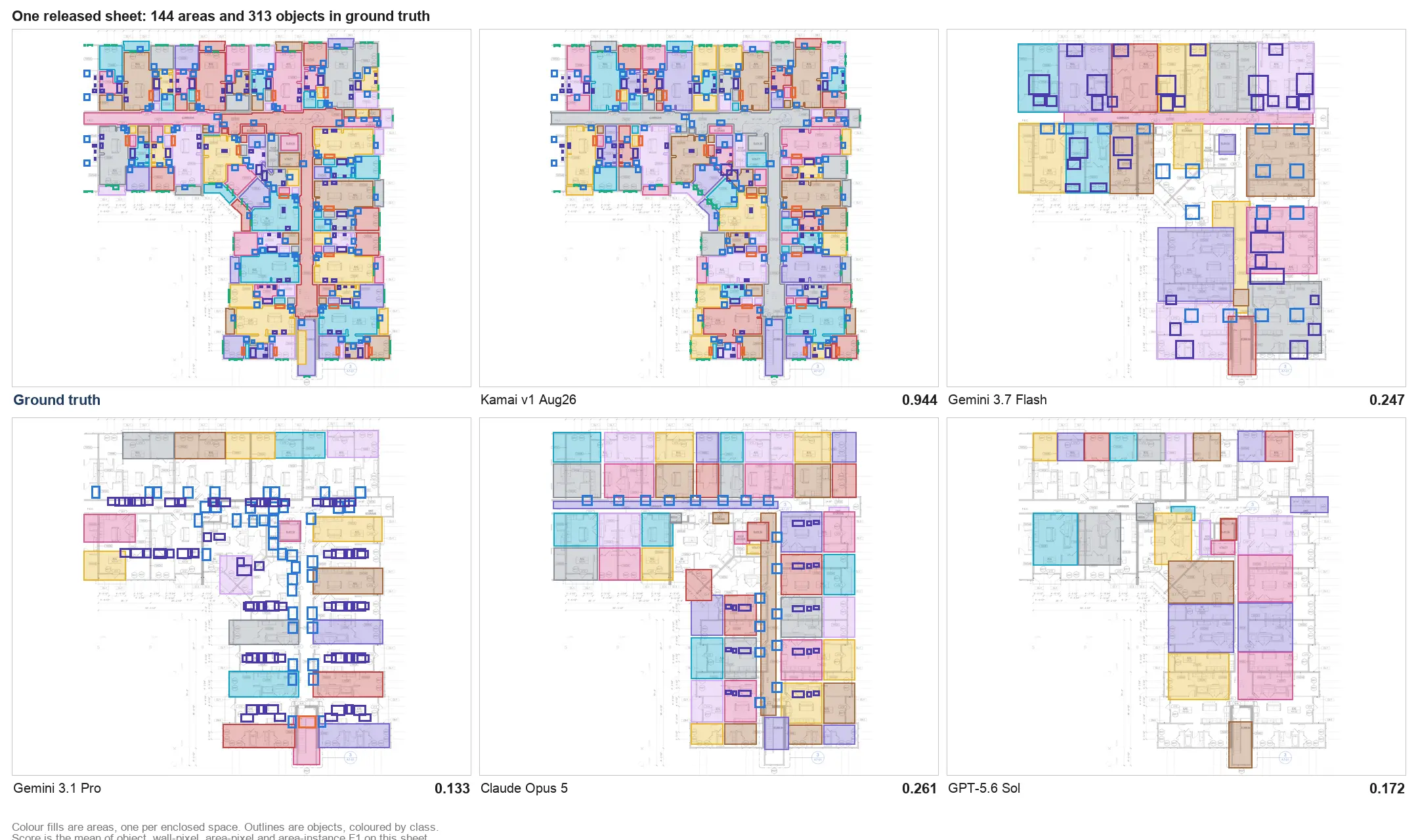
At the core of the platform are proprietary geometry-based AI models developed specifically for construction drawings and protected by a registered U.S. patent. Rather than relying solely on conventional image recognition, the system understands the engineering structure of a blueprint. It identifies elements such as doors, walls, windows, and building systems, measures them, associates them with the specifications provided by the architect and the project's consultants, and produces fully traceable structured data. Every quantity is linked directly to the corresponding element in the drawing, allowing users to verify every result with a single click.
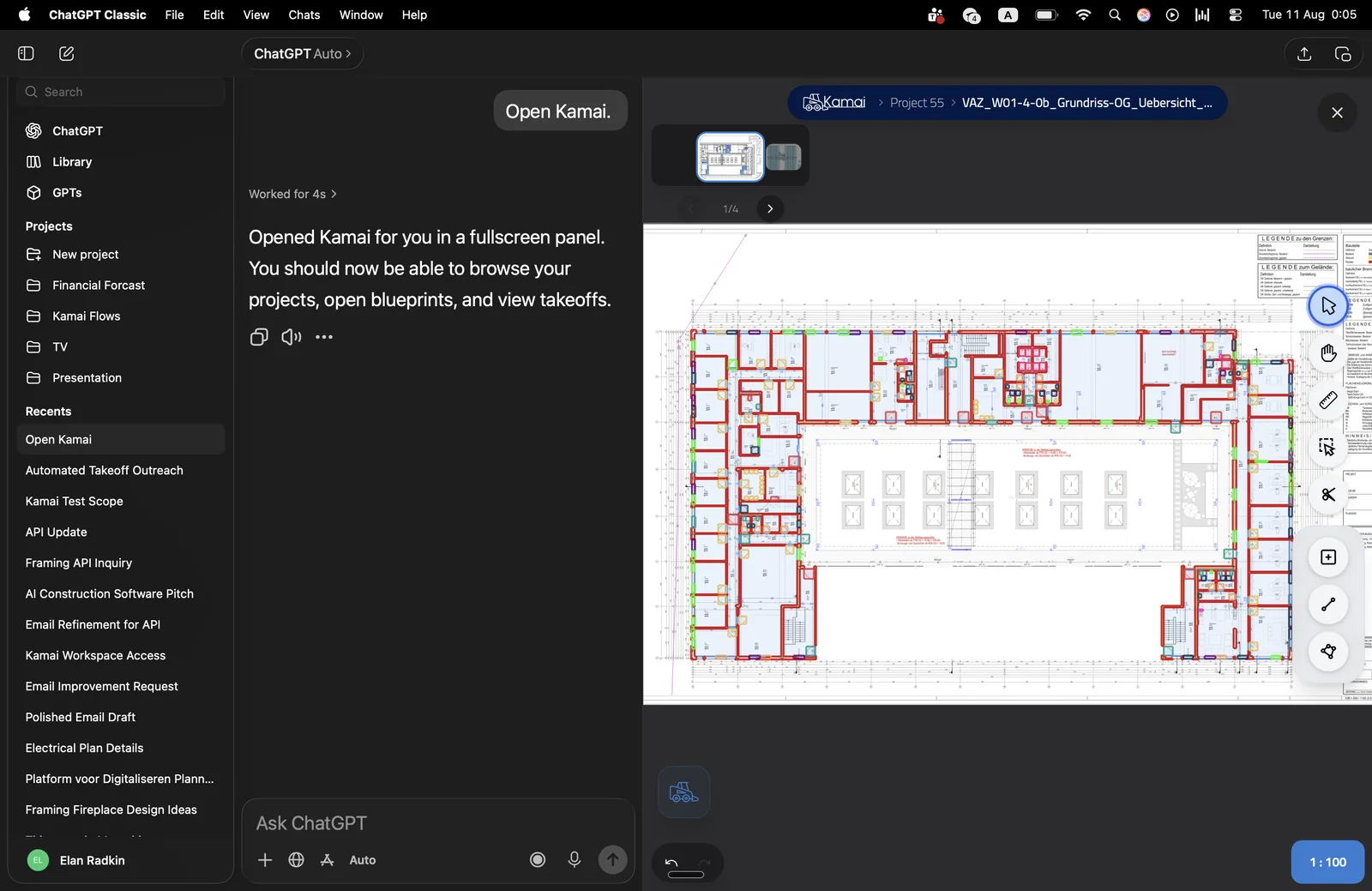
One of the company's greatest strengths is its simplicity. Instead of requiring users to learn a new application packed with complex features, they simply ask the system questions in natural language, in any language, and receive structured tables containing quantities, materials, and specifications. The platform is available as a plugin for AI platforms such as ChatGPT and Claude, as well as through an API that integrates directly into existing software. Rather than selling a conventional application, Kamai provides an intelligence layer that can be embedded into virtually any construction workflow.
The company believes the AI revolution has finally reached even the most traditional industries. As they see it, within the next few years, AI-powered blueprint analysis will become a necessity rather than a competitive advantage. Just as it is difficult to imagine a construction site operating without an excavator today, the company expects it will soon be almost impossible to manage a construction project without AI, such as this, which is capable of automatically interpreting engineering drawings.
The system's immediate value is generating bills of quantities, but its by-products are what point to the next stages of development: detecting conflicts and errors across drawings, issuing partial invoices to contractors against project milestones, and identifying weaknesses in a tender that could translate into winning the bid - alongside further capabilities to be built on the same structured-data foundation.
Beyond its commercial applications, the technology also offers significant value for the defense sector. The ability to rapidly analyze engineering plans and generate quantities and material requirements can dramatically accelerate the planning and construction of emergency infrastructure, military bases, fortifications, and other operational facilities. As defense organizations increasingly rely on rapid decision-making and digital planning, technologies like Kamai's can eliminate critical bottlenecks and significantly shorten the time between planning and execution. As part of its collaboration with the Israeli Ministry of Defense (specifically with the Department of Engineering and Construction), the company is currently developing the ability to generate bills of quantities from Israeli-format construction drawings, structured according to the standard Israeli construction chapters. The company expects this to make its platform the standard by which construction projects are priced across Israel.
Today, Kamai has raised $1.2 million in pre-seed funding. Its platform serves approximately 4,000 users, analyzes roughly 100,000 construction blueprints every month, and supports customers across North America, Europe, and Israel. The company is now preparing for a significantly larger seed round. According to the company, competing solutions exist, but they do not achieve the same level of accuracy as Kamai's geometry-based AI models.
Kamai was founded by Elan Alexander Radkin (24), CEO and Co-Founder, who served as a non-commissioned officer in a communications officer role in the Israeli Air Force air defense battalions and is leading the company's vision of becoming the AI infrastructure layer for the construction industry, and Ben Rudin (25), AI Researcher and Co-Founder, a former cyber engineer at the Israeli Ministry of Defense and an alumnus of an elite Israeli Air Force technology unit. The two grew up together in Be'er Sheva, studied together throughout their school years, and went on to the military high school at the Israeli Air Force Technological College in Be'er Sheva, the track that set them both on a technology career. Together, they are developing technology that aims to transform how the construction industry, both civilian and defense, interprets, understands, and leverages engineering blueprints.
Read the original on iHLS.
Get the next post in your inbox.
Low frequency. High signal.